IN Brief:
- TDA235E5 and TDA235E0 combine OptiMOS 6 MOSFETs and a dual-phase driver in a 6 × 6 × 0.8mm package.
- The devices support up to 300A peak current and 120A total design current, with specified density above 2A/mm².
- Engineering samples support lateral and vertical power architectures, with top-side thermal performance intended for liquid cooling.
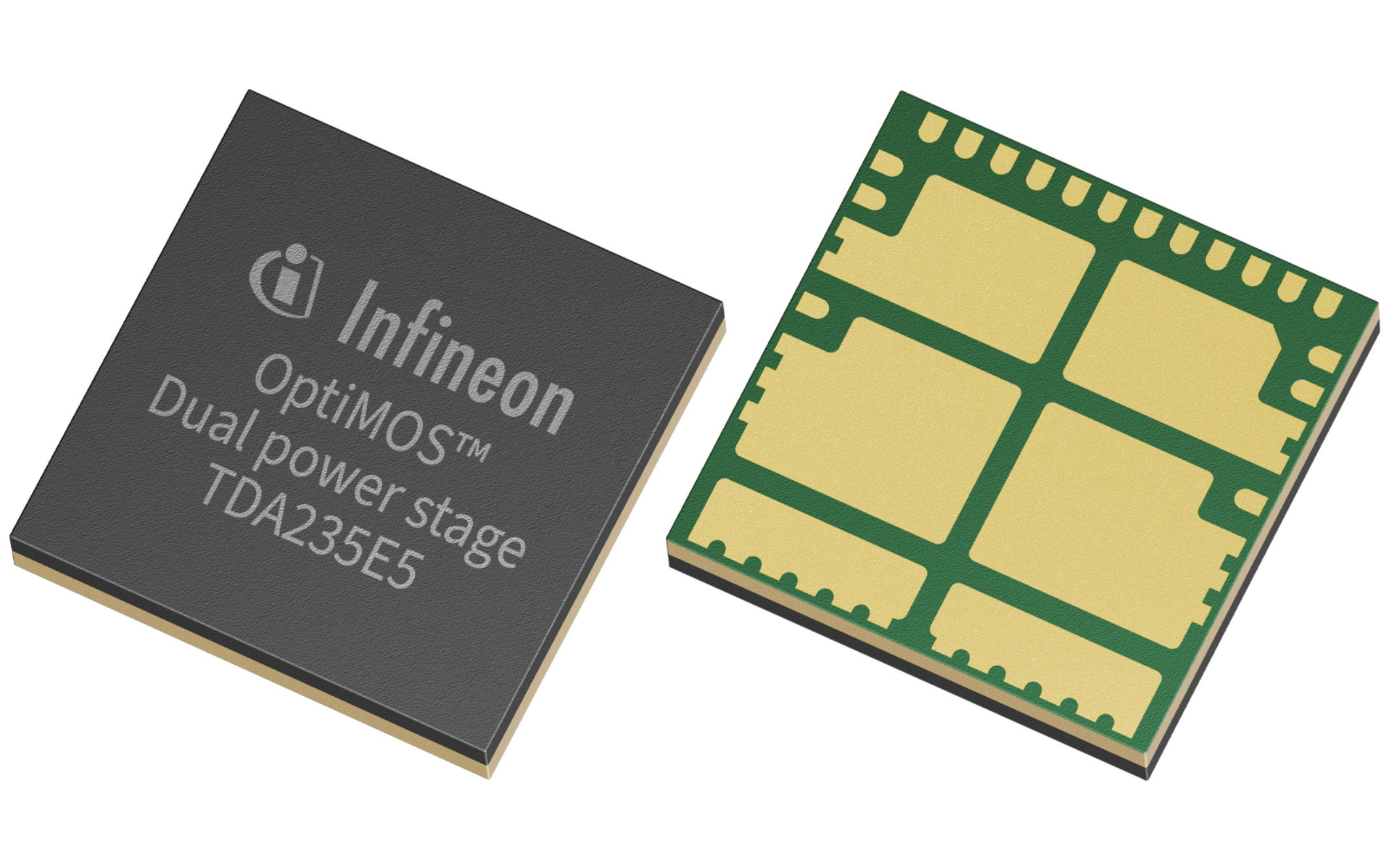
Infineon Technologies has introduced the TDA235E5 and TDA235E0 dual-phase smart power stages for AI accelerators and server processors, combining two power phases in a 6 x 6 x 0.8mm package. The devices integrate OptiMOS 6 MOSFETs with a dual-phase driver IC and are specified to deliver power density above 2A/mm², with engineering samples now available for customer evaluation.
Both devices support up to 300A peak current and 120A total design current, positioning them for processor rails that increasingly have to deliver very high current at low voltage within a restricted footprint. Infineon supports both lateral and vertical power-delivery layouts, allowing the stages to be used in conventional board-level multiphase regulators or in architectures that bring regulation physically closer to the processor package.
The package is designed around top-side thermal performance, which becomes more important as accelerator sockets move beyond the limits of air-cooled power conversion. Lower junction-to-top thermal impedance gives system designers a more direct path into cold plates or other liquid-cooling structures. In a dense multiphase regulator, that can help prevent the power-delivery network from becoming the thermal bottleneck alongside an already heavily cooled accelerator.
Vertical power delivery is attracting attention because very high-current processor rails are increasingly difficult to route efficiently across a motherboard. Long, wide copper paths consume area and introduce resistive and inductive losses, while the distance between regulator stages and the processor can make transient response harder to control. Moving power conversion beneath or immediately adjacent to the processor shortens those paths, but it also compresses the available component area and raises the thermal burden on every stage.
Infineon’s dual-phase approach reduces the number of separate power-stage packages required for a given multiphase design, while its digital multiphase controllers provide the control layer for multi-rail implementations. The company is developing that component-level work alongside broader AI power architectures spanning solid-state transformers, high-voltage DC distribution, and local energy storage. The TDA235 family sits at the other end of that chain, close to the processor where current density and transient performance are most acute.
At processor level, the final low-voltage stage is one of the most physically constrained parts of the power system. A rail operating at around one volt can require hundreds of amperes, meaning small improvements in distribution resistance, package parasitics, conversion efficiency, and thermal impedance can materially change board layout and cooling requirements. As accelerator packages become larger and more power hungry, those electrical constraints increasingly shape the mechanical design around them.
Dual-phase packaging also changes how phases can be distributed around the processor. Conventional multiphase regulators spread current across several switching stages to reduce ripple, share thermal load, and improve transient response; integrating two stages into one package can increase local current density while reducing placement overhead. External magnetics and output capacitance are still required, and the practical gain will depend on phase count, switching frequency, thermal coupling, and how closely the modules can be placed to the load.
Transient response is another constraint in accelerator power because load current can change sharply as compute blocks switch between operating states. The regulator has to supply those steps without allowing the processor voltage to move outside its permitted range, which puts pressure on control-loop bandwidth, local capacitance, package inductance, and phase placement. Bringing switching stages closer to the load can reduce some parasitics, but it also increases local heat flux and layout sensitivity.
Infineon has not disclosed production dates or final volume pricing for the TDA235E5 and TDA235E0, so the immediate milestone is customer evaluation rather than volume deployment. Engineering samples will allow server and accelerator developers to test current sharing, transient response, cooling integration, and layout behaviour in both lateral and vertical arrangements. Those measurements will show whether the specified package density delivers a system-level advantage once the surrounding inductors, capacitors, controller, interconnects, and cooling hardware are included.