IN Brief:
- SECORA Connect X provides ultra-low-power active NFC payment capability for the Hammer smartwatch.
- SECORA Wallet supports Mastercard MDES, Visa VTS, and CDCVM-secured payment integration.
- The watch is the first implementation combining both Infineon payment solutions and reaches European retail channels in November.
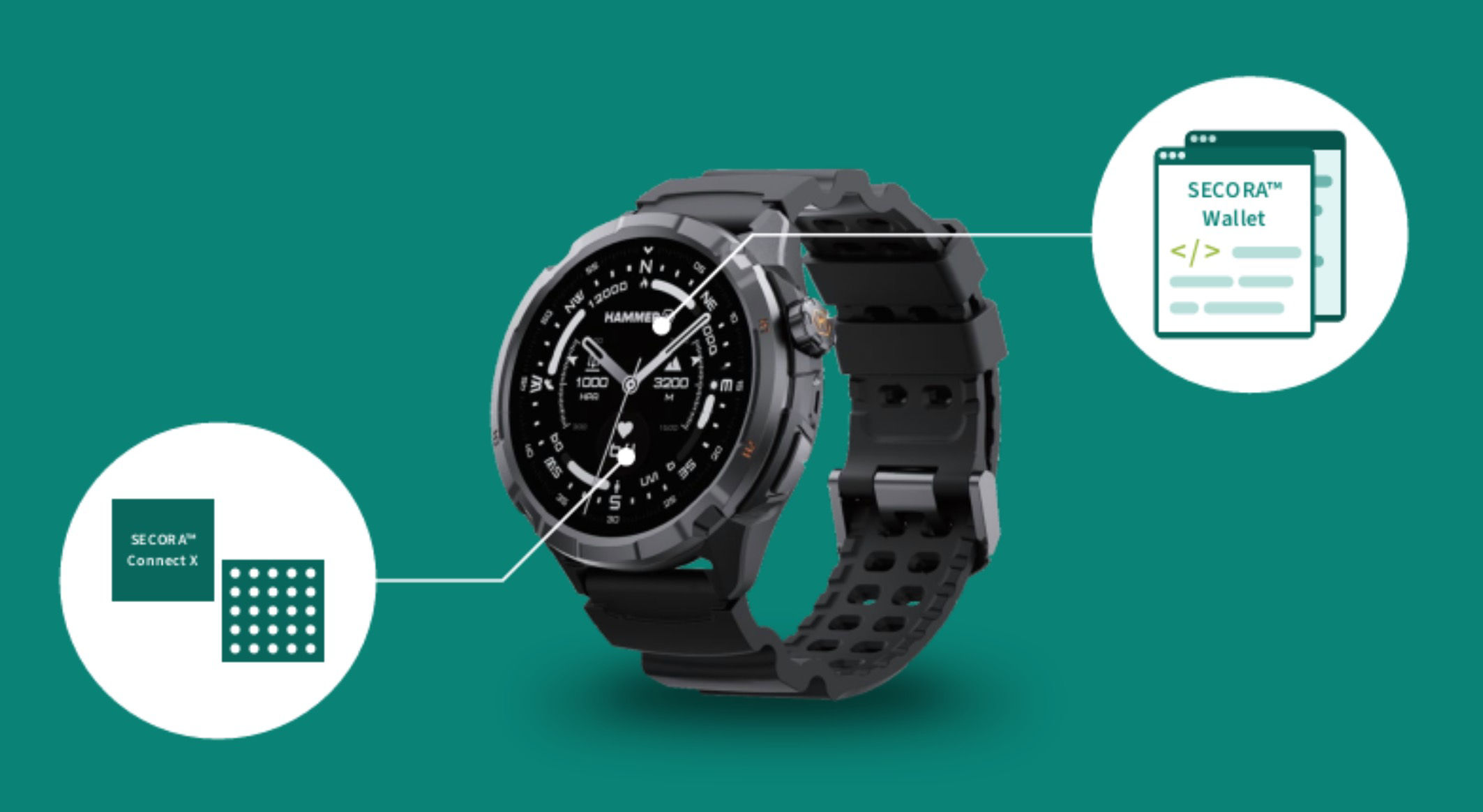
Infineon Technologies has supplied the embedded security and wallet technology used to add NFC payments to mPTech’s latest Hammer smartwatch, combining SECORA Connect X and SECORA Wallet in the first wearable implementation to use both Infineon solutions.
The integration places the payment function across two parts of the embedded architecture. SECORA Connect X provides the active NFC payment capability, while SECORA Wallet connects the wearable with the tokenisation and payment infrastructure needed to support Mastercard and Visa transactions.
For a smartwatch manufacturer, adding payments involves considerably more than incorporating an NFC radio. The finished device has to protect credentials, communicate reliably with point-of-sale terminals, support payment-network provisioning, handle cardholder verification, remain inside a tight battery budget, and fit the necessary RF design into an enclosure already occupied by displays, sensors, radios, and power-management hardware.
Infineon positions SECORA Connect X around those hardware constraints. The ultra-low-power payment solution supports active NFC operation and is designed to maintain contactless performance inside metal-enclosed products, where the mechanical construction can otherwise complicate antenna and RF behaviour.
Wearables create a particularly constrained NFC environment because industrial design leaves little freedom to increase antenna area or separate the payment circuitry from other electronics. Battery capacity is limited, while displays, Bluetooth connectivity, sensing, processing, and user-interface functions are already competing for the same energy budget.
The security element is therefore only one part of the design decision. Contactless performance has to remain predictable across different terminal geometries and user positions, while the device must be able to present payment credentials without exposing sensitive data to the host application or unnecessarily increasing standby power.
SECORA Wallet supplies the corresponding payment-software layer. It is integrated with Mastercard Digital Enablement Services and Visa Token Services, allowing tokenised payment credentials to be provisioned for use by the wearable rather than relying on conventional card details being handled directly by the device.
The platform also supports Consumer Device Cardholder Verification Method, or CDCVM, allowing authentication carried out on the connected device to form part of the payment-verification process. That becomes relevant for higher-value transactions, where a conventional contactless card may otherwise require an additional cardholder-verification step.
Infineon has joined Mastercard’s MDES Express programme, which is intended to simplify the route between device manufacturers, wallet providers, issuers, and Mastercard’s tokenisation infrastructure. For an OEM, the value lies in reducing the amount of scheme-specific integration needed before a payment-capable device can move towards commercial deployment.
The Hammer implementation also supports Visa Token Services. Supporting both major tokenisation systems broadens the potential issuer base and separates the smartwatch’s payment function from a single card network, although individual commercial deployments still depend on the participating banks, issuers, and services available in each market.
Infineon says SECORA Wallet can be integrated into applications already running on active wearables, including fitness and healthcare software, without requiring the user to download and maintain a separate payment applet. Payment functionality can therefore sit inside the wider device software environment while security-sensitive operations remain associated with the dedicated payment architecture.
The arrangement illustrates how secure elements are increasingly supplied as part of a broader embedded service rather than as isolated cryptographic hardware. OEMs still have to design the host electronics, antenna environment, user interface, and application software, but significant parts of credential handling, tokenisation, and payment-network integration can be taken from a pre-established platform.
That has consequences for development schedules. Payment products must work not only electrically but within certification and provisioning processes controlled by financial-services organisations. Hardware integration can be completed relatively quickly compared with establishing every payment-network, issuer, and security relationship independently.
The approach also creates a longer-term lifecycle requirement. A smartwatch may remain active for years, during which payment credentials can expire, cards can be replaced, software can be updated, and security requirements can change. Tokenisation and remote credential management allow those changes to be handled without treating the secure hardware as a fixed representation of the original physical card.
mPTech plans to demonstrate the Hammer smartwatch at IFA Berlin in September, with European retail availability scheduled from November 2026. The product provides a practical deployment for Infineon’s combined SECORA platform, but the more consequential electronics development is the integration model underneath it: NFC hardware, embedded security, tokenisation, CDCVM, and payment-network connectivity packaged into a route that wearable OEMs can incorporate without designing the complete payment stack themselves.