
IN Brief:
- Farnell will distribute Hailo processors, accelerator modules, and development products globally.
- The portfolio moves neural-network inference closer to cameras, machines, robots, and other data sources.
- Wider distribution could shorten prototype cycles, although production designs still require thermal, software, and lifecycle validation.
Farnell has entered a global distribution partnership with Hailo, adding the company’s edge-AI processors, accelerator modules, and development products to its component and embedded-systems portfolio.
The agreement expands access to Hailo hardware for industrial automation, logistics, smart-city systems, transport, security, robotics, and other applications that require neural-network inference close to the point where data is generated.
Processing at the edge reduces the need to send every camera frame or sensor stream to a central data centre. Local inference can lower network traffic, shorten response times, preserve sensitive data within the machine, and allow equipment to continue operating when external connectivity is limited.
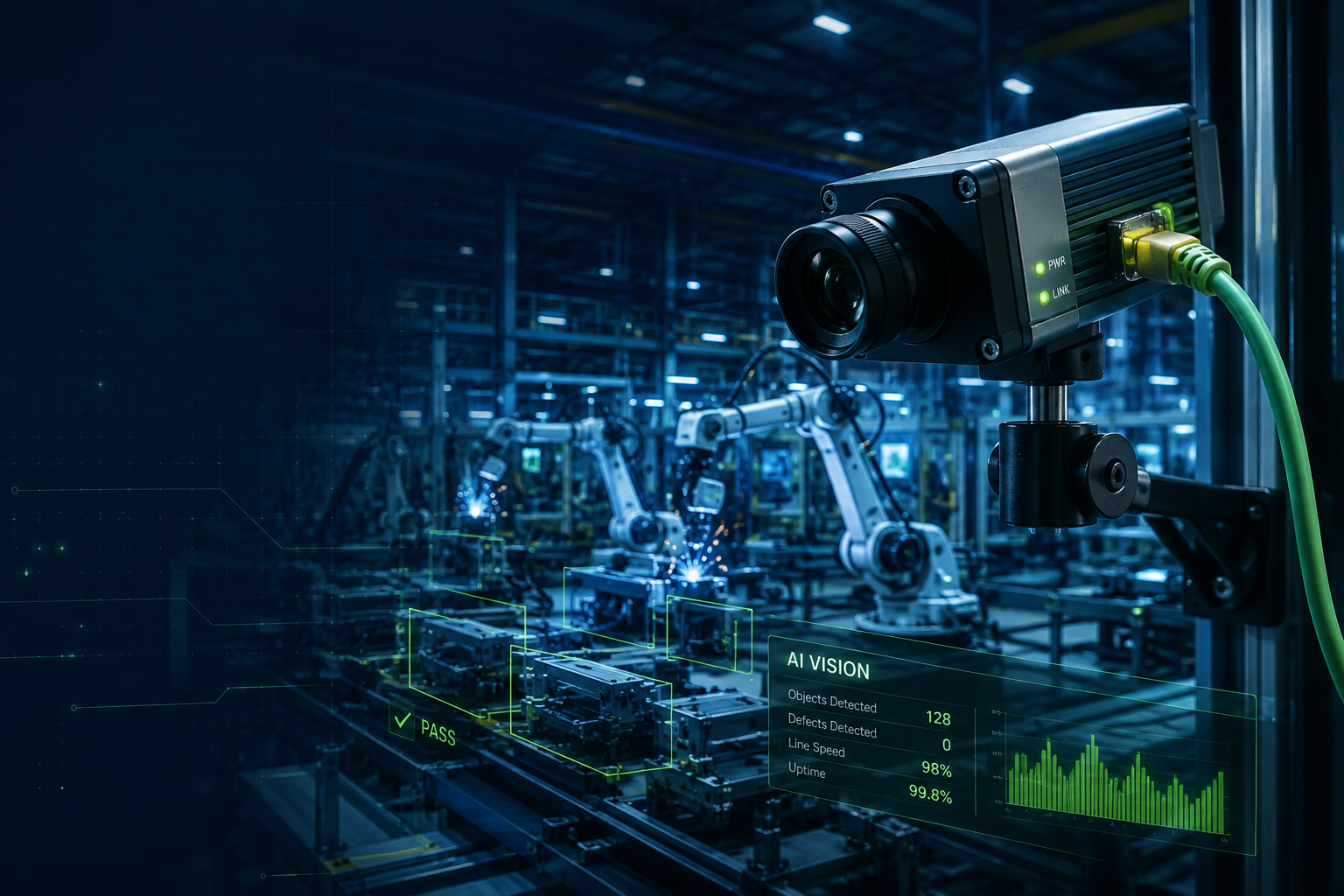
Machine-vision systems expose those constraints clearly. A production line may need to identify a defect, stop a process, or reject a component within milliseconds, while remote processing introduces additional latency and makes machine availability dependent on network performance beyond the factory cell.
Hailo’s architecture uses dedicated neural-network acceleration rather than relying solely on general-purpose GPU processing. Its devices can operate as standalone AI processors or alongside host CPUs and microcontrollers, depending on model size, sensor workload, control requirements, and the amount of preprocessing performed elsewhere in the system.
Farnell will support products ranging from development kits to production hardware. Many edge-AI projects prove a model on an evaluation platform but slow down when the design moves towards manufacture, where power, temperature, camera synchronisation, storage, connectivity, cybersecurity, enclosure design, and software maintenance must be resolved together.
Semiconductor portfolios are broadening around the same integration challenge. onsemi’s proposed acquisition of Synaptics would combine sensing, power, compute, connectivity, and human-machine interfaces within one group. Distribution partnerships operate at another level, yet they similarly reduce the distance between individual silicon and a deployable platform.
Prototype environments are becoming more comprehensive as sensor combinations expand. Infineon’s PSoC Edge E84 development kit combines compute, wireless connectivity, microphones, radar, inertial sensing, and environmental measurement, while Hailo addresses higher neural-network workloads where several cameras or larger vision models must be processed simultaneously.
Peak operations per second provide only a partial basis for comparison. Application performance depends on model architecture, supported operators, memory movement, quantisation, compiler efficiency, input resolution, batch size, and the proportion of the workload that can execute on the accelerator without falling back to the host processor.
Power must likewise be assessed across the complete system. An efficient accelerator can still sit beside demanding image sensors, interfaces, storage, networking, and host processing, so thermal design needs to reflect sustained operation inside the intended enclosure rather than a short benchmark on an exposed development board.
Robotics adds deterministic control and safety requirements to perception. STMicroelectronics’ investment in Oversonic Robotics is linking semiconductor capability with complete industrial and humanoid platforms, where local intelligence must interact consistently with motors, sensors, communications, and protective systems.
Software support will influence how quickly Hailo hardware enters such equipment. Developers require model-conversion tools, profiling, debugging, maintained runtimes, examples, and clear handling of unsupported operations, while industrial deployments need stable software baselines and security updates across product lives that may extend well beyond consumer-device cycles.
Supply continuity is equally significant. A prototype can use whichever accelerator is immediately available, whereas production machinery needs dependable lead times, change notification, documentation, and migration support. Distribution can improve inventory access and commercial reach, although the silicon supplier remains central to long-term software and device support.
Edge AI is also moving beyond isolated image classification. Inspection systems increasingly identify defects, estimate severity, correlate several sensor streams, and return process data to control systems. Logistics platforms combine detection, identification, tracking, and route planning, while security equipment fuses visual, thermal, acoustic, and radar inputs.
The Farnell agreement gives Hailo a wider route into those projects and provides another supported accelerator family for embedded development. Production adoption will depend less on headline AI performance than on whether the toolchain, module supply, thermal architecture, and software lifecycle remain manageable after a successful prototype becomes deployed equipment.

