
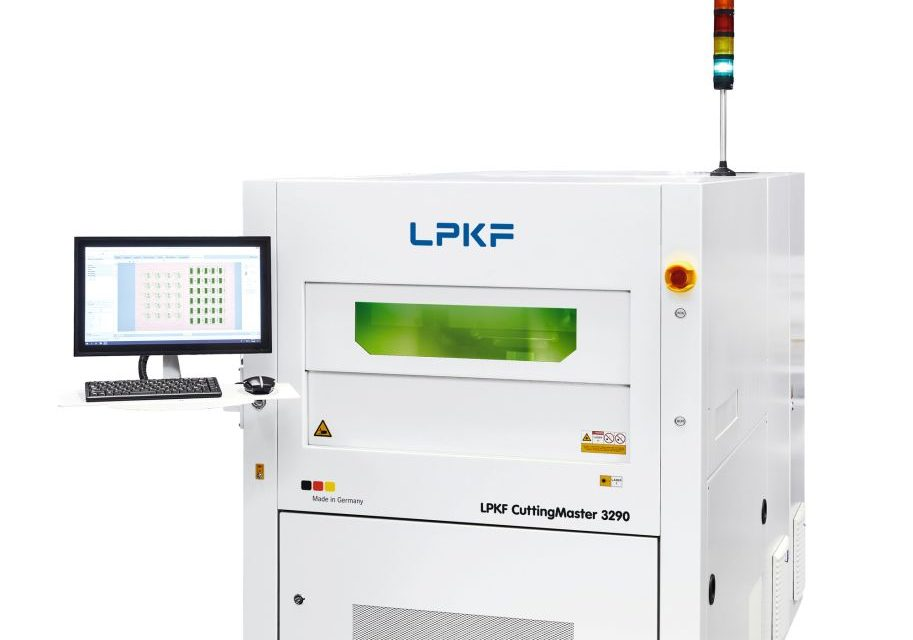
IN Brief:
- CuttingMaster 3290 combines 90W laser power with LPKF Tensor Technology.
- The system processes FR4 exceeding 2.4mm alongside ceramic, flex, and rigid-flex substrates.
- Higher throughput expands laser depaneling into applications traditionally dominated by mechanical routing.
Altus Group has added the LPKF CuttingMaster 3290 laser depaneling system to its electronics-production portfolio for the UK and Ireland.
The platform combines 90W laser power with LPKF Tensor Technology to process FR4 boards exceeding 2.4mm in thickness, alongside ceramic, flex, and rigid-flex substrates. Throughput is specified at more than double that of conventional laser depaneling equipment in suitable FR4 applications.
Depaneling separates individual printed circuit boards from the larger manufacturing panel used during assembly. Although the operation takes place near the end of production, it can introduce mechanical stress, debris, edge damage, contamination, or heat after most of the product’s manufacturing value has already been added.
Mechanical routers remain widely used because they are flexible, familiar, and economical, yet the rotating tool applies force to the panel and creates dust. Tool wear changes cut quality over time, while board support, routing direction, tab placement, spindle speed, and feed rate all influence the stress transmitted into the assembly.
Laser separation removes direct mechanical contact and follows a programmed path, allowing narrow cutting channels and complex contours without changing a physical tool. Small boards, densely packed panels, delicate assemblies, and products containing sensors or ceramic devices close to the edge can all benefit from lower mechanical loading.
Earlier laser systems have faced limitations around speed, carbonisation, and heat-affected zones in thicker FR4. LPKF’s higher-power architecture and beam-control method are intended to place more useful energy within the cut while limiting thermal damage around it.
Material behaviour remains central to the process. FR4 combines glass fibre and resin with different optical and thermal properties, while ceramic, flex, and rigid-flex constructions require their own settings. Cut quality must be maintained through changes in copper distribution, coatings, board thickness, panel design, and material batch.
Higher-power equipment forms part of a wider move towards controlled PCB finishing. Technosert has introduced automated precision depaneling to improve handling and repeatability. The processing method differs, but both investments recognise that separation can no longer be treated as a low-risk manual step on high-value assemblies.
Miniaturisation increases the sensitivity of that final operation. Components sit closer to routed edges, thinner boards tolerate less flexing, and MEMS sensors, ceramic capacitors, ball-grid arrays, and large power packages can all be damaged by strain that remains difficult to identify during visual inspection.
Software-defined cut paths can also simplify high-mix manufacturing. Fixtures, extraction, recipe control, and process validation are still required, but changing from one panel design to another does not involve replacing a router bit or manufacturing dedicated cutting tooling.
Automated programming is advancing across other stages of PCB production. GÖPEL’s boundary-scan software generates test programmes from design data, reducing manual preparation around complex variants. Laser depaneling applies the same digital principle to geometry at the end of the assembly line.
Design-for-manufacture remains essential. Board spacing, copper clearance, fiducials, panel rigidity, material selection, and component placement all influence whether a reliable process window can be established. A poorly designed panel can restrict speed or expose adjacent features to heat regardless of the available laser power.
Extraction and maintenance also require control. Vaporised material and fine particles must be removed from the cut zone, while optics and protective windows need to remain clean enough to preserve beam quality. Monitoring becomes increasingly important when one machine processes several substrates across long production runs.
Mechanical routing will continue to suit products with generous edge clearance and moderate sensitivity. Laser processing becomes more attractive where tooling wear, contamination, mechanical strain, narrow channels, or frequent changeovers impose a larger cost than the equipment investment.
The 90W platform extends that comparison into thicker boards and higher-volume work that previously favoured routing on throughput grounds. Sustained cut speed, edge quality, process stability, and extraction performance across real panel variation will determine how widely the system moves beyond specialist applications.
Altus will provide regional sales, applications support, installation, and service. Local process development will be needed to match each recipe to board construction, product geometry, factory handling, and extraction rather than relying on one generic setting for every assembly.

