
IN Brief:
- The conga-HPC/cRX1 combines up to 16 Zen 5 CPU cores with RDNA 3.5 graphics and a 50-TOPS XDNA 2 NPU.
- Industrial configurations operate from −40°C to +85°C, with power configurable between 45W and 120W.
- Integrated CPU, GPU, and NPU resources support consolidated robotics, machine-vision, medical, and automation platforms.
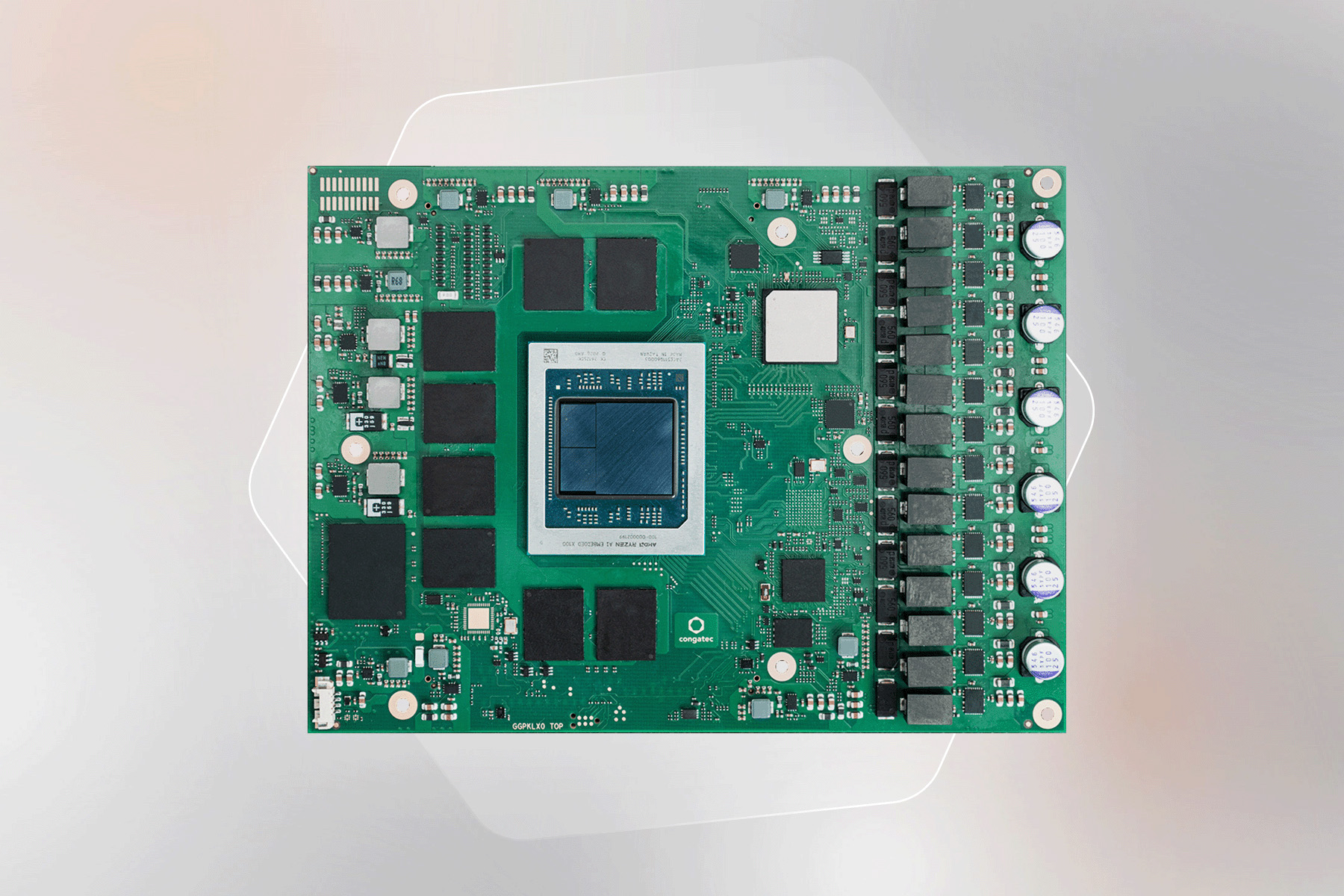
Congatec has introduced the conga-HPC/cRX1, a COM-HPC Client Size C module built around AMD Ryzen AI Embedded X100 processors for robotics, autonomous machinery, medical equipment, industrial automation, and other compute-intensive edge systems.
The 120mm × 160mm module combines up to 16 Zen 5 CPU cores, 40 RDNA 3.5 graphics compute units, and an XDNA 2 neural-processing unit within one system-on-chip platform. Processor options extend from eight cores and 16 threads to 16 cores and 32 threads, with maximum boost frequencies reaching 5.1GHz.
Alongside the CPU, the integrated graphics engine delivers up to 59 TOPS of dense INT8 inference performance and 29.7TFLOPS of FP32 compute performance, while the dedicated NPU provides up to 50 TOPS for continuously active inference workloads. The combination supports image processing, object recognition, sensor fusion, planning, and local execution of selected language and multimodal models.
Memory configurations extend to 128GB of soldered LPDDR5X-8533, giving the CPU, GPU, and NPU access to a unified high-bandwidth pool rather than forcing each engine to work through separate accelerator memory. Soldered devices also improve resistance to shock and vibration, although capacity cannot be upgraded after the module has been assembled.
Optional onboard NVMe storage provides up to 512GB, while as many as 24 PCIe Gen4 lanes support frame grabbers, industrial Ethernet, fieldbus adaptors, wireless communications, additional storage, and application-specific acquisition hardware. The remaining interfaces include two 2.5GbE ports, four USB 3.2 Gen2 connections, eight USB 2.0 connections, two SATA channels, UART, I²C, SPI, SMBus, and GPIO.
Commercial versions operate from 0°C to 60°C, whereas industrial variants extend the range from −40°C to +85°C. A nominal 55W thermal design point can be configured between 45W and 120W, allowing the same module family to serve systems constrained by energy use as well as platforms designed for sustained maximum performance.
Those options give system architects considerable latitude, but they also concentrate several demanding workloads inside one thermal envelope. A robotic controller may be expected to run machine vision, motion planning, communications, operator interfaces, diagnostics, and local inference simultaneously, so power limits have to be established around realistic concurrent loading rather than isolated benchmarks.
Consolidation can remove accelerator cards, cables, connectors, and separate cooling assemblies, yet time-critical control cannot simply compete with graphics or inference work for processor time and memory bandwidth. Real-time operating systems, hardware partitioning, virtual machines, or dedicated safety controllers may still be required where response times and fault boundaries must remain deterministic.
Cooling design will likewise govern how much of the published performance can be sustained. At the upper 120W setting, heat spreading, cold plates, heat pipes, forced air, or conduction paths must account for the processor module alongside storage, networking, power conversion, and nearby sensors inside a restricted enclosure.
Congatec supports Windows 11, Windows 11 IoT Enterprise, and Linux, with optional preconfigured operating environments including ctrlX OS, Ubuntu Pro, and KontronOS. Its aReady.VT configuration adds virtualisation technology for separating real-time control, human-machine interface, AI, and gateway functions, while aReady.IOT components provide remote management and data exchange.
A compact edge system from Axelera AI has already demonstrated how multi-camera inference can be condensed without a discrete GPU, processing more than 25 Full HD streams through a dedicated accelerator and conventional host processor. Congatec takes a different route by integrating CPU, GPU, and NPU resources within the processor module itself.
COM-HPC also separates the compute module from the application-specific carrier board, enabling processor upgrades without redesigning every interface and mechanical feature. That modularity can extend platform life, although firmware compatibility, signal integrity, cooling limits, and controlled module revisions still determine whether a later replacement is genuinely interchangeable.
The conga-HPC/cRX1 has been developed in accordance with IEC 62443-4-1 and includes TPM 2.0 support, placing secure development and device identity alongside performance specifications. As connected machinery falls within the EU Cyber Resilience Act, operating-system maintenance, signed updates, vulnerability handling, and long-term software support will increasingly shape module selection.
Higher integrated performance has shifted the design constraint from obtaining enough compute towards keeping several compute engines predictable, cool, secure, and supportable throughout an industrial product’s life. The conga-HPC/cRX1 supplies the processing headroom; carrier-board architecture, software partitioning, and thermal engineering will determine how much of it reaches the application.

