
IN Brief:
- Ryzen AI Embedded X100 processors combine Zen 5 CPU cores, RDNA graphics, and an XDNA neural processor.
- New Kria modules add industrial connectivity, camera interfaces, and programmable logic for robotic systems.
- AMD is targeting autonomous machines that combine perception, inference, control, and real-time I/O locally.
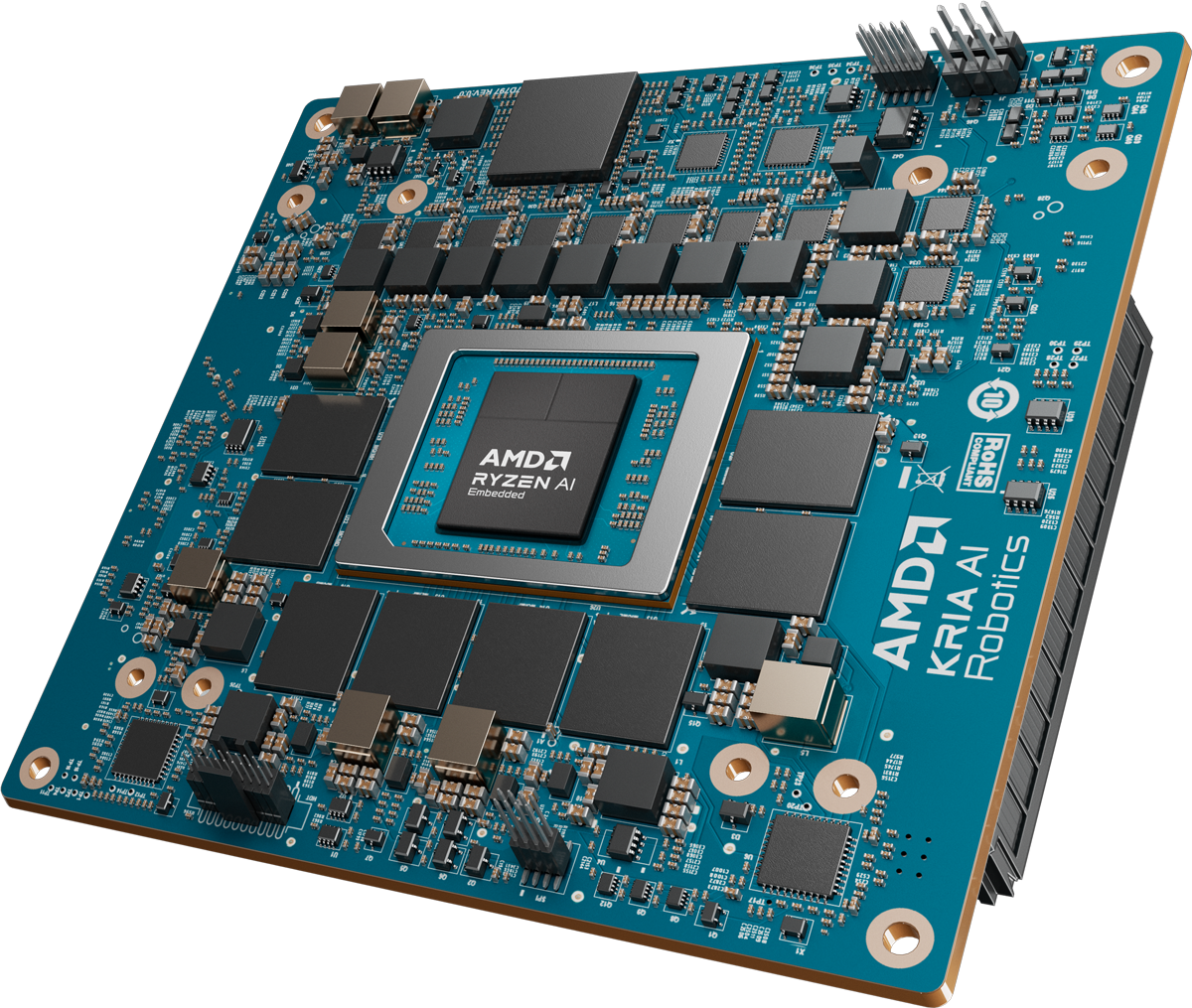
AMD has expanded its embedded processing portfolio with Ryzen AI Embedded X100 processors, new Kria system-on-modules, and a robotics platform combining perception, inference, control, and deterministic industrial interfaces.
Ryzen AI Embedded X100 devices integrate as many as 16 Zen 5 CPU cores with RDNA 3.5 graphics and an XDNA 2 neural processing unit. Operating-system functions, application logic, machine-learning inference, image processing, planning, and visualisation can consequently be assigned to compute resources suited to their different execution characteristics.
A Kria module based on the architecture supports as much as 128GB of LPDDR5X memory and is designed for COM-HPC deployment. Up to eight camera inputs can be connected alongside CAN-FD, RS-485, and 10GbE interfaces, creating a route between vision pipelines, motor controllers, safety equipment, industrial networks, and external systems.
Programmable logic remains part of the platform through an FPGA-equipped carrier, where it can handle custom I/O, protocol conversion, sensor synchronisation, tightly timed signal processing, and deterministic control. Tasks that would otherwise compete with a general-purpose operating system can therefore remain isolated from less predictable application workloads.
ROCm support and ROS 2 integration are intended to simplify software development across autonomous mobile robots, manipulators, inspection systems, factory equipment, and emerging humanoid platforms. AMD has also demonstrated configurations running large numbers of concurrent software agents, although deployed performance will vary with model size, memory traffic, numerical precision, sensor count, and thermal headroom.
Robotics extends beyond inference throughput
Where a conventional edge device may classify an image or detect an anomaly, an autonomous machine must interpret several sensor streams, estimate position, plan movement, monitor safety zones, communicate with surrounding equipment, and update actuators within controlled time limits. Each operation places a different burden on latency, bandwidth, numerical precision, and determinism.
Neural inference maps naturally to an NPU or GPU, whereas navigation, application logic, and system management continue to favour CPU execution. Image pre-processing, motor interfaces, precise timing, and specialist protocols can be moved into programmable logic, reducing jitter and preventing the main processor from becoming occupied by repetitive data movement.
Unified memory can reduce the need to copy large image tensors between processors, but several workloads then compete for the same bandwidth. Multiple cameras, graphics, mapping algorithms, inference models, and control applications can overwhelm an otherwise powerful device unless memory access and scheduling are treated as architectural constraints from the outset.
Thermal design imposes another boundary, since industrial robots frequently operate inside sealed or fanless enclosures exposed to dust, vibration, and elevated ambient temperatures. A processor capable of substantial burst performance may settle at a lower sustained level unless the surrounding system provides adequate conduction cooling or forced airflow.
Aetina has extended the available choice of Jetson Thor-based systems for physical-AI deployments, while AMD’s datacentre architecture is moving into Microsoft’s planned Helios infrastructure. The Kria platform brings a different balance, retaining programmable logic and industrial connectivity alongside CPU, GPU, and NPU resources.
Long production lives distinguish embedded machinery from rapidly replaced computing equipment. Processor availability, operating-system maintenance, security updates, model formats, software tools, and functional-safety evidence may need to remain controlled for a decade or more, during which several generations of development infrastructure can change.
ROS 2 provides a widely adopted software foundation, although production machinery still requires secure boot, authenticated updates, controlled configuration, diagnostics, fault containment, and predictable recovery behaviour. AI can guide perception and planning, while conventional control and independent protection systems continue to determine whether motion remains safe.
Heterogeneous hardware gives developers more freedom to partition those responsibilities, yet it also increases the number of decisions made early in a programme. Performance will depend on how effectively workloads are divided among CPU, GPU, NPU, and FPGA resources rather than on treating their aggregate capability as a single pool of interchangeable compute.

