
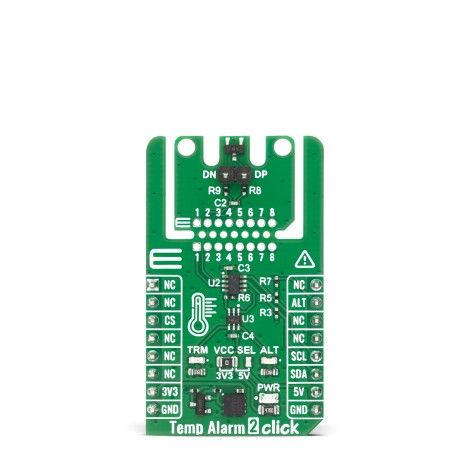
IN Brief:
- Temp Alarm 2 Click monitors its local temperature and a remote diode connected semiconductor junction.
- The board uses TI’s TMP411 with 12 bit conversion, programmable limits, fault detection, and I²C communication.
- Distributed thermal sensing is expanding as processors, FPGAs, and power stages concentrate heat in smaller assemblies.
MIKROE has introduced Temp Alarm 2 Click, a compact development board that monitors its local temperature alongside a remote diode connected junction inside a processor, microcontroller, ASIC, FPGA, or discrete transistor.
The board is built around Texas Instruments’ TMP411 digital temperature sensor and provides 12 bit conversion with stated accuracy of ±0.8°C. Separate DP and DN connections carry the remote junction signal, while an I²C interface links the device to the host controller.
Operation from either 3.3V or 5V allows the module to be used across a broad range of embedded platforms. Programmable high and low thresholds generate an alert when either channel moves outside its configured range, supporting staged cooling, performance reduction, fault reporting, or shutdown.
Remote diode fault detection identifies open or shorted connections, while series resistance cancellation and offset adjustment compensate for errors introduced by PCB traces, connectors, and the characteristics of the monitored junction. Those functions become increasingly useful when the sensing point sits some distance from the measurement IC.
MIKROE has routed the alarm through an ALT output and added ClickID support for board identification. The 42.9mm by 25.4mm module follows the mikroBUS format, while the Click Snap arrangement allows the sensing section to be separated along predefined lines for installation closer to the target device.
A board mounted ambient sensor cannot always describe the thermal condition of a processor or programmable device. Silicon temperature may rise much faster than the surrounding air, particularly when workload changes quickly or airflow is restricted, leaving an external sensor several seconds behind the point that requires protection.
Remote junction sensing provides a closer measurement by using a diode integrated into the semiconductor. The resulting data can regulate fan speed, reduce clock frequency, alter a power limit, or trigger an orderly shutdown before the device exceeds its permitted operating range.
Accuracy remains dependent on implementation. Junction ideality, trace resistance, coupled noise, leakage, grounding, and electromagnetic interference can distort the reading, especially where the DP and DN pair passes near switching power circuitry or fast digital signals.
Short, balanced traces and controlled filtering help preserve the remote measurement, while the series resistance cancellation function reduces one source of error without compensating for poor routing. The thermal path between the device, package, board, heatsink, and enclosure must also be understood before a threshold can be translated into a reliable protection policy.
Compact mass flow controllers with integrated sensing and local control reflect the same movement towards electronics placed closer to the physical process. Thermal management is following a similar pattern as more measurements are taken inside the enclosure and converted into digital data before being passed to the host system.
Edge processors, FPGAs, and dense power stages are creating steeper temperature gradients across smaller assemblies. A single enclosure reading may no longer indicate the condition of the hottest silicon, particularly when fan speed, filter loading, installation orientation, and local power dissipation vary during operation.
Dual channel monitoring also allows the system to compare local board conditions with the remote junction. During development, the relationship can reveal whether a heatsink or airflow change is reducing die temperature or merely moving heat elsewhere, while production equipment can use the two readings for plausibility checking.
Temp Alarm 2 Click is designed primarily for evaluation and integration, providing access to the TMP411 before the sensor is placed on a custom board. The supplied software and mikroBUS connection can accelerate firmware development, threshold testing, and fault handling, while the separable format supports more realistic sensor placement.
Thermal supervision is moving beyond simple emergency shutdown as equipment uses temperature data to regulate sustained performance. MIKROE’s board provides a direct route into that control loop, combining local and remote measurement with programmable limits and the diagnostics required to distinguish overheating from a failed sensor connection.

