IN Brief:
- The second-generation RTD oscillator reaches 40µW, approximately four times the first device’s maximum output.
- The 0.5 × 0.5mm die remains in a 4.0 × 4.3mm PLCC package designed for compact evaluation systems.
- ROHM plans to begin RTD-EVK-G2 kit sales during August 2026 for industrial and research development.
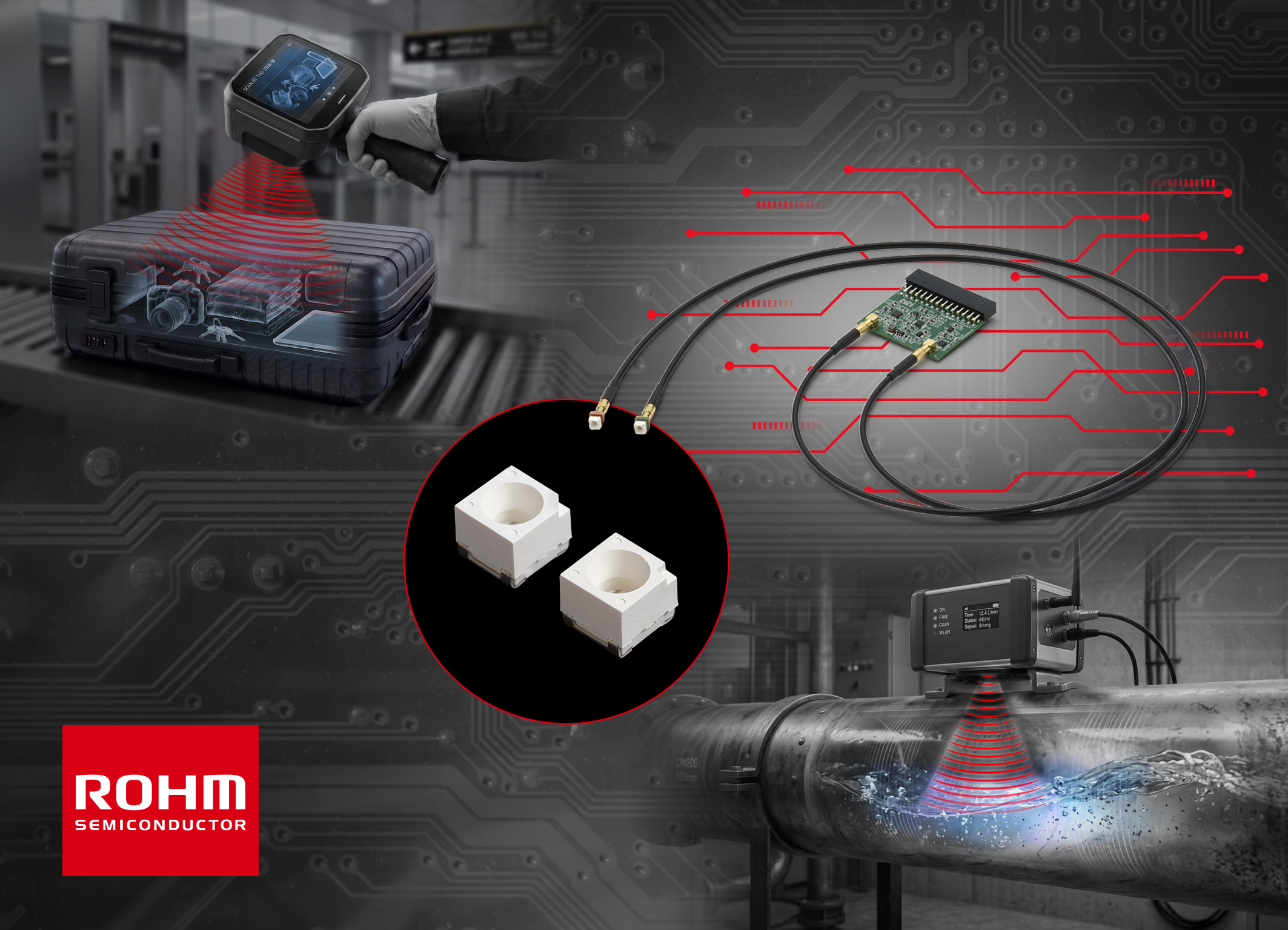
ROHM has developed a second-generation terahertz oscillator that raises maximum output power to 40µW while retaining the die and package dimensions of its first commercial samples. Sales of the RTD-EVK-G2 evaluation kit are scheduled to begin during August 2026.
The oscillator uses a 0.5 × 0.5mm resonant tunnelling diode chip mounted in a 4.0 × 4.3mm plastic leaded chip carrier. A revised internal structure produces approximately four times the output of the first-generation device without increasing its footprint, strengthening the signal available after transmission through, or reflection from, a target.
Terahertz radiation occupies the frequency region between conventional radio waves and infrared light. It can penetrate a range of non-conductive materials while retaining relatively straight-line propagation, and different substances produce characteristic absorption responses across the band. Those properties have supported research into non-destructive inspection, material identification, moisture detection, medical imaging, high-resolution radar, and short-range communications.
Commercial adoption has remained limited by the size, cost, and thermal demands of many terahertz sources and measurement systems. Laboratory arrangements assembled from optical or microwave equipment can deliver useful performance, but they are difficult to package into compact products and impose a substantial entry cost on organisations testing an application.
Resonant tunnelling diodes offer a semiconductor route to generating terahertz waves. An RTD uses quantum tunnelling through a barrier structure and can exhibit negative differential resistance at very high frequencies. When incorporated into a resonant circuit, that behaviour supports oscillation without the bulky optical chain associated with some alternative methods.
ROHM says its implementation produces less heat and consumes less power than other terahertz generation approaches, reducing the supporting hardware needed during evaluation. The company began supplying samples of its first-generation device in 2024 after research with the Institute of Science Tokyo, Osaka University, and other academic partners.
User feedback identified output power as a constraint where the signal must pass through a target, or return from a reflecting surface, before detection. Increasing output while retaining the same package geometry allows existing compact evaluation concepts to pursue a higher signal-to-noise ratio without redesigning around a larger source.
Professor Safumi Suzuki of the Institute of Science Tokyo said the RTD device is “compact, power saving, and does not require cooling”. He added that the second-generation device should accelerate work on applications requiring higher signal quality.
The RTD-EVK-G2 kit includes a sample oscillator, cable, and evaluation board. ROHM says it can be combined with instruments such as Digilent’s Analog Discovery 3, a computer, and suitable software to create a compact oscillation and detection environment. Purchase requires a non-disclosure agreement, placing the kit firmly in structured research and commercial development rather than unrestricted hobbyist evaluation.
The 40µW output remains modest beside sources designed for high-power spectroscopy or longer-range transmission. Frequency stability, beam formation, detector sensitivity, packaging loss, calibration, and the absorption characteristics of the target will all influence system performance, so the higher figure should not be read as a complete application result.
Evaluation will also show whether the higher output can reduce averaging time or simplify receiver design in practical test arrangements.
The engineering gain is the availability of a stronger semiconductor source in a package that fits an electronics development workflow. ROHM will continue supplying the first-generation oscillator for projects where lower power consumption takes precedence over signal strength, giving teams a direct choice between power economy and output.
Terahertz systems will still require application-specific antennas, optics, detectors, and signal processing, but a compact kit reduces the cost of establishing whether the band offers a genuine advantage for a given material, imaging, or sensing problem. The August sales launch will provide the first indication of how quickly development teams can move the device from laboratory evaluation into repeatable system designs.