IN Brief:
- Ouster shipped more than 17,000 lidar and camera sensors during Q2, with lidar representing about 53% of units.
- Revenue reached $55 million, up 56% year on year, while product revenue reached $53 million.
- Industrial demand included warehouse automation, yard logistics, and intelligent transportation deployments.
Ouster shipped more than 17,000 lidar and camera sensors during the second quarter as industrial and smart-infrastructure deployments increased across warehouse automation, yard logistics, and intelligent transportation. Revenue reached $55 million, 56% higher year on year and 12% above the first quarter.
Product revenue accounted for $53 million, up 51% from a year earlier and 9% sequentially. Lidar represented approximately 53% of the total units shipped, with the balance coming from camera products following Ouster’s acquisition of Stereolabs. The quarter therefore provides an early indication of the scale of the combined sensing portfolio rather than a lidar-only shipment figure.
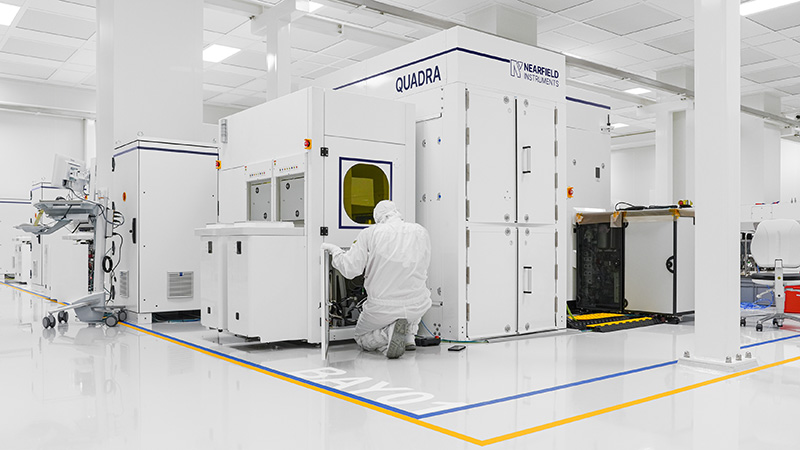
The volume increase coincides with Ouster’s Rev8 digital lidar family entering broader production. In June, the company expanded its manufacturing relationship with Benchmark Electronics specifically to support high-volume Rev8 production for industrial, robotics, automotive, and smart-infrastructure applications. The manufacturing arrangement has established capacity above 100,000 units per year and is designed around automated microelectronics and precision optical assembly.
Optical sensors become a different engineering proposition once deployment moves from dozens of units to thousands. Lidar assembly requires repeatable control of emitters, receivers, optics, mechanical structures, electronics, calibration, and environmental sealing, while finished devices have to maintain consistent ranging performance despite manufacturing tolerances. Scaling output therefore depends on automated calibration and test as much as additional assembly capacity.
Ouster has designed Rev8 for volume production and a planned ten-year production life, reflecting the long operating periods expected in industrial and automotive programmes. That approach is particularly relevant in warehouse and yard applications, where sensors can become part of a fleet of autonomous machines rather than a stand-alone installation. A deployment that begins with several vehicles can require substantially more hardware when extended across sites or equipment types.
Fixed infrastructure creates a similar multiplication effect. Intelligent transportation systems may place sensors at junctions, roads, or other monitored locations, turning an individual lidar specification into a network-wide procurement and maintenance requirement. Consistent calibration, interfaces, environmental performance, and software compatibility become more important as the installed base grows.
Ouster is also combining lidar with camera sensing and perception software. Each sensor type supplies different information: lidar measures three-dimensional range and geometry, while cameras capture detailed visual information. Combining them can improve object classification and scene understanding, but it increases requirements around timing, calibration, processing bandwidth, and software integration.
The financial results suggest that greater production volume is beginning to improve manufacturing economics. GAAP gross margin increased to 49%, compared with 43% in the first quarter and 45% a year earlier. Ouster attributed the improvement partly to volume growth and operating efficiencies, which is significant for a sensing technology that has historically faced pressure to reduce unit costs while maintaining relatively complex optical and mechanical assemblies.
The company reported a GAAP net loss of $18 million and an adjusted EBITDA loss of $4 million, so higher shipment volume has not yet translated into overall profitability. Cash, restricted cash, and short-term investments totalled $263 million at the end of June. The balance between investment and product scale remains important as new sensor generations move through customer qualification and production.
Third-quarter revenue is expected between $54.5 million and $57.5 million, broadly maintaining the Q2 run rate. That guidance puts the next emphasis on the composition of shipments: whether industrial and infrastructure customers continue expanding deployments and whether Rev8 becomes a larger proportion of lidar production.
More than 17,000 quarterly sensor shipments do not by themselves establish mass adoption of lidar, particularly with cameras included in the total. They do, however, show Ouster operating at a materially higher production volume while its manufacturing partner prepares Rev8 for longer-term programmes. The next measure will be whether those industrial installations convert from individual projects into repeatable fleets and infrastructure networks.