IN Brief:
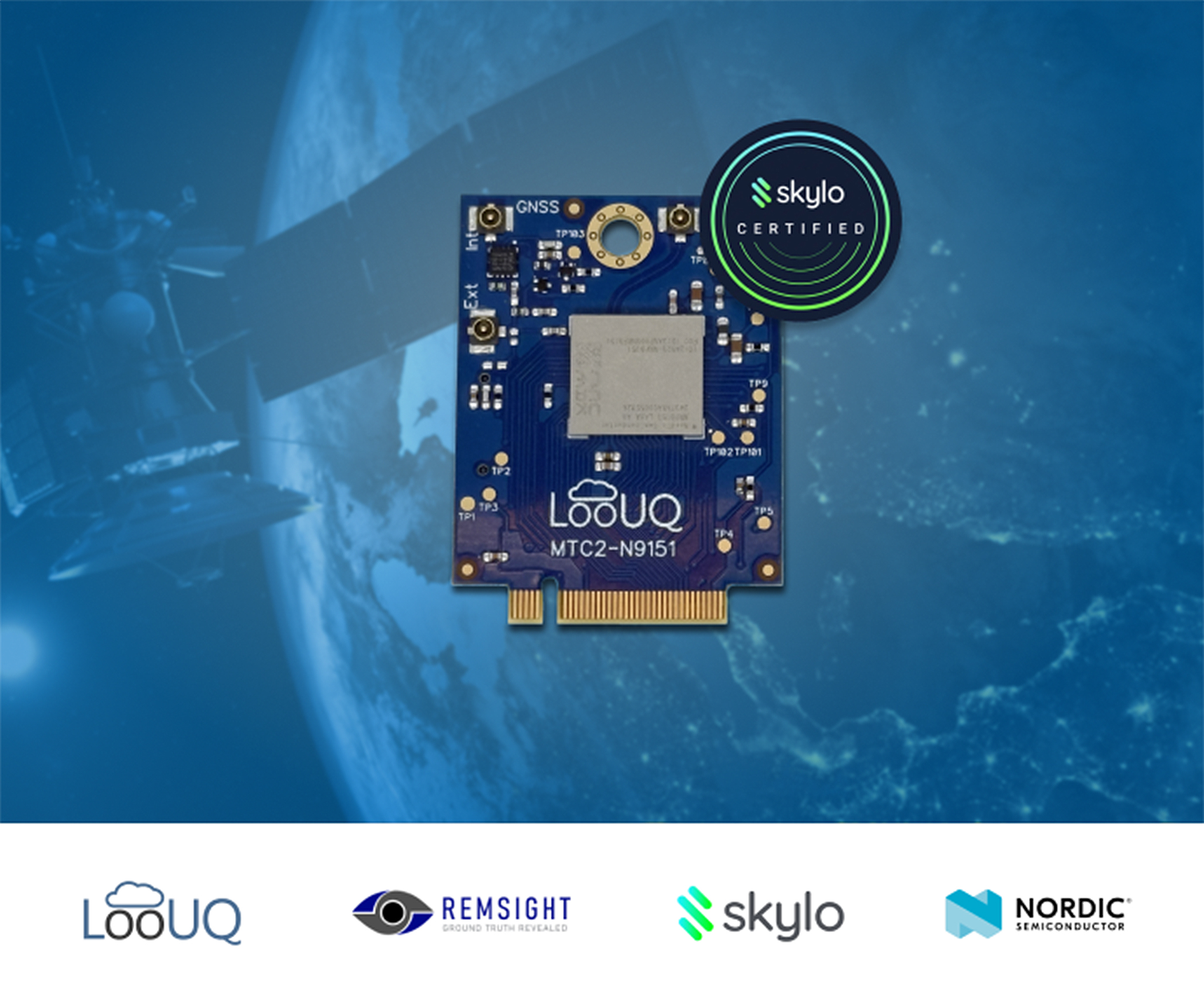
- LooUQ’s MTC2-N9151 embedded modem has gained Skylo NTN certification using Nordic’s nRF9151.
- The hardware supports movement between terrestrial LTE-M/NB-IoT and standards-based NB-NTN satellite connectivity.
- Remsight is deploying the architecture in solar-powered water-infrastructure sensors across remote areas of the American West.
Nordic Semiconductor says Skylo certification of LooUQ’s MTC2-N9151 embedded modem is reducing the integration and approval work required for IoT devices that need to operate across both terrestrial cellular and satellite networks.
The LooUQ modem is built around Nordic’s nRF9151 cellular IoT module and has gained certification for Skylo’s standards-based Non-Terrestrial Network service. Because the underlying nRF9151 had already been certified, LooUQ was able to build on that approved radio platform rather than beginning the satellite-network qualification process from the component level.
The nRF9151 combines an application MCU with LTE-M, NB-IoT, NB-NTN satellite, and DECT NR+ support in one compact module. Nordic positions the device for low-power connected products that may have to operate across locations where terrestrial cellular coverage is intermittent or unavailable.
Skylo’s service uses 3GPP-defined NB-NTN technology rather than a separate proprietary satellite radio protocol. That allows compatible hardware to apply cellular-derived communications standards across non-terrestrial links and gives developers a more unified route to products that can use conventional mobile networks where available and satellite coverage where they are not.
LooUQ has taken that capability into the MTC2-N9151 embedded modem, exposing the nRF9151 through its MTC.2 hardware interface and adding the components required to turn the Nordic module into a more complete integration platform.
The practical objective is to reduce how much radio-frequency and certification work has to be repeated by the finished-device manufacturer. A company developing a remote sensor still has to design its enclosure, power system, application electronics, antenna placement, and software, but it can begin from a modem whose underlying cellular and satellite architecture has already progressed further through operator qualification.
LooUQ says the MTC2-N9151 requires only two external components when integrated into a new design. Its combined terrestrial and NTN antenna arrangement supports both LTE and 3GPP NB-NTN bands in one element, avoiding the need to develop completely separate cellular and satellite antenna systems.
The modem is also intended to move between terrestrial and satellite connectivity according to coverage without requiring a corresponding change in application software. That is useful for low-data-rate industrial applications where the device is expected to send the same telemetry regardless of which physical network happens to be available.
Remote infrastructure is an obvious application. Water-monitoring company Remsight is using the MTC2-N9151 in its HydroProxy platform, which connects solar-powered sensors installed across irrigation infrastructure in the American West. Some of those sites sit beyond dependable terrestrial cellular coverage, making satellite connectivity a practical fallback rather than an additional consumer feature.
The architecture also applies to agricultural monitoring, energy infrastructure, asset tracking, logistics equipment, and other distributed IoT systems. Many such applications operate mainly within cellular coverage but still have a minority of installations in locations where conventional mobile networks cannot provide a dependable link.
Using a standards-based NTN capability in the same radio platform changes the economics of supporting those outlying devices. Developers do not necessarily need a separate proprietary satellite subsystem for the minority of deployments outside cellular range, reducing the hardware duplication and software integration required across the product family.
That does not remove the engineering constraints associated with satellite communication. Link budgets, antenna orientation, enclosure materials, power consumption, network access, and transmission timing still have to be considered carefully, particularly for battery or solar-powered equipment. NTN connectivity is useful only if the finished product can maintain an acceptable energy budget while establishing the required satellite link.
Certification at module and modem level also does not eliminate all approval work for the finished device. Product manufacturers still have their own regulatory and network obligations, but building on already certified hardware can reduce the amount of testing that has to be repeated and give developers a clearer route through the remaining qualification process.
LooUQ offers breakout and development kits around the MTC2-N9151 so engineers can begin over-the-air testing before committing the modem to a production PCB. That makes the architecture easier to assess under realistic coverage and power conditions, which is particularly important for satellite IoT because laboratory connectivity does not fully reproduce field deployment.
The development illustrates how standards-based NTN is moving down through the component stack. Satellite connectivity is becoming less dependent on a separate specialist modem and more closely integrated with mainstream cellular IoT hardware, allowing equipment designers to treat coverage as another network-selection problem rather than building two unrelated communications systems into the same device.