IN Brief:
- The Kraków facility combines cognitive assets, digital twins, autonomous operations, robotics, and autonomous infrastructure.
- Demonstrations include AI vision, drone monitoring, robotic systems, equipment maintenance, quality control, and synthetic-data workflows.
- GlobalLogic is using an open architecture intended to combine embedded engineering with multiple AI and technology platforms.
GlobalLogic has opened a Physical AI demonstration zone at its engineering centre in Kraków, Poland, bringing robotics, digital twins, autonomous operations and AI-based monitoring into an active development environment. The Hitachi Group company is using the facility to demonstrate how software, sensing, control and machine intelligence can operate together in systems that interact with physical equipment and infrastructure.
The zone brings together five areas defined by GlobalLogic as cognitive assets, digital twin and simulation, autonomous operations, robotics and automation, and autonomous infrastructure. Separate demonstrations also cover enterprise AI and AI development lifecycle work, extending the facility beyond a conventional robotics laboratory.
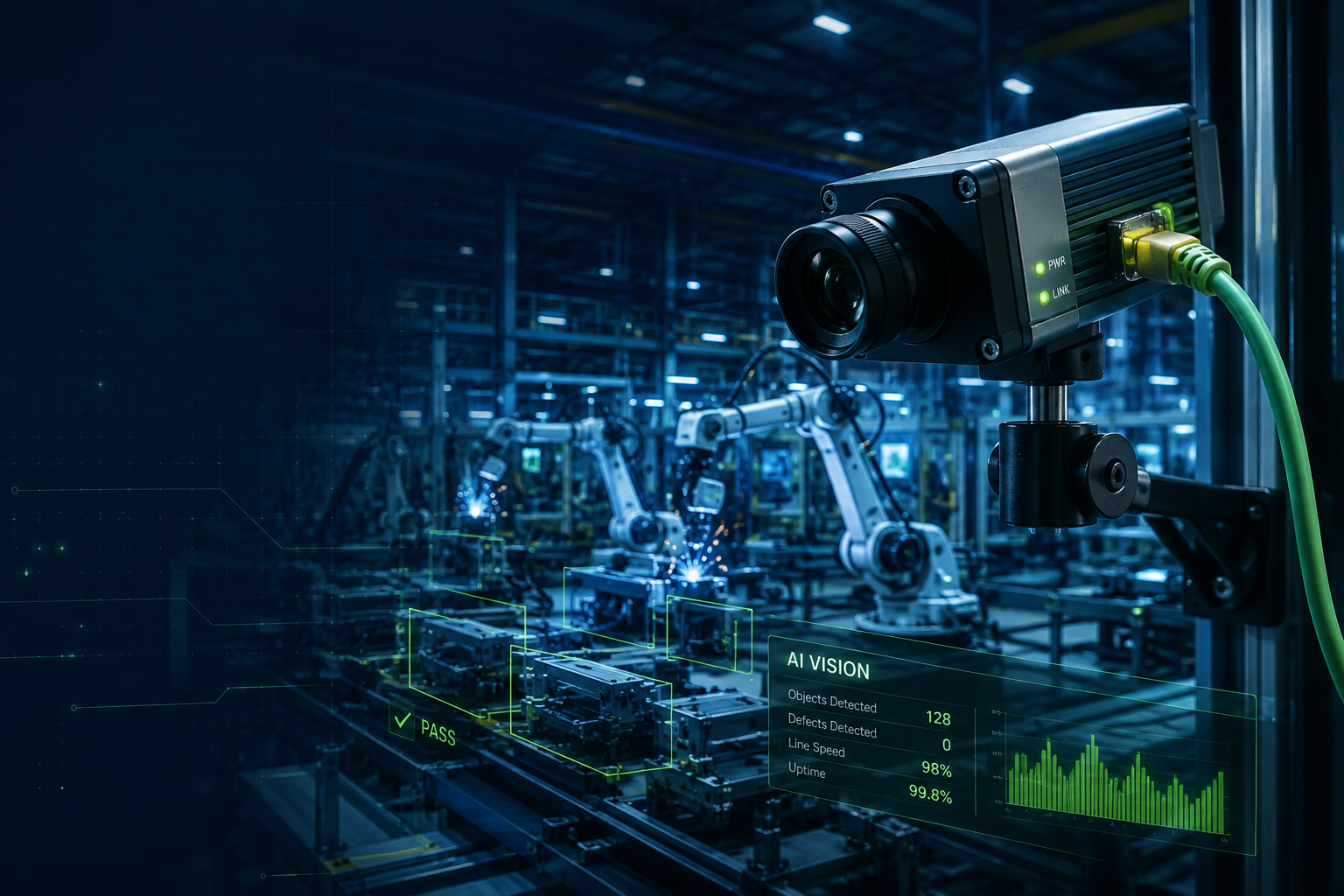
Projects include AI vision for data collection, digital twins for modelling and optimisation, drone-based infrastructure monitoring using computer vision, robotic systems that respond to their surroundings, and AI-supported equipment maintenance, quality control and analytics. Selected demonstrations also use generative AI, multi-agent systems and synthetic data during engineering, testing and deployment.
Physical AI places a substantial integration burden on embedded hardware and software. A deployed autonomous system must acquire reliable sensor data, process it within timing and power limits, communicate with other equipment, and produce an output through actuators or control systems. Processors, accelerators, cameras, other sensors, communications hardware and embedded software consequently have to operate as one system rather than as independent components.
GlobalLogic says the Kraków facility builds on more than 25 years of work in embedded systems, computer vision, digital twins, robotics, industrial automation and intelligent control. The engineering emphasis is important because AI models used in physical environments face constraints that are largely absent from cloud-only applications, including deterministic response, sensor errors, hardware failures, latency, environmental variation and safety requirements.
Locating the demonstrations inside an operating engineering centre also gives teams access to physical hardware while software remains under development. Simulation can cover a wide range of scenarios, but it cannot reproduce every timing effect, sensor imperfection or mechanical interaction found in a deployed machine. Prototype hardware exposes those differences before an architecture is fixed for production.
Digital twins and synthetic data extend that test space further. Access to vehicles, industrial equipment or critical infrastructure can be costly or restricted, and some fault conditions are difficult or unsafe to reproduce deliberately. Simulated environments allow developers to generate additional operating conditions and test perception or control software before transferring the workload to physical systems.
The difficult stage is then the transition between simulated and real behaviour. Cameras encounter changing illumination, sensors accumulate noise and drift, communications links suffer congestion or interruption, and mechanical systems do not respond with mathematical precision. Those differences have to be absorbed by the electronics, embedded software and system architecture rather than hidden behind the AI model.
GlobalLogic is using an open architecture at the Kraków facility, combining its engineering frameworks with technology platforms from multiple suppliers. The approach reflects the lifecycle mismatch common in industrial electronics: machinery and embedded systems may remain deployed for a decade or more, while AI accelerators, software frameworks and model architectures can change within much shorter periods.
The demonstration zone covers manufacturing, transport, energy, healthcare and critical infrastructure applications. Across those sectors, the hardware problem is increasingly similar — combining sensing, compute, communications and control with enough reliability to turn an AI output into a physical action. Kraków gives GlobalLogic a European environment in which those interfaces can be tested before the systems are committed to production hardware.