IN Brief:
- The gateway carries PROFINET and PROFISAFE traffic over private DECT NR+ wireless links.
- Hardware combines Nordic’s nRF9151 with an IP54 enclosure, M12 connectors, 24 V DC, and seamless handover.
- STRATUM 9 has also developed a software stack and starter kit around the industrial wireless platform.
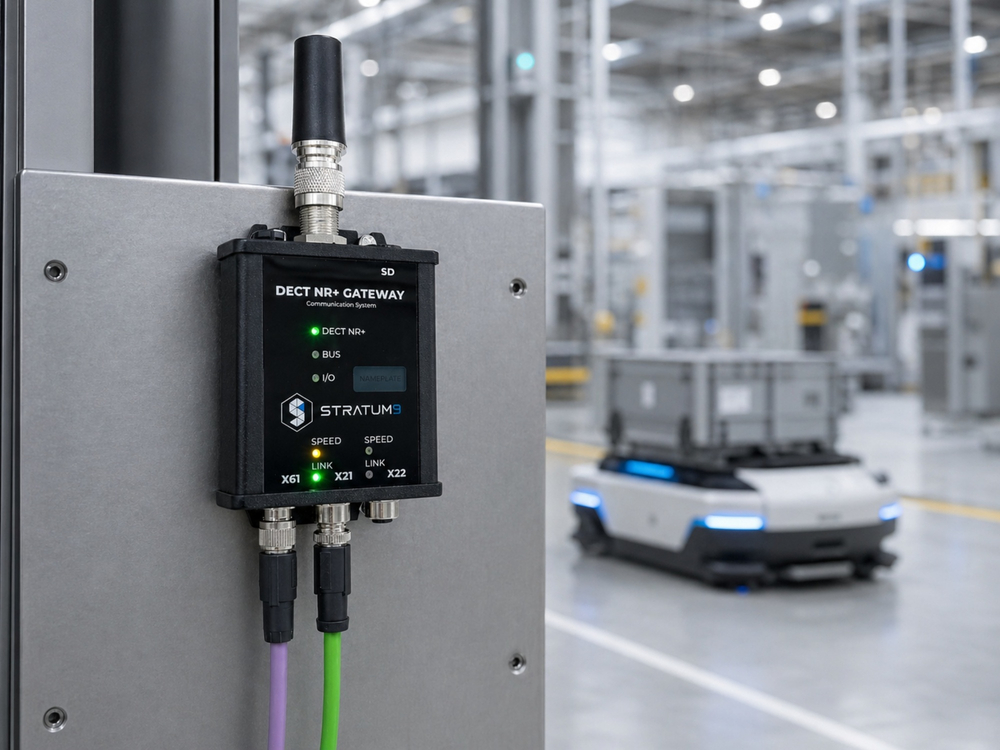
STRATUM 9 has developed a production-ready DECT NR+ gateway for deterministic industrial wireless communication using Nordic Semiconductor’s nRF9151 system-in-package and nRF Connect SDK. The Austrian engineering company is targeting automation applications that require predictable communications timing without depending on a public mobile network or external cloud service.
The gateway carries established industrial protocols including PROFINET and PROFISAFE over DECT NR+ links and supports seamless handover as equipment moves between base stations. Scheduled access allocates radio resources predictably, while the architecture can also support battery-powered nodes that cannot keep a radio active continuously.
The hardware uses an IP54-rated aluminium enclosure, M12 connectors, and a 24 V DC supply for installation around industrial equipment. It can operate as a point-to-point radio bridge, a stationary base station for moving devices, or a protocol bridge connecting DECT NR+ equipment with existing Ethernet or IoT networks.
STRATUM 9 has built the system around Nordic’s nRF9151, which combines DECT NR+ with LTE-M, NB-IoT, and non-terrestrial-network connectivity. Development used Nordic’s nRF Connect SDK, while STRATUM 9 concentrated its own engineering work on the deterministic Scheduled Access MAC layer used to control network access.
Industrial wireless systems face different constraints from office connectivity. Variable latency that is tolerable for ordinary data traffic can become problematic when the network is carrying control information for moving machinery, robots, conveyors, or safety-related equipment. Interference, network loading, topology, and radio coverage all influence whether a wireless installation can maintain the required communication behaviour.
DECT NR+ uses scheduled rather than purely contention-based access, allowing transmission opportunities to be allocated in advance. Nordic positions the technology for high-reliability, low-latency private networks operating in licence-exempt spectrum, although actual application performance still depends on the complete installation rather than the radio specification alone.
Keeping PROFINET and PROFISAFE at the protocol layer reduces the amount of surrounding automation architecture that has to change when introducing wireless transport. Controllers and plant networks can continue using established industrial interfaces while the gateway replaces part of the physical communication path.
That approach is particularly relevant to retrofits involving automated guided vehicles, mobile robots, rotating equipment, and production cells that are reconfigured regularly. Eliminating trailing cables or fixed network connections can increase mechanical freedom, but the replacement network still has to meet the timing, diagnostic, and availability requirements of the original application.
Private ownership also places more responsibility with the plant operator or integrator. The network does not depend on carrier coverage, but radio planning, coverage, device configuration, cybersecurity, and lifecycle management remain local engineering tasks. Deterministic access can make wireless behaviour more predictable; it does not remove the work needed to design and validate the installation.
STRATUM 9 has extended the gateway into a broader DECT NR+ portfolio including a full software stack and an AI-assisted starter kit for evaluation and development. The company is targeting AGV fleets, mobile robotics, smart metering, and predictive-maintenance retrofits, with deployed factory performance now the key measure of how well the architecture translates from protocol capability into industrial operation.