IN Brief:
- LG has begun deliveries of its 5G Release 16 telematics platform to a premium European automaker.
- The design combines the communications module with up to 12 antennas and supports multiple communications chipsets.
- Modular hardware and reusable software are intended to reduce RF cabling and support different vehicle architectures.
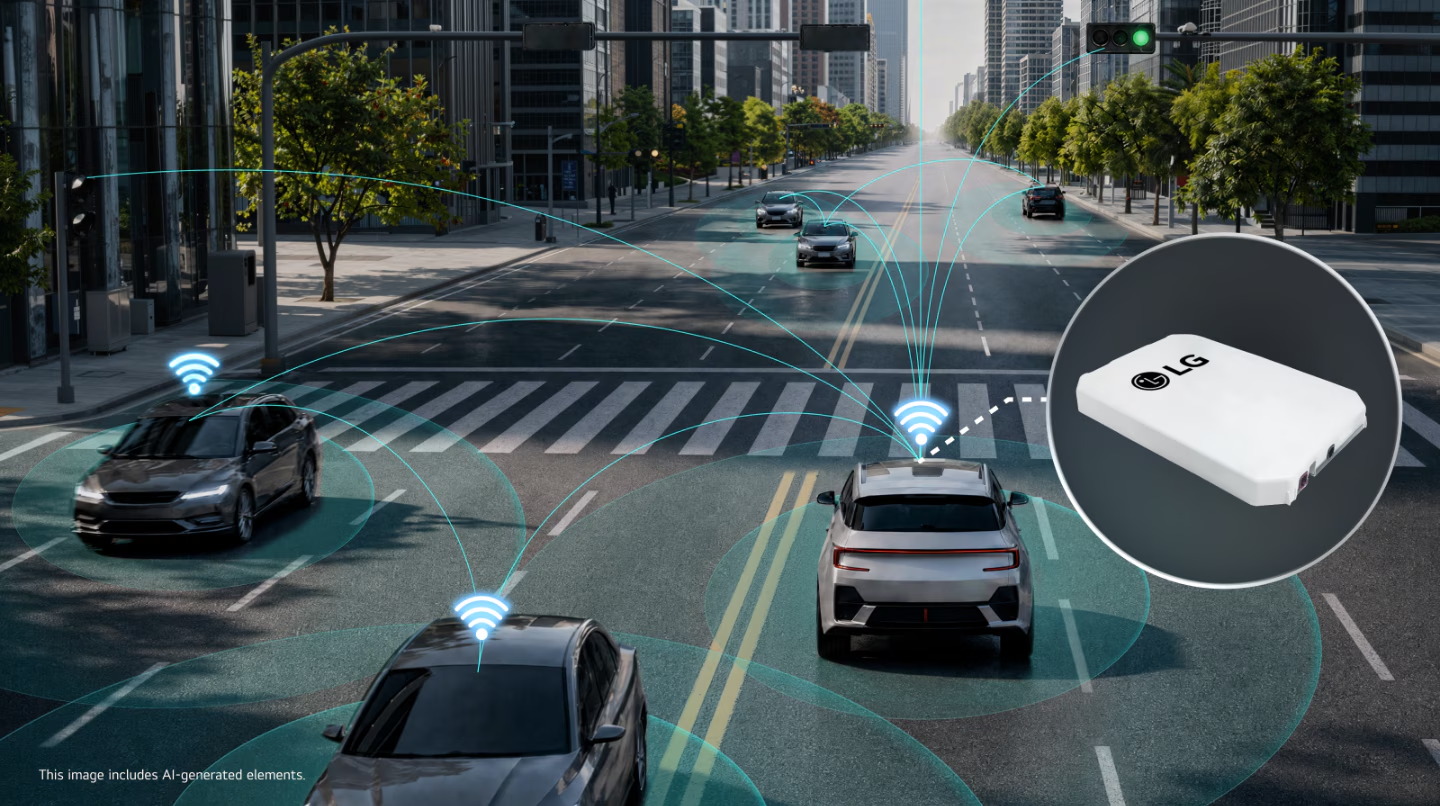
LG Electronics has begun mass production and deliveries of a 5G Release 16 telematics platform for a premium European vehicle manufacturer, marking the system’s first deployment in a production vehicle in Europe. The design combines a communications module with as many as 12 antennas, consolidating hardware that is often distributed between a telematics control unit and externally mounted antenna assemblies.
Vehicle connectivity has become harder to package as the number of radio functions increases. Multi-frequency GNSS, 5G, Wi-Fi, and vehicle-to-everything communications can require several antennas operating across different bands, while 5G itself often relies on multiple antenna paths. Conventional shark-fin housings have limited space, so additional antennas can end up spread around the vehicle, adding RF cabling, connectors, mass, and assembly work.
LG’s architecture brings more of those functions into one unit but retains a modular internal layout. The telematics and antenna boards can be combined or separated according to the vehicle platform, allowing the same underlying system to be adapted to different packaging constraints. That flexibility is important in automotive electronics, where a module that fits one body style or electrical architecture may be difficult to reuse across the rest of an OEM’s range.
The software layer is based on LG’s Automotive Telematics Platform, which has been developed over more than a decade. The same core software can be reused across supported applications with changes at the chipset interface, and the hardware is designed to support multiple communications chipsets. That reduces the dependence of the complete module on a single silicon source while giving vehicle programmes more room to manage component availability.
Integration also changes the RF and thermal design. Shorter links between modem electronics and antennas can reduce some cable losses, but placing more active electronics and radiating elements in a compact assembly increases the importance of internal structure, metal placement, heat paths, electromagnetic compatibility, and antenna isolation. The platform has been tested in real vehicles under high-temperature conditions, with stable data transmission and reception reported during those tests.
Those constraints become more significant as telematics takes on a larger role in software-defined vehicle architectures. Release 16 connectivity can support over-the-air updates, V2X communications, and data exchange associated with automated and connected functions. A failure in the communications module can therefore affect considerably more than infotainment, while changes to modem silicon or antenna configuration have to be managed without destabilising the wider vehicle network.
For electric vehicles, reducing RF cabling and separate antenna locations can also remove small but cumulative sources of weight and installation complexity. RF cables are relatively costly, have to be routed carefully through the vehicle, and introduce losses between the antenna and communications electronics. Consolidation can simplify that path, although the real manufacturing benefit will depend on how much wiring and hardware each vehicle platform can actually eliminate.
Vehicle integration also has to account for the body itself. Glass, metal, roof geometry, nearby electronics, and antenna orientation can all alter RF performance, so consolidating more antennas into one assembly does not remove the need for vehicle-level tuning. It concentrates more of that work around a defined module and its installation position.
The production programme is more significant than the earlier technology introduction because series deployment exposes the architecture to the constraints that determine whether integration works at scale. Assembly repeatability, thermal variation, software maintenance, component substitutions, vehicle-level validation, and long service life all become part of the engineering problem once units are being delivered for customer vehicles.
LG’s first European production-vehicle deployment therefore puts the integrated approach into a much less forgiving environment than a demonstrator. Automotive telematics has to survive temperature cycling, vibration, network changes, and software updates over many years. The useful measure of the platform will be whether its consolidation of antennas, RF connections, software, and modem options can be repeated across additional vehicle programmes without recreating the complexity it is intended to remove.