IN Brief:
- MCX A5 combines an Arm Cortex-M33 core with integrated 10BASE-T1S digital PHY and topology discovery.
- Security includes PSA Certified Level 3 capability and a post-quantum cryptography-based hardware root of trust.
- The family is sampling now for industrial, building automation, energy, and IoT edge applications.
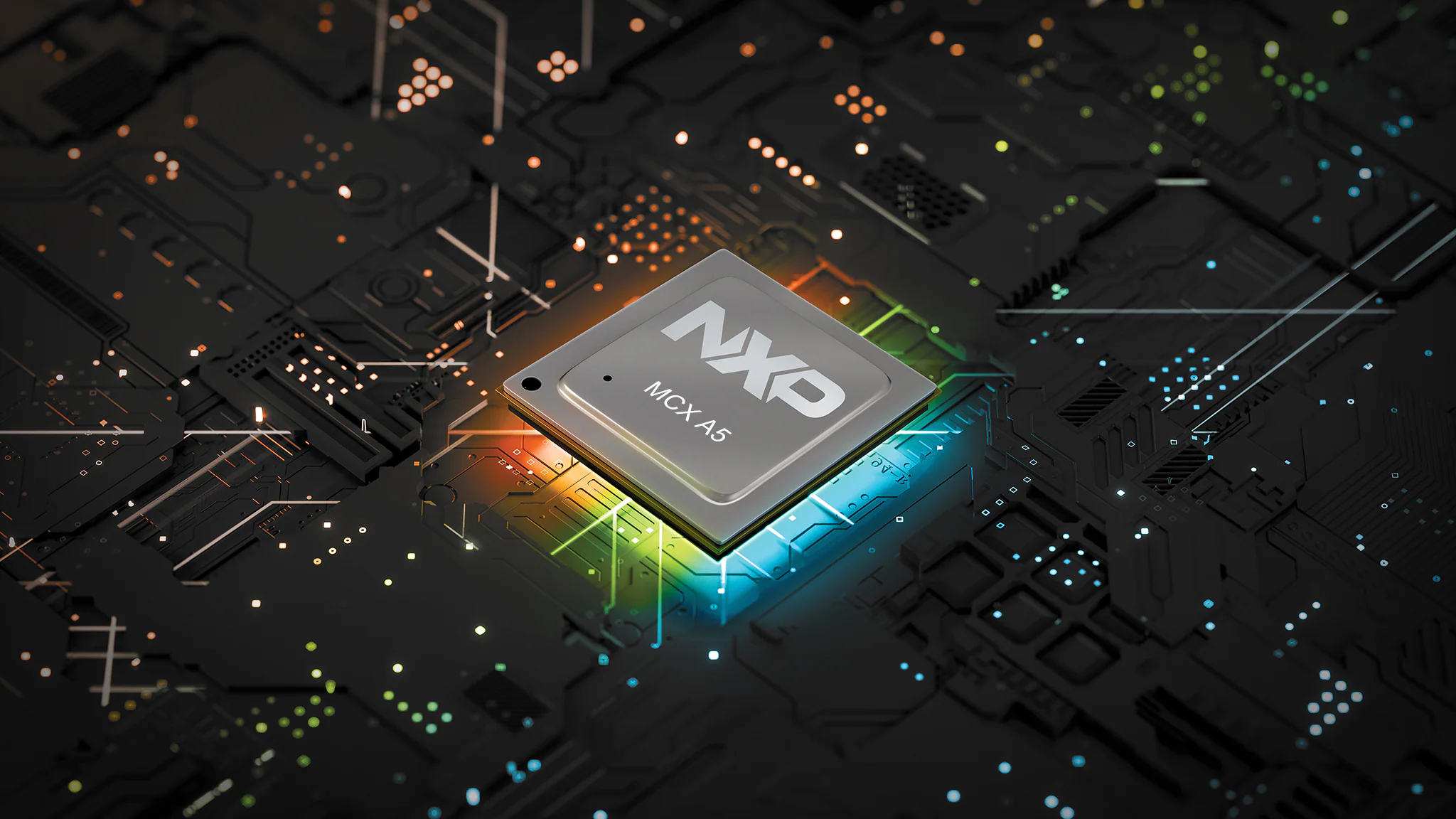
NXP Semiconductors has introduced the MCX A5 family of Arm Cortex-M33 microcontrollers, combining an integrated 10BASE-T1S Ethernet digital PHY, topology discovery, and post-quantum cryptography for industrial and IoT edge nodes. The devices run at up to 240MHz and are intended to move Ethernet connectivity closer to sensors, actuators, controllers, and other distributed equipment without requiring a larger processor or separate digital Ethernet subsystem.
10BASE-T1S supports multidrop single-pair Ethernet, allowing several nodes to share one segment while retaining IP-based communication. NXP has added topology discovery so connected devices can be identified and mapped automatically, addressing installations where engineers need better visibility of field equipment but cannot justify a conventional switched Ethernet port at every endpoint.
The MCX A5 family offers up to 2MB of flash and 640KB of RAM, with interfaces including UART, I2C, I3C, SPI, CAN FD, high-speed USB, and FlexIO. Development support comes through MCUXpresso, including SDKs, middleware, Visual Studio Code integration, and long-term-support software releases, while Zephyr RTOS is also supported and selected devices add Rust for memory-safe embedded development.
Security is built around PSA Certified Level 3 capability and a hardware root of trust with post-quantum cryptography support. NXP lists secure boot, secure firmware updates, secure attestation, secure debug authentication, external flash encryption, and lifecycle controls among the available functions, giving designers a security architecture that extends beyond adding new cryptographic algorithms to an otherwise conventional MCU.
That lifecycle emphasis is increasingly relevant in industrial equipment expected to remain deployed for years after installation. Europe’s Cyber Resilience Act is pushing connected-product manufacturers towards defined vulnerability handling, secure update mechanisms, and longer-term maintenance obligations, while the eventual transition away from today’s public-key algorithms will have to be considered for products whose service life extends well into the next decade.
The digital PHY is paired with NXP’s TJF1410 physical-medium-dependent transceiver, which provides the analogue front end for IEEE 802.3cg-compliant 10BASE-T1S networks. Splitting the analogue line interface from the MCU’s digital PHY keeps the architecture compact while allowing NXP to target industrial automation, building automation, energy infrastructure, and other distributed systems where single-pair cabling can reduce wiring weight and installation complexity.
The family also reflects a broader change in industrial control silicon. More endpoints are being asked to expose telemetry, support authenticated updates, and participate in higher-level software services without surrendering deterministic local control. NXP has already taken Ethernet deeper into industrial processing with devices such as the i.MX RT1180 crossover MCU family; MCX A5 works closer to the sensor and actuator layer, where cost, power, and board area are tighter constraints.
10BASE-T1S is particularly useful where the existing alternative is not Ethernet at all. Industrial equipment still contains large estates of RS-232, RS-485, CAN, and proprietary field connections because they are inexpensive, familiar, and adequate for many tasks. Replacing them wholesale would make little engineering sense, but an MCU with an integrated digital Ethernet function lowers the threshold for new designs that need direct IP connectivity, remote diagnostics, or access to real-time operational data.
Topology discovery may also reduce commissioning effort in systems with many similar endpoints. Automatically identifying how devices sit on a multidrop segment does not eliminate the need for network design, addressing, or fault diagnosis, but it gives maintenance and control software a better picture of the physical network than a collection of anonymous serial nodes.
The MCX A5 family is sampling now, so production availability, qualification, variant coverage, and software maturity remain part of the evaluation work ahead. Its combination of single-pair Ethernet, long-life security features, and familiar MCU resources nevertheless gives NXP a credible route into industrial nodes that increasingly have to behave as connected, maintainable software products rather than isolated control components.