IN Brief:
- Northrop Grumman SYNOPTICS has grown a Yb:YLF boule with a diameter about three times the conventional industry size.
- A slice measuring 127 mm at its widest point will support high-energy laser research at Germany's DESY.
- The IFuEL programme is developing a 200 J-class cryogenic Yb:YLF module as a potential building block for future fusion laser drivers.
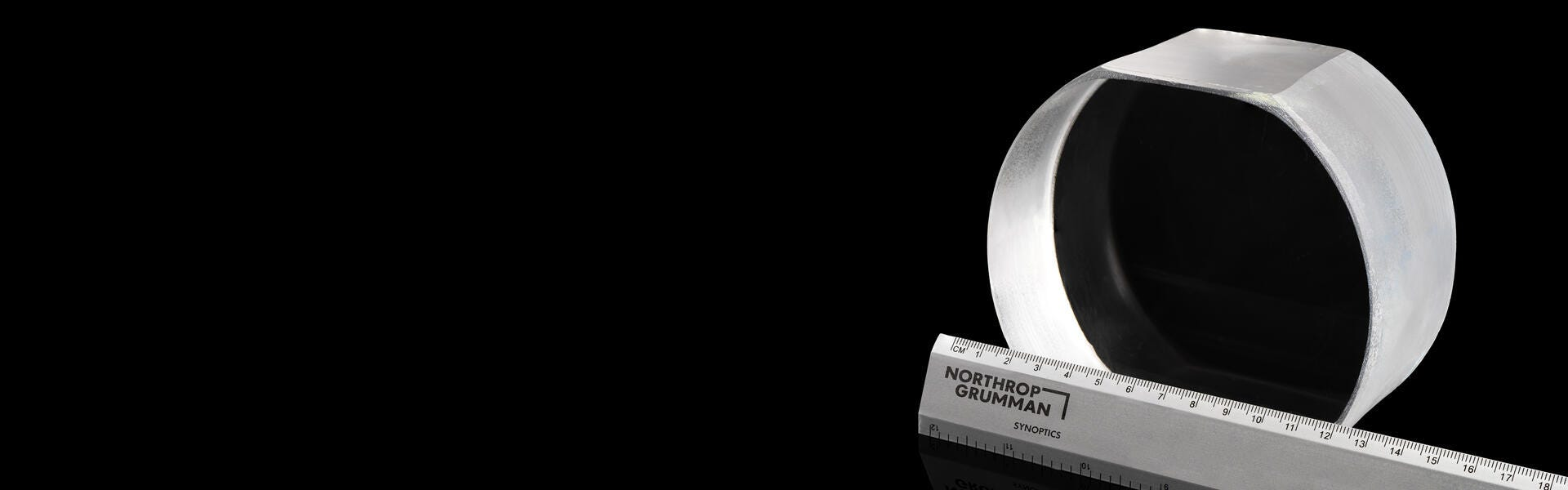
Northrop Grumman SYNOPTICS has grown and harvested a large-diameter ytterbium-doped yttrium lithium fluoride crystal for high-energy laser development, producing a boule with a diameter around three times greater than the conventional industry size. A finished Yb:YLF slice measures 127 mm at its widest point and will be used in laser research at Germany’s Deutsches Elektronen-Synchrotron, DESY.
The development is primarily a crystal-growth and optical-manufacturing problem rather than a new laser architecture. Yb:YLF acts as the gain medium in a solid-state laser, storing energy introduced by optical pumping and releasing it as amplified laser light. Increasing the usable aperture allows designers to work with higher pulse energies, but producing a larger crystal without unacceptable inclusions, stress, optical distortion, or compositional variation becomes progressively more difficult as the boule diameter increases.
SYNOPTICS manufactures synthetic laser crystals at its Charlotte, North Carolina operation and carries out crystal growth, fabrication, thin-film coating, and optical assembly. The company says the new material will support high-energy, high-average-power systems, where optical quality has to remain controlled across a much larger cross-section than would be required for smaller scientific or industrial laser components.
The immediate destination is DESY’s Inertial Fusion Energy Laser Development and HED Analytics programme, known as IFuEL. The multi-institutional project forms part of Germany’s Fusion 2040 activity and is examining laser technology suitable for inertial fusion energy. Its planned 200 J-class module is intended as a possible repeatable building block for larger fusion laser drivers.
Large gain media are required because increasing laser energy without increasing the optical aperture can drive fluence towards levels that damage coatings, surfaces, or the crystal itself. Simply enlarging a conventional laser component is not straightforward, however. Thermal gradients can change refractive index and distort the beam, mechanical stress can alter optical behaviour, and crystal defects that are tolerable in smaller components can become significant once a large portion of the boule sits inside the active beam path.
Yb:YLF is of particular interest to DESY because of its behaviour in cryogenic laser systems. Cooling the gain medium can improve characteristics relevant to high-energy operation, while the material’s optical and thermal properties offer an alternative to more familiar solid-state laser hosts. DESY has worked on cryogenic Yb:YLF technology for more than a decade, so the larger crystal extends an established research programme rather than introducing an entirely new material system.
Cryogenic operation brings additional engineering constraints. The crystal has to be mounted and cooled without introducing stress that compromises optical performance, while the wider laser system has to accommodate refrigeration, pump sources, diagnostics, beam transport, control electronics, and precision alignment. Those requirements become more demanding when the goal is not a single high-energy shot but a scalable architecture capable of operating repeatedly and efficiently.
Manufacturing also continues after the boule leaves the growth station. Large sections have to be cut, oriented, polished, coated, inspected, and integrated into mounts while preserving the material quality achieved during growth. The 127 mm slice therefore represents only one stage in the component chain, albeit a stage that determines whether the laser designer has enough usable aperture to attempt the intended energy scaling.
That supply-chain dimension matters for photonics engineering. High-energy laser programmes depend on pump diodes, power electronics, optical coatings, gain media, precision mechanics, thermal systems, and control hardware advancing together. A laser architecture capable of higher pulse energy cannot move far beyond modelling if its critical optical materials cannot be manufactured repeatedly at the required size and quality.
IFuEL still has to demonstrate the efficiency, repetition rate, reliability, and system integration required for a practical fusion driver. The new SYNOPTICS material does not answer those questions by itself. It does provide DESY with the larger aperture needed to test them at a more representative scale, shifting one part of the fusion-laser problem from crystal-growth capability towards operating laser hardware.