IN Brief:
- 6G, Wi-Fi, satellite, and defence radios require repeatable laboratory reproduction of increasingly complex propagation and MIMO conditions.
- Vertex 6.0 provides 400MHz instantaneous bandwidth, carrier support to 23.6GHz, and up to 36 RF ports and 256 digital links per chassis.
- Field-replaceable modules allow laboratories to extend existing Vertex systems as FR3 and wider-bandwidth test requirements develop.
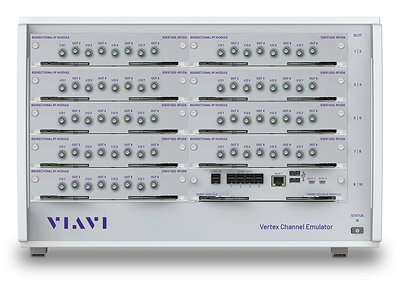
VIAVI Solutions has expanded its Vertex channel-emulation platform with hardware for 6G, Wi-Fi 7 and 8, FR3, non-terrestrial networks, and integrated sensing and communications development. Vertex 6.0 provides 400MHz instantaneous bandwidth and supports carrier frequencies up to 23.6GHz when used with VIAVI’s FR3 conversion hardware.
The system is intended to recreate controlled radio-propagation conditions in the laboratory, allowing developers to expose chipsets, radios, and complete systems to fading, multipath, motion, interference, and complex MIMO channels without depending solely on field trials. A 6U Vertex chassis supports up to 36 RF ports, 256 digital links, and 1.6GHz of aggregate bandwidth.
VIAVI has added field-replaceable RF modules so that existing chassis can be upgraded as frequency and bandwidth requirements change. The platform extends the 5G FR1 and FR2 capability of earlier Vertex systems into new cellular, Wi-Fi, military, and aerospace configurations rather than requiring a completely separate emulator for each programme.
FR3 testing is one of the immediate engineering drivers. Spectrum above conventional sub-7GHz cellular bands and below millimetre wave is being studied for future mobile systems because it offers greater available bandwidth without all of the propagation losses encountered at substantially higher frequencies. That compromise still changes antenna, RF front-end, propagation, and beamforming requirements enough to demand new laboratory channel models.
Vertex 6.0 supports FR3 operation with up to 1GHz bandwidth when combined with the company’s MIMO converter. Multiuser MIMO configurations include phase alignment and both TDD and FDD operation, allowing engineers to reproduce the relationships between several spatial channels rather than test a radio through a single static RF path.
Wi-Fi development brings a different set of requirements. The platform supports 320MHz channels, 4096-QAM, and configurations from 2×2 through to 8×8, giving developers enough channel capacity to test the wider bandwidth and higher modulation orders used by current and emerging WLAN equipment.
Those specifications become more useful when the propagation itself is changing. A device that behaves correctly through a cable can still fail when reflections, attenuation, Doppler shift, interference, and antenna orientation interact in a real environment. Channel emulation lets the same difficult condition be reproduced repeatedly while firmware, RF hardware, antennas, or algorithms are changed.
Non-terrestrial networks make repeatability particularly valuable. LEO, MEO, and GEO satellite links introduce changing delay and Doppler conditions, while airborne and drone scenarios add three-dimensional motion. VIAVI includes land-to-land, land-to-air, air-to-air, mesh, drone, and NTN operating modes so that those effects can be brought into the same controlled test environment.
Integrated sensing and communications adds another layer because the radio is expected to derive information about its surroundings while carrying communications traffic. In that case, the channel emulator must reproduce reflections and changing propagation conditions that a sensing algorithm can interpret, not merely provide an impaired communications link.
VIAVI is combining the platform with ray-tracing techniques for those environments. A digital representation of a building, street, or other deployment area can be used to derive the RF channel presented to the hardware under test, allowing development teams to repeat a location-specific scenario without physically returning to that site.
The approach still depends heavily on calibration. Wider bandwidth, more RF ports, and large MIMO configurations increase the opportunities for the test system itself to introduce phase, amplitude, or timing errors. Channel emulators have to remain sufficiently well characterised that engineers can separate a device failure from an artefact generated by the equipment attempting to reproduce the channel.
The first Vertex 6.0 announcement was made on 12 August, so this is not being presented as a newly released 20 August product. Its inclusion in the current commissioning run follows the Stage 2 editorial override, while the technical development remains relevant to laboratories preparing for radio standards that are still evolving. Field-replaceable modules are particularly pertinent in that context: the requirements will change long before anyone can pretend the 6G test plan is finished.