IN Brief:
- SPVQK is designed for 48V vehicle electrical architectures, with the launch material specifying direct compatibility up to 52VDC.
- Its revised contact structure raises stated C-load inrush capability from 0.1A peak for SPVQ8 to 3A peak.
- Current catalogue data rates the standard parts at 0.1A, 48VDC resistive load and confirms 300,000-cycle life.
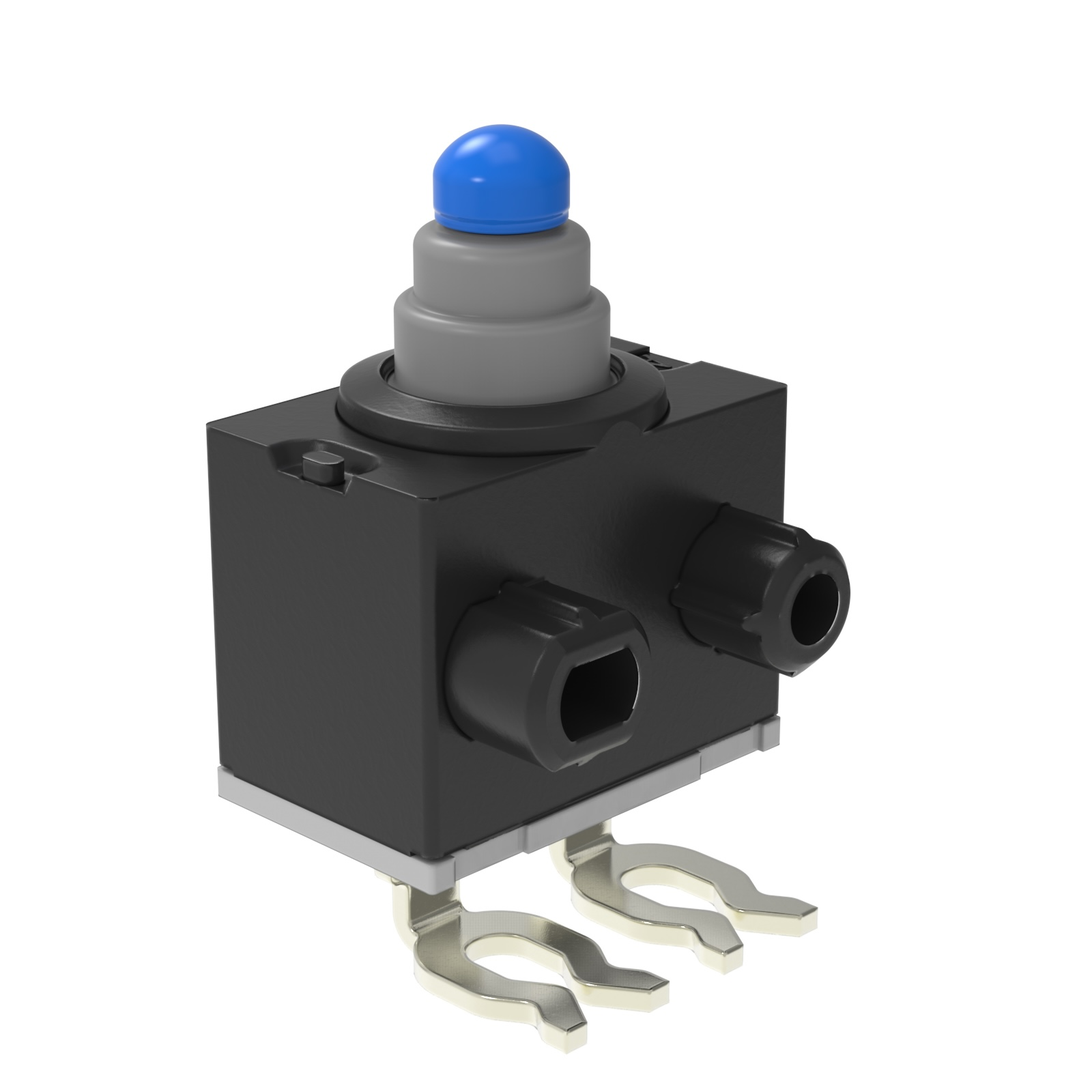
Alps Alpine has introduced the SPVQK detector-switch family for 48V automotive electrical systems, increasing the voltage and inrush-current capability of a compact mechanical switch while retaining the physical footprint of the company’s existing SPVQ8 series.
The devices are intended for position and state detection in mechanisms including door latches, seat-belt buckles, electric parking brakes, and column shifters. Alps Alpine’s launch material specifies direct compatibility with 48V vehicle architectures and a maximum system rating of 52VDC, reducing the need to introduce a separate lower-voltage supply solely for the detector-switch circuit.
Moving vehicle auxiliary systems from conventional 12V architectures towards 48V allows a given amount of electrical power to be transferred at lower current. Since resistive wiring losses increase with the square of current, that can reduce conductor losses and make higher-power loads easier to support without proportionally increasing cable cross-section.
The change does not make the electronics automatically simpler. Switches, relays, connectors, protection devices, DC/DC converters, and sensing circuits all have to tolerate the higher voltage and the transient conditions created by the loads connected to it. Components that previously operated comfortably inside a 12V environment may therefore need a different contact, insulation, or protection design.
For SPVQK, Alps Alpine has concentrated particularly on the contact system. The launch information specifies C-load inrush-current capability of up to 3A peak, compared with 0.1A peak for the existing SPVQ8. Capacitive loads can draw a much larger current when first connected because an uncharged capacitor initially presents a low impedance, placing far more stress on a small mechanical contact than its steady-state current suggests.
The revised contact structure is intended to reduce wear and degradation under that condition. Alps Alpine says the additional capability can remove external current-limiting components such as chip resistors that had previously been used to protect the switch. In a detector circuit repeated across several vehicle mechanisms, removing a protection component can reduce board area, bill-of-material count, and the number of interconnections requiring validation.
The launch specification also gives an overcurrent withstand figure of 18A for five minutes as a typical value and an operating life of 300,000 cycles. The construction complies with IP6K7, although Alps Alpine’s current catalogue notes that the device must not be used immersed in water and that the IP6K7 rating excludes the terminals.
The standard package measures 5.3mm × 8.3mm × 6.5mm and uses a single-pole, single-position normally open circuit with an operating force of 1.4N ±0.5N. SPVQK10100 uses press-fit terminals, while SPVQK10900 provides lead terminals. Both are listed by Alps Alpine as standard automotive parts in mass production.
Retaining the SPVQ8 mechanical footprint may prove particularly useful because a detector switch is normally buried inside a larger electromechanical mechanism. Changing its envelope can alter mouldings, actuator travel, PCB geometry, connector positions, tooling, and assembly validation. Reusing the package gives designers more scope to change the electrical characteristics without reopening every mechanical element around it.
There is an important distinction between the launch description and the detailed catalogue rating. The original announcement describes the SPVQK as directly compatible with 48V architectures and gives a maximum rated voltage of 52VDC. Alps Alpine’s current standard-product table, meanwhile, specifies a maximum resistive-load rating of 0.1A at 48VDC, alongside 0.1A at 16VDC and a minimum rating of 1mA at 4.5VDC.
The current SPVQK10100 catalogue also specifies initial contact resistance of 500mΩ maximum, 100MΩ minimum insulation resistance at 500VDC, 500VAC dielectric withstand for one minute, and an operating temperature range from -40°C to +85°C. Alps Alpine recommends obtaining the formal delivery specification before incorporating the component into an actual design.
That caution matters particularly where capacitive or inductive loads are involved. The catalogue states that its normal published ratings are for DC resistive loads and advises customers to consult the company when using other load types. The 3A C-load inrush capability from the launch therefore describes a specific transient capability, not a 3A continuous contact-current rating.
Mass production began at Alps Alpine’s Wuxi operation in China in June 2026. The initial deployment is intended largely as a replacement for existing detector switches in mechanical vehicle components before broader use in vehicles adopting 48V electrical architectures.
SPVQK does not change the basic job performed by a detector switch. Its significance is that an ordinary mechanical sensing component has been reworked for a higher-voltage electrical environment. As 48V architectures spread beyond isolated subsystems, that same qualification exercise will have to work its way through connectors, switches, protection devices, sensors, and wiring across the vehicle.