IN Brief:
- GIGALIGHT has completed a shippable socket-based 1.6T NPO engineering sample built around OIF specifications.
- Thermal-expansion mismatch, optical coupling variation, press-fit force, and alignment remain volume-manufacturing concerns.
- Customer evaluation will test whether near-package optics can preserve performance and serviceability beyond laboratory-scale assembly.
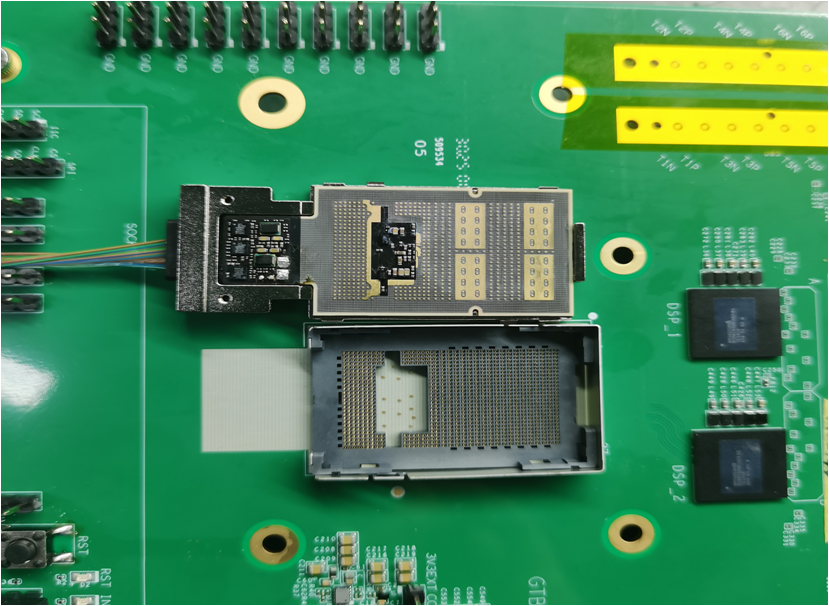
GIGALIGHT has completed a shippable engineering sample of a socket-based 1.6T near-package optical interconnect built around OIF specifications, placing the design at the customer-evaluation stage rather than mass production. The company is simultaneously highlighting thermal-expansion mismatch, socket compression, and alignment as unresolved manufacturing constraints for NPO systems deployed at data-centre scale.
Near-package optics moves optical engines closer to the switch or accelerator package than conventional front-panel pluggable modules, reducing the length of the highest-speed electrical traces across the board. Shorter electrical paths can lower channel loss and ease some SerDes reach constraints, but the architecture transfers more of the engineering burden into packaging, fibre attachment, cooling, assembly tolerances, and serviceability. GIGALIGHT’s design uses a socketed press-fit structure intended to retain a degree of replaceability around the optical engine.
The first-generation device is described as a 1.6T DR16 silicon-photonics NPO engine, with demonstrations planned for CIOE and ECOC 2026. GIGALIGHT says the engineering sample is now shippable, allowing customers to evaluate the architecture in representative hardware rather than on an optical bench alone. The release does not provide detailed insertion-loss, power, or bit-error-rate figures, so the current milestone is best treated as an integration and manufacturability step rather than a quantified performance benchmark.
One constraint is the coefficient-of-thermal-expansion mismatch between materials around flip-chip assemblies. Repeated thermal cycling and continuous high-power operation can create mechanical stress that shifts optical alignment and changes coupling loss over time. Small variations may be manageable in an engineering sample, but they become yield and field-reliability problems when the same assembly has to remain within a narrow optical budget across very large production volumes.
The socket introduces another source of variation. Press-fit interconnects depend on controlled force and alignment, and GIGALIGHT notes that small differences during factory assembly or field installation can produce unpredictable optical-performance changes. At data-centre scale, those differences can affect first-pass yield, replacement behaviour, maintenance effort, and the consistency of links installed across a large fleet.
Those constraints explain why several optical-interconnect architectures continue to develop in parallel. Front-panel pluggables retain a familiar service model, while co-packaged optics moves the optical engine closer to the switch ASIC and minimises the electrical reach still further. NPO occupies an intermediate position, shortening the electrical path without necessarily making the optical engine a permanent part of the main package, but connectors, sockets, fibre routing, and cooling all have to be controlled tightly enough to preserve that advantage.
The wider silicon-photonics market is already shifting towards higher-volume deployment as AI systems demand more bandwidth between processors and switches. Recent industry expectations for silicon photonics to take a majority share of optical transceivers during 2027 put more attention on the production disciplines around the photonic devices themselves: lasers, fibres, connectors, testing, package yield, and repeatable assembly. GIGALIGHT’s latest NPO sample sits squarely in that manufacturing problem.
The company is also preparing for CPX-standardised solutions associated with the 224G electrical era and says it is maintaining several interconnect architectures in parallel. That approach reflects the way 1.6T and later optical systems will be judged on total power, link margin, manufacturability, replacement strategy, and operating cost rather than bandwidth alone. A laboratory architecture can meet its electrical or optical target and still fail commercially if assembly variation or field servicing is too difficult to control.
Customer evaluation of the socketed sample can now expose the design to real switch layouts, cooling systems, fibre-routing constraints, and assembly processes. The decisive step will be repeatable production evidence: controlled optical performance across thermal cycling, acceptable assembly yield, and predictable replacement behaviour at scale. Until those results exist, the shippable 1.6T sample is a useful engineering checkpoint, not evidence that NPO’s manufacturing problems have been solved.