IN Brief:
- ETRI is using Anritsu’s VectorStar ME7838G for broadband on-wafer characterisation and design verification of GaN MMIC devices.
- The VNA supports single-sweep measurement to 220GHz, reducing the need to change test systems between frequency bands.
- Consistent broadband measurement is intended to improve reproducibility and correlation between simulated and measured high-frequency behaviour.
Anritsu is supporting GaN MMIC development at Korea’s Electronics and Telecommunications Research Institute with its VectorStar ME7838G broadband vector network analyser, giving ETRI a single measurement platform for device characterisation from millimetre-wave frequencies into the sub-terahertz range.
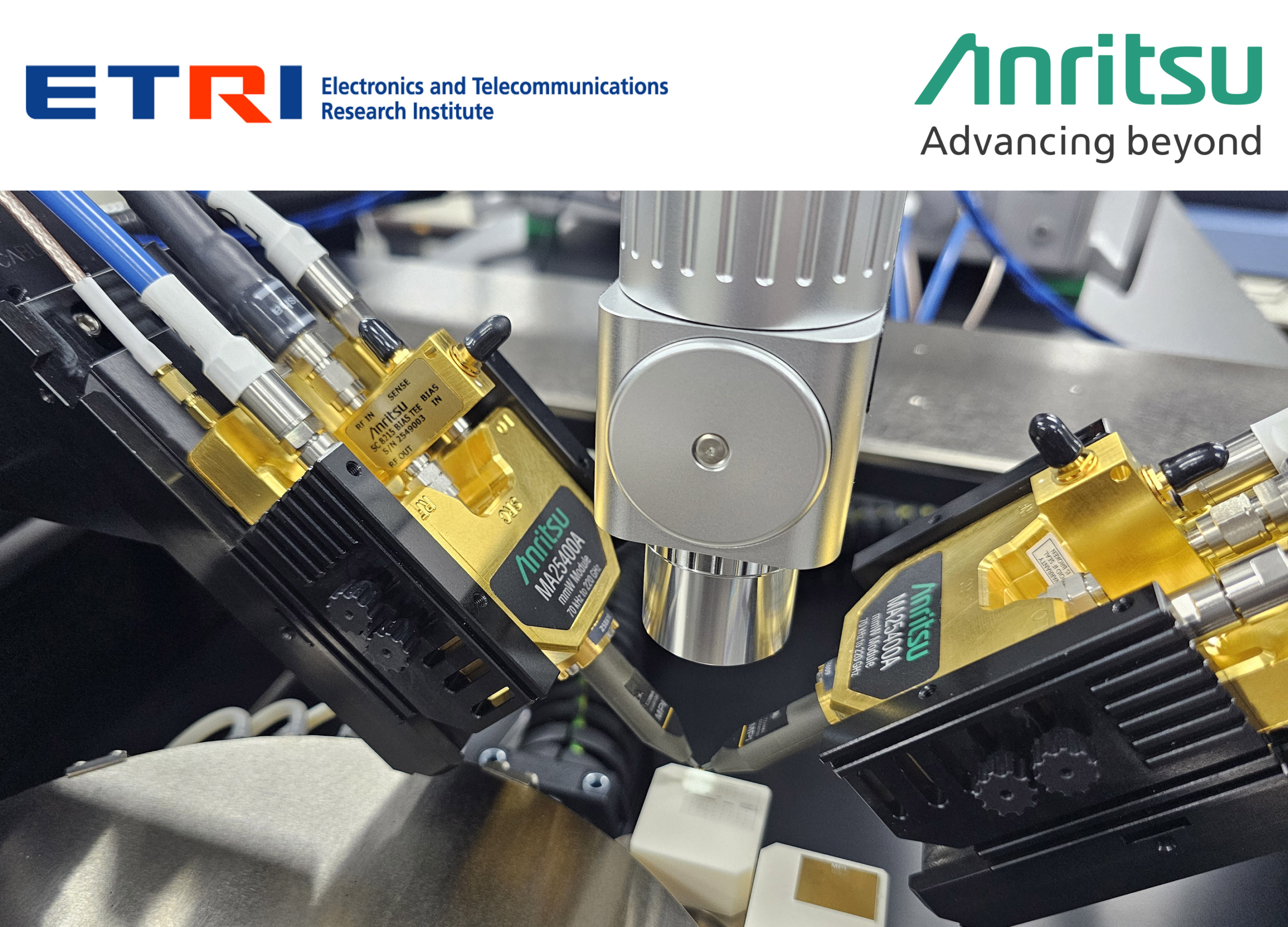
The system is being used for on-wafer measurement and design verification of high-frequency devices based on gallium-nitride monolithic microwave integrated circuits. VectorStar ME7838G supports single-sweep measurements to 220GHz, allowing engineers to examine a wide frequency range without moving the device between independent test systems as measurement frequency increases.
That continuity is important because useful semiconductor characterisation can extend well beyond a device’s intended operating band. Harmonics, parasitic effects, impedance behaviour, matching networks, and non-linear performance all influence whether measured hardware follows the model used during MMIC design, particularly as operating frequencies move further into millimetre-wave and sub-THz territory.
ETRI is conducting broadband measurements covering both operating and harmonic frequency ranges. The institute is using on-wafer techniques, where probes contact structures directly on the semiconductor wafer, reducing the influence of package and mounting effects and allowing measured behaviour to be compared more closely with device and circuit simulations.
The measurement becomes increasingly sensitive to the test environment as frequency rises. Probe contact, calibration, cable and waveguide behaviour, mechanical alignment, temperature, substrate characteristics, and small changes in the measurement plane can all alter the result. Switching between separate instrument configurations introduces another opportunity for variation because each setup may use a different calibration, probe arrangement, and connection path.
The ME7838G is intended to reduce that discontinuity by carrying measurements across a wide frequency range on one system. ETRI can therefore compare broadband measurement data with simulated results under more consistent conditions, helping engineers distinguish genuine device behaviour from changes introduced by the measurement configuration.
That does not remove the calibration problem. Sub-THz on-wafer work still depends on suitable calibration standards, repeatable probe contact, stable fixtures, and careful de-embedding if engineers are to isolate the behaviour of the MMIC from the measurement path around it. A broader single-system sweep instead removes one source of variability from an already sensitive process.
GaN makes that problem particularly relevant because the technology is used where high power density and high-frequency operation have to coexist. RF power amplifiers, radar electronics, satellite communications, and emerging communications research can all place GaN devices in operating regions where inaccurate models translate quickly into lost efficiency, reduced output power, instability, or excessive thermal loading.
Broadband characterisation therefore feeds directly back into model quality. Measured S-parameters and other RF data can be used to adjust compact models and electromagnetic simulations before a design is committed to packaging or a further fabrication iteration. The closer that relationship becomes, the more accurately designers can predict circuit behaviour before another wafer run.
Reproducibility also becomes a manufacturing question when research moves towards foundry-grade processes. Measurements have to be repeatable across wafers, lots, operators, and device revisions if engineers are to determine whether a change came from the semiconductor process, the MMIC design, or the test arrangement. A platform that produces highly operator-dependent results is of limited use for statistical process control or design-rule validation.
Anritsu identifies 6G and next-generation satellite communications as areas where broadband measurement and reproducibility will become increasingly important. Both push electronics towards wider bandwidths and higher carrier frequencies, increasing the proportion of the complete design problem that sits outside conventional microwave test ranges.
For ETRI, the more useful measure of the installation will therefore be correlation rather than frequency reach alone. A 220GHz ceiling extends the available measurement range, but the engineering value comes from obtaining repeatable broadband data that can be compared with simulation and reproduced as devices, wafers, and process conditions change.
That requirement is likely to become more demanding as experimental high-frequency devices move towards manufacturable systems. GaN process development, MMIC design, packaging, and RF measurement increasingly have to operate as one engineering chain, with characterisation data providing the evidence that a simulated circuit can be fabricated repeatedly and still behave as intended.