IN Brief:
- Nexora uses 3.2µm backside illuminated global shutter pixels in 12MP and 16MP versions operating at up to 240fps and 180fps respectively.
- Quantum efficiency reaches 73% at 550nm and 15% at 940nm, supporting lower-light and near-infrared imaging.
- Samples and documentation are available for the pre-production family ahead of customer camera integration.
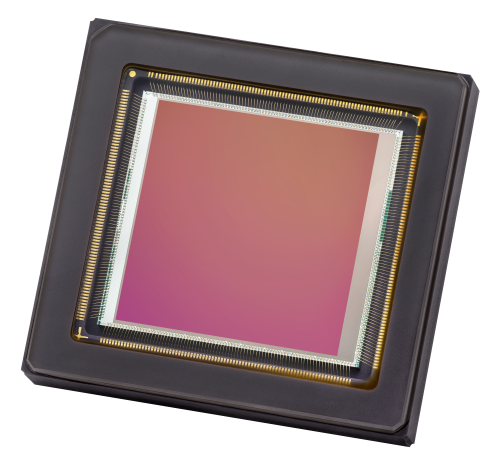
Teledyne e2v has introduced the Nexora family of backside illuminated global shutter CMOS image sensors, combining 12MP and 16MP resolutions with a 3.2µm pixel pitch, high frame rates, and compact packaging for machine vision and intelligent traffic cameras.
The 12MP device provides a 4,096 by 3,072 array and operates at up to 240 frames per second, while the 16MP version increases vertical resolution to 4,096 pixels and reaches up to 180 frames per second. Both are available in monochrome and colour versions and use global shutter exposure, allowing every pixel in the frame to capture the scene over the same time interval.
Global shutter operation avoids the geometric distortion that can appear when a rolling-shutter sensor captures different rows at different moments. That becomes important when an object, conveyor, vehicle, or camera is moving quickly. The sensor still has to balance noise, sensitivity, power, and readout bandwidth while transferring a large quantity of image data at high frame rate.
Nexora uses Teledyne e2v’s proprietary backside illuminated pixel technology. Moving the photosensitive region closer to the incoming light reduces obstruction above the photodiode and increases the amount of light reaching the detector compared with a conventional front-side illuminated structure. Teledyne specifies quantum efficiency of up to 73% at 550nm and 15% at 940nm, extending the operating range into lower-light and near-infrared conditions.
The family also uses a 3D stacked architecture, separating functions across multiple layers rather than requiring all circuitry to share the same plane. This provides greater freedom to optimise the pixel layer and supporting electronics independently while keeping the complete sensor compact.
Teledyne packages the devices in a 23 by 21.5mm format and targets 29 by 29mm cameras using standard C-mount optics. That combination allows higher-resolution imaging to move into established industrial-camera dimensions without forcing system builders towards substantially larger housings or optics solely because of the sensor package.
Image data is carried through an LVDS interface intended to work with a broad range of FPGAs and image signal processors. At 12MP and 240fps, raw pixel throughput becomes a major design constraint, so timing, buffering, FPGA resources, interface conversion, and downstream image processing have to scale with the optical front end.
Machine vision, intelligent traffic systems, outdoor surveillance, drones, and broadcast equipment are among the initial applications. Factory inspection places particular emphasis on deterministic exposure and detailed capture at production-line speed, while traffic and surveillance systems add wider lighting variation and stronger requirements around near-infrared response.
The higher quantum efficiency can reduce the illumination burden in inspection equipment or extend useful operation under low-light conditions, but complete camera performance will also depend on read noise, fixed-pattern behaviour, dynamic range, thermal design, and the optical system surrounding the sensor. Headline resolution and frame rate therefore define only part of the camera architecture.
Teledyne lists the 12MP and 16MP Nexora devices as pre-production products, with samples and documentation available for customer evaluation. Camera makers can begin checking FPGA compatibility, image quality, thermal behaviour, optics, and processing requirements before committing production platforms around the new devices.
The next useful evidence will come from complete camera implementations. The 3.2µm pixels, global exposure, quantum efficiency, and frame-rate figures establish a demanding sensor specification, but industrial adoption will depend on how consistently those characteristics survive the wider optical, electronic, and thermal design under real inspection and traffic conditions.