IN Brief:
- The EC11P replaces conventional DIP mounting with an SMD configuration suitable for automated PCB assembly.
- Alps Alpine specifies 30% higher signal detection performance than its conventional encoder products.
- Mass production is scheduled for November 2026, with automotive HMI among the principal intended applications.
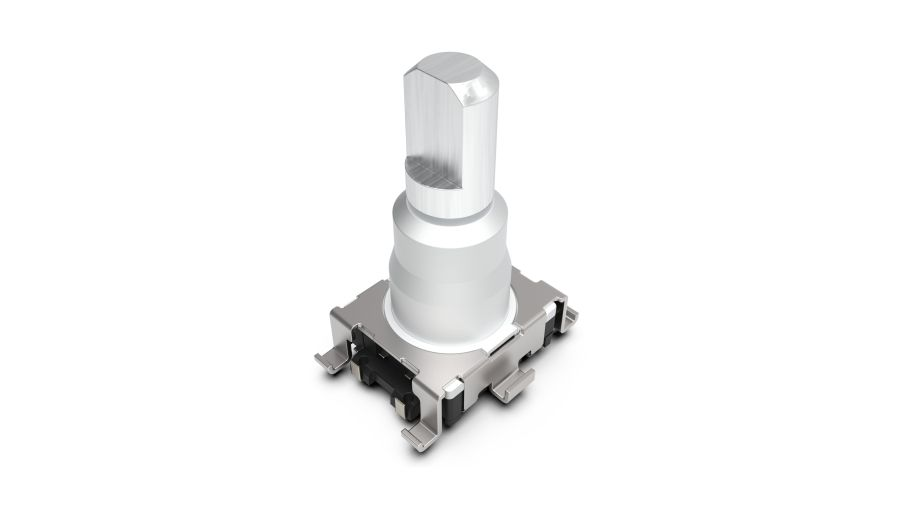
Alps Alpine is preparing its EC11P Series surface-mount rotary encoder for mass production in November, replacing the through-hole mounting traditionally used for this class of automotive control with a design compatible with automated PCB assembly.
The 11mm encoder is intended for automotive control panels and other human-machine interfaces. Its main manufacturing change is the move from dual in-line mounting, where terminals pass through the PCB before being soldered from the opposite side, to a surface-mount configuration that can enter the same automated placement process as other SMD components.
That removes a manual insertion stage which can otherwise remain as an exception on a largely automated electronics production line. A control board containing predominantly surface-mount devices may still require separate handling when one electromechanical component uses through-hole terminals, adding labour and another process step to the assembly flow.
The EC11P also removes the PCB holes required by the conventional mounting method. Alps Alpine says this gives designers more freedom over board routing and allows single-side mounting, creating opportunities to reduce the space or manufacturing complexity associated with the control interface.
Signal performance has been revised alongside the mechanical format. The company specifies a 30% improvement in signal detection performance compared with its conventional encoder products, intended to preserve stable detection as internal components wear through repeated use.
The EC11P1525402 variant provides 30 mechanical detents and 15 pulses per rotation. Detent torque is specified at 10 ±4mN·m, while the integrated push switch requires 4 ±2N operating force and provides 1.5 ±0.5mm travel.
The device measures 11.7 by 15.3 by 24.5mm and carries a 5V DC, 10mA rating. Alps Alpine specifies an operating temperature range from -40°C to 85°C, with both rotary life and push-switch life rated at 100,000 operations.
Those characteristics keep the component firmly within physical HMI rather than replacing mechanical controls with touch sensing. Vehicle interiors increasingly combine large displays with software-defined functions, but rotary controls remain useful where the driver needs tactile feedback or wants to change a setting without maintaining visual attention on a screen.
Manufacturing compatibility can therefore extend the life of the mechanical interface without preserving the assembly method around it. Moving the encoder to SMD lets the physical control remain in the cabin while making its PCB assembly closer to the automated process used for the surrounding electronics.
The environmental argument also comes from production rather than vehicle operation. Conventional DIP mounting can use liquid flux during soldering, followed by waste handling and cleaning. Alps Alpine says the SMD configuration reduces flux consumption and consequently lowers the associated waste and wastewater burden.
The company also lists projectors, microwave ovens, washing machines, and other control interfaces among the possible applications, although automotive HMI is the principal focus of the EC11P development. The same manufacturing problem appears wherever a mechanical rotary input interrupts an otherwise surface-mount assembly process.
Alps Alpine began promoting the component ahead of mass production to give customers time for mechanical and electrical evaluation. That qualification matters for automotive applications because the mounting change has to preserve tactile behaviour, electrical detection, and operating life across the temperature and vibration conditions expected in the finished control panel.
The EC11P does not introduce a new type of human interface. Its engineering value lies in removing an old manufacturing constraint from an established one. Through-hole rotary encoders have remained useful because of their mechanical characteristics, but manual insertion becomes increasingly awkward as the rest of the PCB moves through automated placement and reflow.
With production scheduled for November, the practical test will be whether the SMD format gives automotive electronics manufacturers the expected assembly savings without compromising the feel and lifecycle performance that keep mechanical encoders in vehicle controls in the first place.