IN Brief:
- CUbIQ packages continuous-variable quantum key distribution into the established QSFP-28 pluggable form factor.
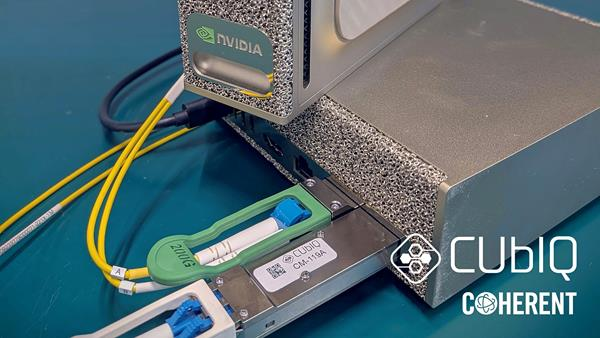
- The demonstration runs beside Coherent 200G FR4 optics on an NVIDIA DGX Spark through its ConnectX-7 interface.
- The proof of concept tests whether quantum key distribution can be added without rebuilding the underlying AI network.
CUbIQ Technologies and Coherent have demonstrated continuous-variable quantum key distribution in a QSFP-28 pluggable, running the security channel alongside 200G datacentre optics on an NVIDIA DGX Spark without modifying the existing host-network architecture.
The proof of concept combines CUbIQ’s CV-QKD module with Coherent 200G FR4 OSFP56 optical transceivers and an NVIDIA DGX Spark using its ConnectX-7 interface. CUbIQ is presenting the system as a route to introduce quantum key distribution into AI infrastructure without the dedicated rack equipment traditionally associated with QKD installations.
Quantum key distribution addresses how encryption keys are established rather than replacing the encryption protecting the data itself. An optical quantum channel is used to derive key material, while interference with that channel changes measurable properties of the signal and can expose an interception attempt.
CUbIQ uses continuous-variable QKD, which encodes the quantum information on properties of coherent optical signals. The approach can draw on components and techniques closer to conventional optical communications than systems based around individual photon detection, making integration into recognised transceiver formats an important part of its commercial argument.
The QSFP-28 package provides a familiar mechanical and electrical integration point, but fitting the hardware into a standard module does not make QKD equivalent to an ordinary data transceiver. Optical loss, calibration, key management, monitoring, and security policy still have to be handled alongside the normal network operations around the port.
In the ECOC demonstration, the QKD module operates through dense wavelength division multiplexing beside Coherent’s production data optics. The host platform is a commercially available DGX Spark connected through ConnectX-7, with the companies stating that the underlying deployment required no modification.
That coexistence matters because a security layer requiring a second dedicated optical network would be difficult to justify across large AI campuses. Back-end fabrics increasingly connect accelerators and servers between racks, buildings, and sites, extending high-value traffic over fibre outside the immediate compute enclosure.
Conventional line encryption already protects that traffic, and quantum key distribution should not be treated as a substitute for established cryptographic controls. Its contribution lies in the key-distribution mechanism and the ability to detect disturbance of the quantum channel. Whether that additional property justifies the operational complexity will depend on the threat model and the value of the information being carried.
The demonstration also sits alongside the industry’s move towards post-quantum cryptography. PQC and QKD address the risk from future quantum computing in different ways: post-quantum algorithms change the mathematics used for cryptographic operations, while QKD uses properties of the physical communications channel to establish keys. A system may employ one, the other, or both.
CUbIQ and Coherent say the pluggable approach substantially reduces the space, power, and cost associated with traditional rack-based QKD systems. Those are supplier claims from the proof-of-concept programme rather than production benchmarks, and the more important engineering evidence will come from sustained operation over realistic network loss and distance.
Reach, temperature stability, key-generation performance, connector variation, and management integration remain important before the technology can move from a trade-show system into routine infrastructure. A module that fits a standard port still has to survive the same maintenance environment and availability expectations as the data optics beside it.
The current demonstration establishes that CV-QKD can share recognisable AI-network hardware with production optical links. The next step is to show that the same integration remains practical outside a controlled demonstrator, where link loss, network changes, and operational support become less predictable.