IN Brief:
- The Qualcomm QCS6490 platform provides up to 12 TOPS of onboard AI processing below 10W.
- Five MIPI-CSI connections and industrial I/O support cameras, sensors, LiDAR, and flight controller integration.
- Ubuntu, ROS 2, PX4, ArduPilot, and MAVLink support target production autonomous UAV development.
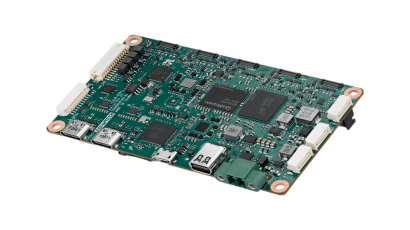
Advantech has launched the ASR-D501, a compact companion and mission computer for autonomous drones combining Qualcomm’s QCS6490 processor with local AI acceleration, multiple camera inputs, and flight controller connectivity.
The 100mm by 60mm board delivers up to 12 TOPS of AI processing within a power envelope below 10W. Its QCS6490 combines Kryo CPU cores, Adreno graphics, and an NPU, supported by 8GB of LPDDR5 memory and 128GB of UFS storage.
Five four-lane MIPI-CSI interfaces provide connections for camera systems, while 2.5GbE, two USB 3.2 Gen 2 Type-C ports, CAN FD, UART, I2C, and GPIO support additional sensors, LiDAR, battery systems, communications equipment, and flight-control hardware.
Wireless connectivity can be added through M.2 expansion, with support for Wi-Fi 6E, Bluetooth, and 4G or 5G cellular connections alongside an onboard Nano-SIM. The configuration allows telemetry, command links, video transfer, and remote mission functions to be integrated without placing every communications interface on the main board.
Advantech supplies the platform with Ubuntu 24.04 LTS and its Robotic Suite for Drone. The software environment connects ROS 2 applications with PX4 and ArduPilot flight-control ecosystems through MAVLink, MAVSDK, and MAVROS, with reference workflows covering perception, localisation, sensor fusion, mapping, object tracking, and path planning.
The companion computer sits alongside rather than replacing the aircraft’s primary flight controller. Stabilisation and actuator control can remain on dedicated real-time hardware, while the ASR-D501 handles workloads such as vision inference, mapping, route planning, and mission logic.
Separating those functions helps prevent intensive AI processing from competing directly with the deterministic control loops needed to keep an aircraft stable. It also allows the perception computer to evolve independently as models and sensors change, provided interfaces with the flight controller remain consistent.
Local inference reduces the amount of raw sensor information that has to leave the aircraft. Several high-resolution camera feeds can create substantial bandwidth and latency requirements if every frame is sent to a remote server, particularly during inspection, mapping, or autonomous missions where communications coverage varies.
Processing those streams onboard allows the aircraft to transmit detections, position estimates, selected imagery, or other derived information instead. The available 12 TOPS still has to be divided between vision models and other workloads, making model optimisation, memory traffic, input resolution, and sustained thermal performance more important than the accelerator’s headline figure alone.
The board weighs approximately 50g without its heatsink and accepts a 5V to 12V DC input. Advantech specifies fanless operation, a -20°C to 70°C operating range, 3.5Grms vibration resistance, industrial ESD protection, and lockable connectors.
Those mechanical and environmental specifications are central to airborne integration because compute capability cannot be separated from weight, heat, and battery endurance. Additional cooling, shielding, cabling, and communications hardware all consume mass and electrical power that remain on the aircraft throughout the mission.
The ASR-D501 extends Advantech’s wider development of local industrial compute platforms into a substantially tighter size, weight, and power envelope. The company is also developing UAV products around OSM and SMARC modules and higher-performance Qualcomm processors, giving system designers several compute levels rather than one common board for every aircraft.
The practical advantage of the new platform will depend on how much integration work its interfaces and software environment remove from an autonomous-drone programme. A compact AI board can shorten hardware development, but production deployment still requires thermal design, sensor calibration, power integration, communications, software validation, and environmental qualification across the complete airframe.