IN Brief:
- The proposed 1.6T cable maps 200G electrical lanes onto multiple lower-rate optical paths using NRZ modulation.
- Credo targets 12W per active cable end, up to 50 metres of reach and a 100-million-hour MTBF design goal.
- Commercial shipments are planned for 2027; independent reliability and full deployment measurements were not disclosed.
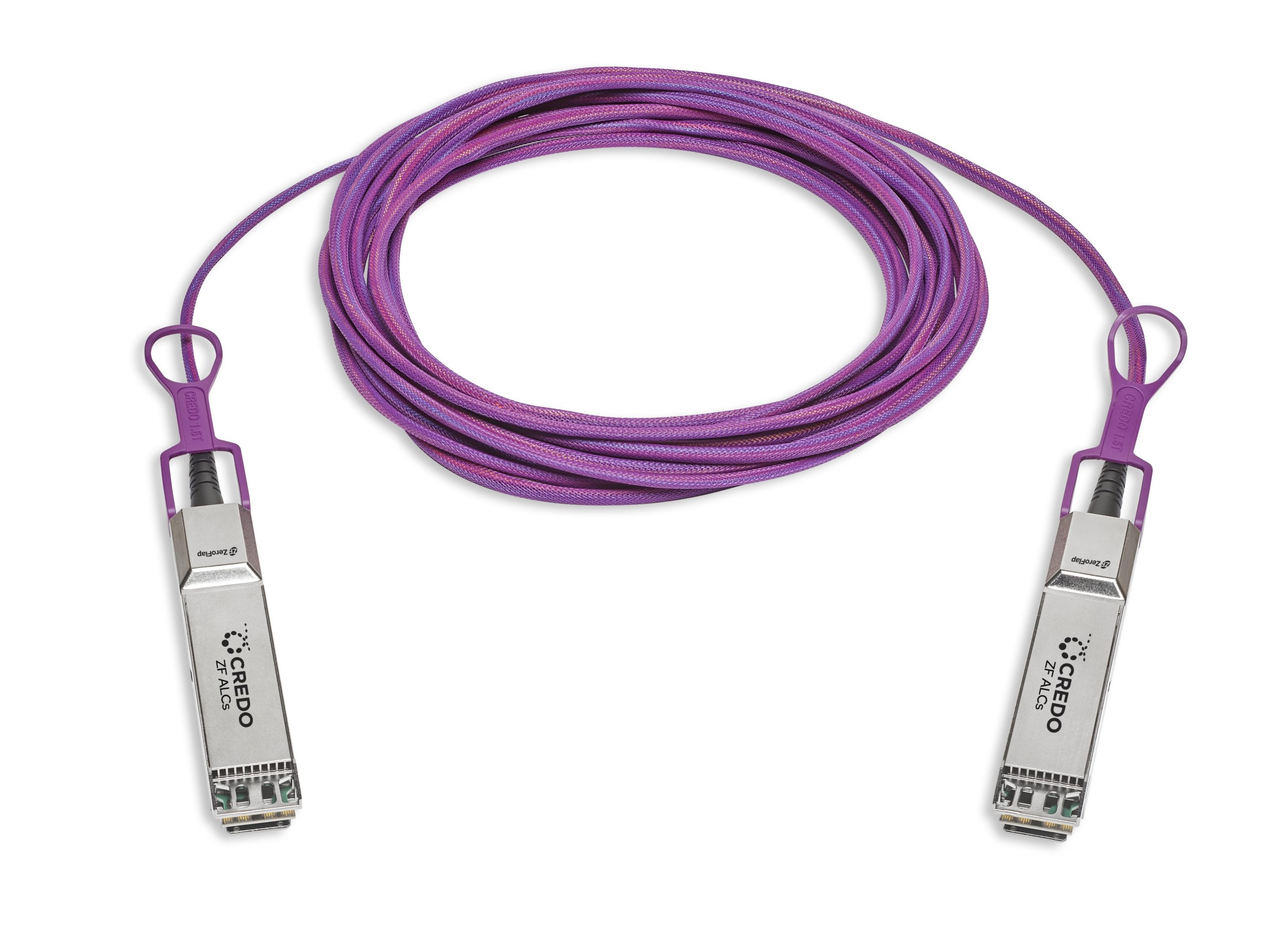
Credo has outlined a 1.6T ZeroFlap active light cable that divides fast electrical connections into numerous lower-rate optical channels. The design uses dense arrays of emitters and photodetectors with flexible fibre bundles, targeting links across a row of AI computing equipment rather than only the short connections within a rack. Credo expects to ship the product in 2027 and has specified target figures for distance, power and reliability.
The architecture takes incoming 200G electrical lanes and distributes their data among many optical paths using non-return-to-zero, or NRZ, signalling. Each optical channel represents the signal with two levels instead of the multiple amplitudes used by high-speed PAM4 links. Distributing traffic across more lanes can reduce the rate required of each emitter and receiver, but it also increases the number of physical channels that have to be coupled, monitored and packaged reliably inside the assembly.
Credo is seeking to avoid some of the signal-processing overhead associated with faster conventional optical transceivers. Lower-rate optical channels can operate with simpler modulation and may need less complex compensation, although synchronising the parallel paths and meeting the electrical interface requirements still need careful design. The energy consumed by the complete cable also includes transmit and receive electronics, clocking, channel control and optical coupling, so modulation choice alone does not determine power efficiency.
The company quotes a design target of 12W at each active end, equivalent to around 24W for both ends before any wider host-system overhead. It claims approximately 30% less power than comparable active electrical cables and a cable assembly one-tenth the weight. These are manufacturer comparisons, not independently established savings across installed racks. Their practical significance depends on cable length, configuration, cooling conditions and whether the same amount of data is carried by each system under comparison.
With intended reach of up to 50 metres, the cable is aimed at distances where passive copper becomes more difficult to use at very high data rates. Active copper can extend useful reach through signal conditioning, but its electrical losses and physical bulk increase as links become longer and denser. Conventional pluggable optics can reach farther, with different conversion and packaging costs. Credo is positioning the active light cable between those approaches, rather than claiming to replace every copper or optical connection in a data centre.
Spare optical channels, link monitoring and event logging are intended to let the assembly respond to failures of individual paths without interrupting the aggregate connection. Credo calls this hitless failover and has set a mean time between failures (MTBF) target of 100 million hours. That figure is a statistical design goal for reliability, not the expected working life of one cable or evidence of fault-free operation across an installed fleet. The company has not supplied an independently verified failure-rate study for the forthcoming product.
An architecture with many parallel optical channels must also manage common failure modes. Spare channels may compensate for one optical path, while faults affecting shared power, control electronics, the connector or a fibre bundle can have broader consequences. Fibre alignment, emitter yield and connector repeatability are therefore part of achieving the claimed link reliability. A complete failure mode analysis, system-wide bit error measurements and long-duration temperature and handling tests will be needed to assess the claimed reliability.
The physical approach is different from optical developments that multiplex several wavelengths over fewer fibres. Wavelength-division designs distinguish optical channels by their carrier frequencies; ZeroFlap instead emphasises many separate emitter and detector paths. Both can raise aggregate capacity, but they distribute complexity differently across the optical package, electrical interface and production testing process.
Credo’s wider ZeroFlap portfolio also includes active electrical cables and optical transceivers. The new active light cable instead integrates a pluggable cable assembly with dedicated parallel optical paths. Selecting between the approaches will involve reach, endpoint compatibility, power, physical routing and diagnostics as well as nominal link rate.
Credo plans to show the new cable architecture during the 2026 Open Compute Project Global Summit in San Jose, ahead of targeted shipments in 2027. Equipment designers will need final connector and endpoint specifications, qualification data and ordering information before assessing it against electrical cables and conventional pluggable optics for particular deployments.