IN Brief:
- Delta claims the enclosed inner-rotor EC motor is nearly 30% smaller than its predecessor and has losses 20% below its IE5 reference.
- Newly presented configurations include HVDC coolant pumps and EC pumps with integrated conversion and motor control.
- Delta reports weight savings up to 30% for selected integrated pumps; no customer deployment of these configurations was announced.
Delta Electronics has announced a next-generation electronically commutated motor and integrated pump configurations for HVAC, industrial and data centre cooling. Presented on 14 October during Chillventa 2026 in Nuremberg, the designs include a smaller enclosed inner-rotor motor, a high-voltage DC coolant pump and EC pumps combining their motor control and power conversion inside the pump assembly. The announcement concerns newly presented technology and portfolio configurations, without identifying customer deployments.
Delta says its motor is nearly 30% more compact than the preceding design. It also claims losses 20% below an IE5 reference, describing performance beyond an IE6-equivalent efficiency benchmark. Those comparisons are manufacturer statements whose precise values depend on the reference motor and test conditions. A percentage reduction in motor losses does not translate directly into the same reduction in electricity consumption across an entire fan or cooling plant.
The enclosed inner-rotor design targets high-airflow axial fans and high-pressure blowers, where the motor must operate as part of a complete aerodynamic system. Fan power is influenced by impeller geometry, rotation speed, pressure differential and the system resistance encountered in ductwork or cooling equipment. Improving motor efficiency can reduce electrical losses, but the overall energy result also depends on the fan’s operating point and the way its speed is controlled.
Delta specifies IP66 protection and enhanced surge protection for the new motor, together with operation at full load in ambient temperatures up to 70°C. These conditions relate to the motor configuration described in the announcement. The wider fan and pump portfolio contains model-dependent ratings, so environmental or temperature specifications should not be applied interchangeably to every product.
Control and diagnostic options include Bluetooth parameter adjustment, vibration monitoring and a local LED status indicator. Monitoring vibration can support investigations into changes in bearings, mounting conditions or imbalance, provided there is a suitable operating baseline. It is not equivalent to a verified prediction of remaining component life, and diagnostic alarms still require interpretation in the context of the complete machine.
The EC fan portfolio is also aligned with European ErP 2026 requirements. Delta states that selected designs maintain total harmonic current distortion below 5%, a characteristic relevant to installations containing many electronically driven fans connected to a common electrical supply. Harmonics depend on drive topology and operating conditions; equipment selection must still account for power quality at system level. Delta attributes efficiency gains of approximately 8–10% and noise reductions of 2–3dBA to optional diffusers at specified operating points, not to all installations.
The newly presented HVDC pump targets coolant circulation in cooling distribution units serving liquid-cooled computing infrastructure. High-voltage DC distribution is being evaluated for dense AI equipment because it can alter the number and placement of conversion stages between incoming electrical power and the final load. Delta has previously worked on 800V cooling architectures; the October announcement extends that work with additional pump designs rather than establishing the company’s first HVDC cooling system.
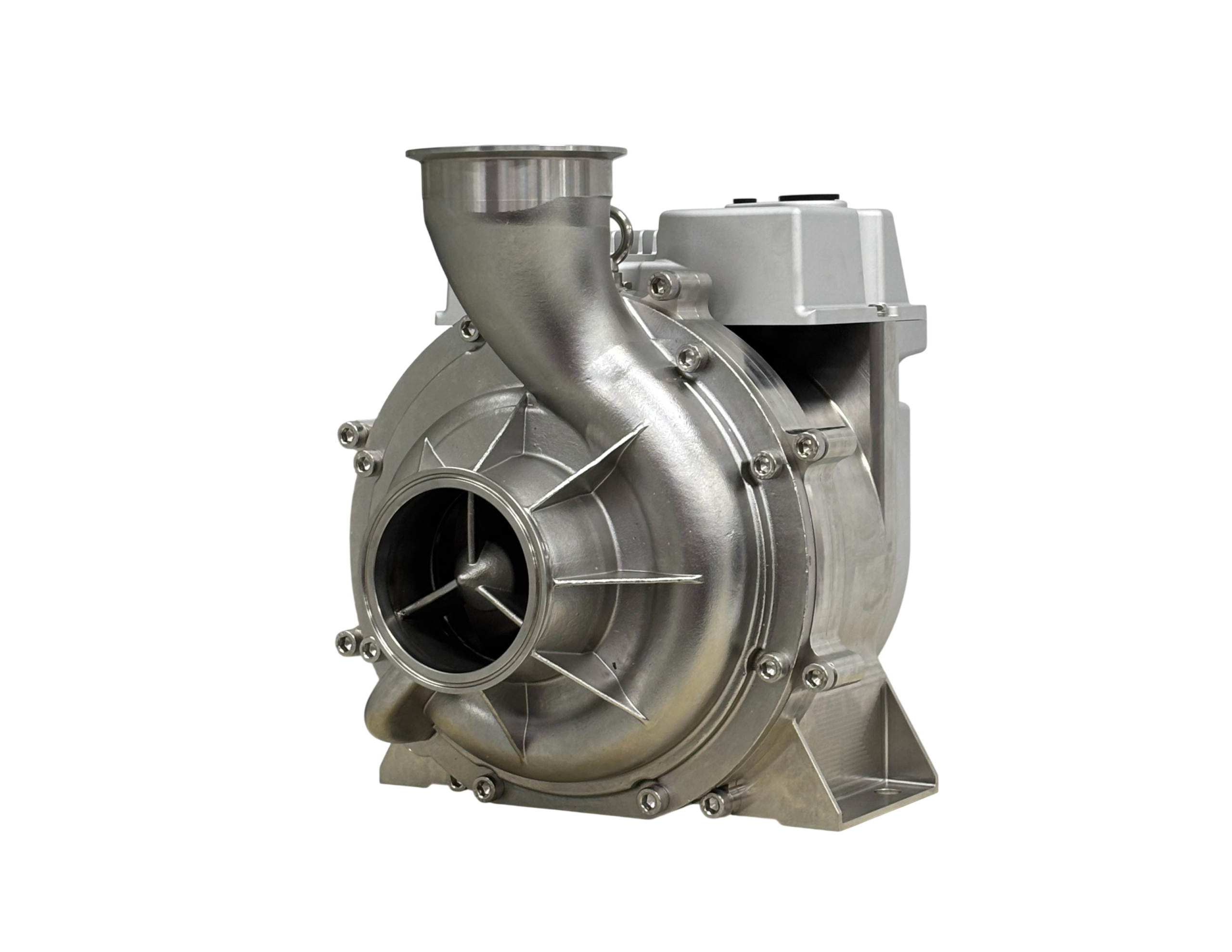
Integrated EC pump configurations combine motor control and power conversion within the pump assembly. Removing a separate external controller can reduce wiring, free space inside a CDU and simplify mechanical integration in compact in-rack or in-row equipment. Delta claims weight savings of up to 30% relative to unspecified comparable market offerings. That comparison is not independently benchmarked and should not be used as a guaranteed saving for a particular pump duty.
The portfolio also includes 48V DC versions and, depending on the model, claimed brushless motor efficiency above 85%, IPX6 protection and operating temperature limits from -10°C to as high as 85°C. Different ratings may apply to different pumps. A system designer must match flow, pressure, coolant compatibility, ambient temperature and electrical input requirements to the exact unit selected.
Integrating drive electronics does not remove the need for thermal management, electrical protection or safe servicing procedures. HVDC connections require particular attention to isolation and interruption of fault currents, while compact pump modules must still dissipate electrical and mechanical losses. Delta has not published independently verified system-level energy savings or completed customer installations for the latest configurations. Product-level performance will need to be evaluated at the coolant flow and pressure required by each installation.