IN Brief:
- Quantinuum measured 99.9995% logical memory fidelity per syndrome-extraction cycle using a distance-seven colour code on its Helios trapped-ion processor.
- Logical memory errors declined by an average factor of 12 for each tested increase in code distance, while Clifford gate errors showed an average suppression factor of nine.
- The result improves on Quantinuum's September error-correction measurements, but Apollo remains a planned fault-tolerant computer targeted for 2029.
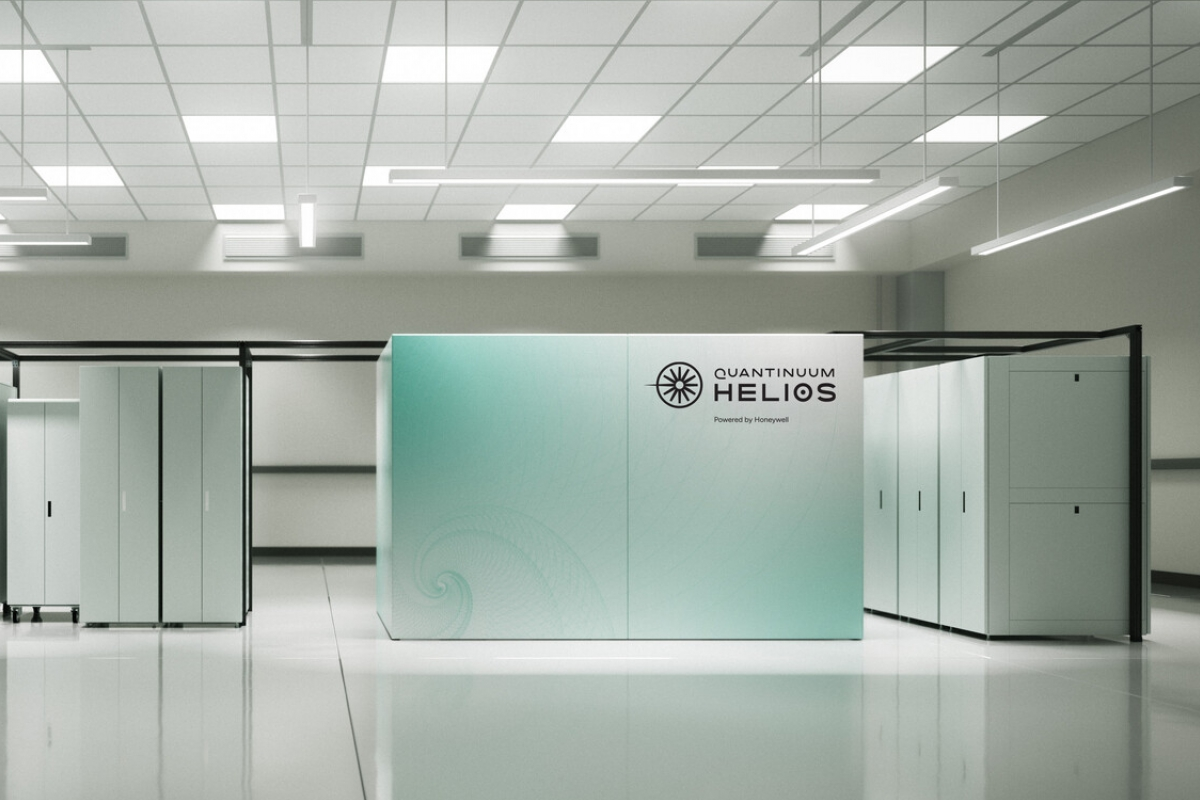
Quantinuum has reported logical memory fidelity of 99.9995% on its Helios trapped-ion quantum computer using a distance-seven error-correcting colour code. The measurement corresponds to an estimated logical failure probability of five in one million syndrome-extraction cycles under the tested conditions, improving on the company’s previous error-correction results reported in September.
Announced on 19 October, the experiment investigated whether increasing the strength of quantum error correction produces a sustained reduction in remaining logical errors. Quantinuum tested colour codes at distances three, five and seven, observing an average twelvefold reduction in logical memory error rate for each successive increase in code distance.
The company separately reports an average suppression factor of nine for logical Clifford gate errors. These measurements concern different operations and must not be combined into a single error rate for a complete quantum algorithm. The 99.9995% figure specifically describes logical memory fidelity per error-correction cycle, rather than the success probability of an arbitrary computation involving many gates.
Quantum processors are vulnerable to disturbances that affect the state of their physical qubits. Imperfect control operations, measurement errors, environmental interactions and unwanted changes in the quantum state can corrupt information before a computation is completed. Reliable quantum processing requires these errors to be suppressed or corrected sufficiently often to preserve the intended calculation.
Conventional digital systems commonly protect stored information by adding redundancy and checking for inconsistencies. Quantum systems cannot simply copy arbitrary unknown quantum states in the same way. Quantum error correction instead encodes logical information across multiple physical qubits and uses carefully constructed measurements to obtain information about errors without directly measuring the protected logical state.
Those measurements are known as syndrome extraction. They provide information about the presence and type of errors affecting the encoded system. A decoder interprets the results and determines how the system should compensate for detected faults while preserving the encoded quantum information.
The error-correction code determines which relationships between qubits are measured and how many physical resources are needed to protect a logical qubit. In colour codes, information is represented using arrangements of physical qubits and associated measurements that can detect selected errors. The exact implementation depends on the code geometry and the capabilities of the quantum hardware.
Code distance describes the protection provided by an error-correcting code against certain combinations of faults. Increasing the distance can allow the encoded information to tolerate more physical errors, but generally requires additional physical qubits and more error-checking operations.
Adding protection therefore has a cost. Larger codes consume more hardware resources and generate additional measurement information that must be processed. The extra operations can themselves introduce errors, so an increase in code distance is useful only when the underlying physical hardware operates accurately enough for the additional protection to outweigh that burden.
The latest Helios experiment tested this relationship directly. Quantinuum reports that logical memory errors declined as code distance increased from three to five and then seven, with an average suppression factor of 12 per tested step. This measured scaling provides evidence that the physical operations were sufficiently accurate for stronger protection to improve logical reliability under the experimental conditions.
The distance-seven result corresponds to a logical error probability of approximately 5 × 10⁻⁶ per syndrome-extraction cycle. Expressed as a percentage, the resulting fidelity is 99.9995%. The value is an estimate derived from repeated experimental measurements, rather than a claim that precisely five errors were observed during a completed million-operation application.
Longer quantum computations introduce additional challenges because stored information must undergo logical operations, measurements and interactions with other encoded qubits. A processor that preserves one logical memory with a very low error rate has demonstrated an important capability, but that result alone does not establish that a large universal algorithm can execute without failure.
Quantinuum’s Helios hardware uses trapped ions as physical qubits. Charged atoms are confined by electromagnetic fields, with controlled operations used to prepare, manipulate and measure their quantum states. Maintaining consistent behaviour requires stable trapping conditions, precise control and reliable measurement across the relevant physical qubits.
The processor uses a quantum charge-coupled device architecture in which ions can be transported within the trapping system. This provides a way to arrange interactions between physical qubits, although ion movement and control introduce engineering requirements concerning timing, heating, calibration and the accuracy of subsequent operations.
Quantinuum’s error-correction system combines hardware control, syndrome measurements and software decoding. The time required to interpret measurement information becomes increasingly important as the number of encoded qubits grows. Decoding must remain sufficiently fast to support the intended sequence of operations without creating unacceptable delays in the wider computation.
The new colour-code measurements follow Quantinuum’s September experiment using its Helix code on the same Helios hardware. The two code families have different resource requirements and error characteristics. Quantinuum says the Helix approach used ten physical qubits per logical qubit, while its comparison with colour-code implementations identifies configurations using up to 37 physical qubits per logical qubit.
Those comparative figures describe particular encoded configurations rather than a universal physical-qubit requirement for every distance or experiment. The more demanding colour-code protection reduced the measured logical error rate, demonstrating a trade-off between hardware resources and the level of reliability obtained.
Using different codes on the same quantum hardware allows the company to investigate how code structure, measurement scheduling and decoding affect logical performance. Quantinuum also describes adaptive syndrome extraction and techniques for connecting code structures as part of its wider error-correction development programme.
Comparisons between different quantum-computing platforms require care because experiments can use different hardware, code structures, measurement procedures and definitions of logical operation. Quantinuum reports a tenfold improvement on its own September result and a reduction exceeding a factor of 100 against a cited superconducting benchmark. These are the company’s comparisons under the respective published test conditions, not a general ranking of all possible quantum workloads.
The October experiment is also distinct from Quantinuum’s earlier semiconductor manufacturing programme, which concerns fabrication of future ion-trap devices and supporting electronics. The new measurements address error correction on an existing operational processor rather than a change in its manufacturing process.
Quantinuum is developing Apollo as its planned universal fault-tolerant quantum computer, with availability targeted for 2029. The company argues that its error-correction approach could reduce the physical resources needed to reach useful reliability levels. That projection remains dependent on extending the experimental results to more logical qubits, suitable logical gates, associated control systems and complete computational workloads.
The next engineering tests will establish whether the measured suppression of errors can be maintained as logical processing and system size increase. The Helios experiment demonstrates improved logical memory protection under specified conditions; universal fault-tolerant operation remains a separate system-level milestone.