IN Brief:
- TDK has introduced the B3201 Y1 metallised polypropylene capacitors for line-to-ground EMI suppression.
- The series spans 0.47–33 nF and 15 mm or 22.5 mm lead spacing, with a 500 V AC rating up to 110°C.
- Operation above 110°C requires voltage derating of 1.5% per degree and is limited to 1,000 hours.
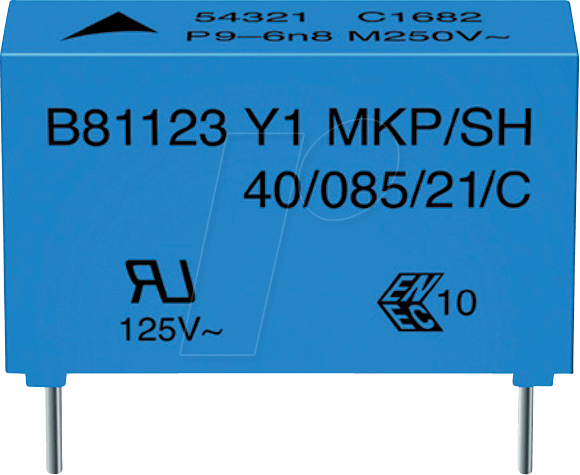
TDK Electronics has introduced compact Y1 safety capacitors intended for line-to-ground electromagnetic interference suppression in automotive and industrial power electronics. The B3201*A5/B5/C5 series uses metallised polypropylene film and is rated at 500 V AC or 1,500 V DC under the specified temperature conditions.
The range covers capacitance values from 0.47 nF to 33 nF, with 15 mm and 22.5 mm lead spacings. TDK identifies electric vehicle charging equipment, industrial drives, power supplies, renewable energy converters, and energy storage systems among the applications that can use the new components.
Line-to-ground capacitors are used in interference suppression circuits to divert unwanted high-frequency electrical noise through a defined path. Their position in the circuit creates safety requirements beyond those normally associated with a general-purpose capacitor, because failure or excessive leakage can affect the protection provided by the equipment.
Y-class safety capacitors are designed and approved for use in specified connections involving earth or insulation barriers. A Y1 classification concerns the component’s applicable safety requirements and intended use, but does not establish the insulation design or regulatory conformity of the complete product. Engineers must still select suitable creepage distances, clearances, protective connections, and other safety measures.
TDK has used a metallised polypropylene construction, commonly described as MKP. The film structure supports self-healing behaviour in which certain local dielectric faults can be isolated by clearing a small region of metallisation. That mechanism can limit the consequences of particular internal defects, although it does not permit operation outside the published electrical and environmental ratings.
Physical dimensions vary across the family. The smaller B32012 versions use 15 mm lead spacing, with the smallest package measuring 5.0 × 10.5 × 18.0 mm and capacitance values extending to 10 nF. B32013 devices use 22.5 mm lead spacing, with the range extending to 33 nF and a minimum package size of 6.0 × 15.0 × 26.5 mm.
The parts use parallel wire leads for through-hole mounting and are available untaped or in ammo-pack and reel formats. Lead spacing, component height, and the assembly process all influence whether a particular value will fit an existing board design. The smallest quoted dimensions should not be assumed to apply to every capacitance option.
The headline 125°C operating capability carries an important restriction. TDK specifies continuous operation at the full 500 V AC or 1,500 V DC rating only up to 110°C. Above 110°C, voltage must be reduced by 1.5% for every additional degree Celsius, and operation in that elevated temperature range is limited to a maximum of 1,000 hours.
At 125°C, the required reduction is therefore 22.5% relative to the specified voltage rating. A designer cannot treat the upper temperature limit as an unrestricted continuous rating at full voltage. The final selection needs to account for worst-case component temperature, operating voltage, and the expected cumulative time spent above 110°C.
Such restrictions are particularly relevant in power conversion equipment where capacitors may be located near transformers, magnetic components, and switching semiconductors. Local temperature can be higher than the surrounding air, while enclosure conditions and the duration of high-load operation affect the stress experienced by the component.
TDK reports temperature, humidity, and bias testing at 85°C and 85% relative humidity while applying 500 V AC for 500 hours. This assesses durability under combined environmental and electrical stress, but is distinct from the 1,000-hour operating limit specified for use above 110°C. The two durations refer to different conditions and cannot be interchanged.
The components comply with AEC-Q200 Revision E requirements and have safety approvals according to IEC/EN/UL 60384-14, CSA E60384-14, and GB/T 6346.14. Their plastic cases and epoxy sealing meet UL 94 V-0 flammability requirements. Automotive qualification addresses passive component robustness, while safety approval addresses the applicable electrical safety characteristics of the capacitor.
Capacitance selection remains part of the interference filter design. Increasing capacitance can help attenuate unwanted noise at certain frequencies, but it also influences leakage current and the filter’s behaviour across its operating range. Engineers must consider the complete filter network and the applicable equipment standard rather than select the largest available value automatically.
The B3201 series adds compact Y1-rated options for converters and other high-voltage systems with constrained board space. Its value for an individual design will depend on the required interference attenuation, package dimensions, safety classification, and the voltage and temperature conditions the component must withstand.