IN Brief:
- Electroninks and Integrated Deposition Solutions manufactured more than 100 multilayer printed aerospace heaters during a three-week production run.
- Every tested device met the specified 30 Ω ±3 Ω resistance requirement, while the companies reported manufacturing yield approaching 100%.
- Integrating conductive and insulating material processing on the IDS NanoJet Gen2 reduced production time per device by 73%; environmental reliability testing remains underway.
Electroninks and Integrated Deposition Solutions have reduced the production time for multilayer printed electronic heaters by a reported 73% during a three-week manufacturing programme. The companies produced more than 100 devices for aerospace applications, with every tested unit meeting an electrical resistance target of 30 Ω within a tolerance of ±3 Ω.
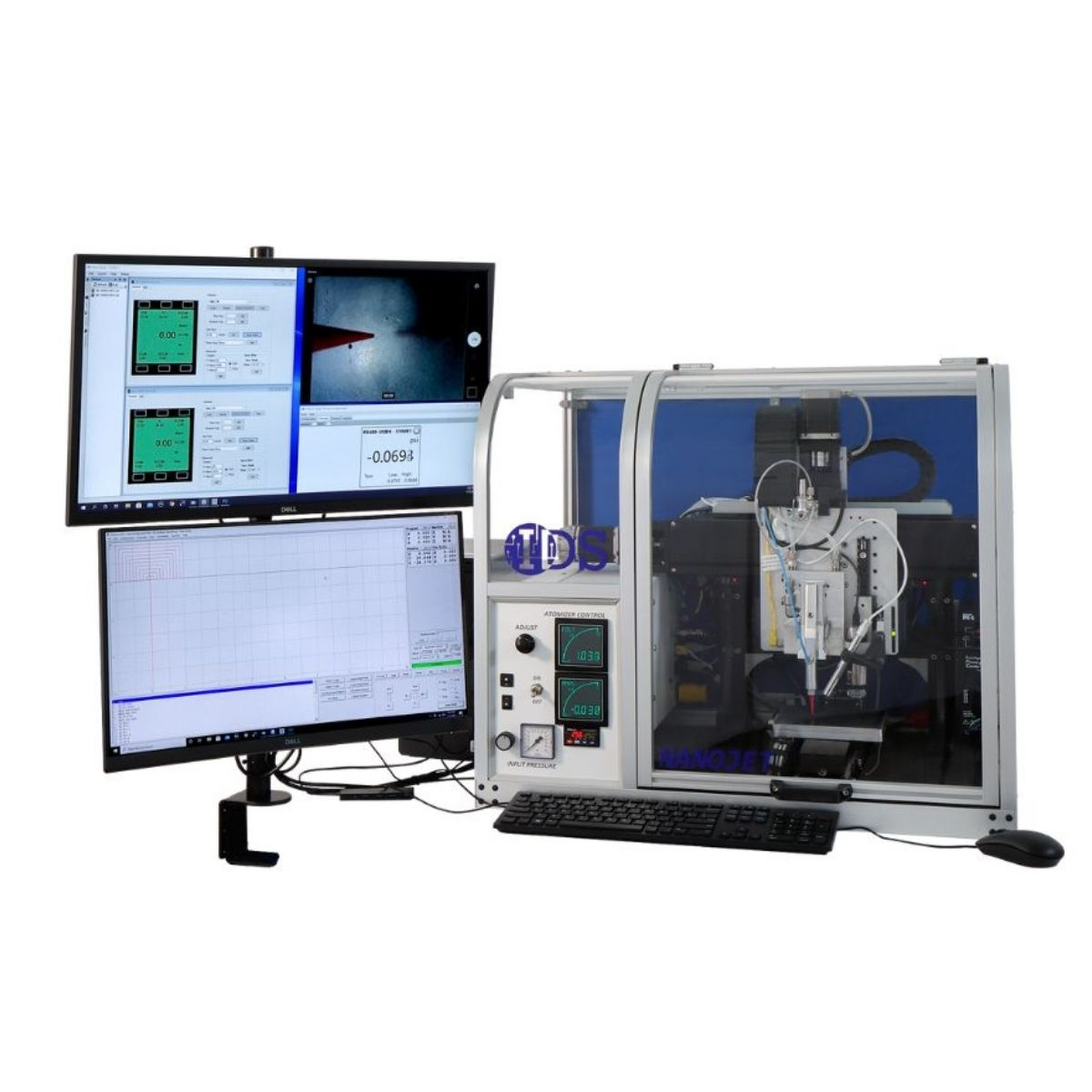
The results were announced on 19 October following joint development of a production process using Electroninks conductive and insulating materials on an IDS NanoJet Gen2 aerosol printing system. The process incorporates material deposition and curing directly into the printing equipment, removing separate oven operations used during the earlier manufacturing sequence.
The programme addresses the production of electronic structures using deposited functional materials rather than conventional subtractive circuit fabrication. In printed electronics, conductive and insulating features are built up on a substrate through controlled material deposition, allowing electrical structures to be formed according to programmed geometries.
Printed heaters provide a defined application for evaluating the process because their electrical resistance can be measured and compared against a target. The conductor geometry and material properties determine how much current flows at a given applied voltage, influencing the electrical power converted into heat.
For a resistive heater operating from a fixed voltage supply, electrical power is proportional to the voltage squared divided by resistance. A change in resistance can therefore alter heat generation, even when the applied voltage remains unchanged.
The acceptance range used during the programme was 27–33 Ω, corresponding to a nominal value of 30 Ω with a tolerance of ten per cent in either direction. Every device produced during the reported run met this electrical requirement, providing evidence of repeatability against the defined criterion.
That result does not establish identical thermal output for every heater or prove that all units will remain within tolerance throughout their operating lives. Heat distribution, mechanical integrity and electrical behaviour after environmental exposure require separate evaluation.
The devices incorporate multiple material layers with different functions. Electroninks EI-615 silver ink provides the conductive structures, while a UV-curable polyimide material is used for insulation and encapsulation.
The conductive material must form an electrical path with the required resistance, while the insulating layers prevent unwanted electrical contact and protect appropriate parts of the printed structure. Producing both successfully involves controlling their geometry, adhesion and compatibility with the underlying substrate.
Electroninks uses particle-free metal complex ink chemistry in its conductive materials. The formulation is designed to create conductive structures through a defined processing method rather than depending on a conventional dispersion of metal particles with the same characteristics as nanoparticle inks.
The electrical result depends on how the deposited material is converted into its conductive state. Processing conditions influence the resulting structure and must be sufficiently consistent to produce the intended resistance across multiple devices.
The partners report that EI-615 processing kept substrate temperatures at or below 120°C during the manufacturing programme. Lower processing temperatures may extend the range of compatible substrates, particularly where materials or assemblies cannot withstand more demanding thermal cycles.
Compatibility nevertheless depends on the specific substrate and the complete process, including adhesion, dimensional stability and behaviour during subsequent operations. A maximum processing temperature alone does not establish suitability for every aerospace material.
IDS used its NanoJet Gen2 aerosol printing platform to deposit the materials according to defined paths. Aerosol printing can produce selected features without the same tooling arrangements used in conventional screen printing, although the achievable geometry depends on the material properties and deposition settings.
The position of the substrate, material delivery conditions and movement of the print system all influence the deposited pattern. Where resistance depends on the dimensions of a printed conductor, variation in its width, thickness or continuity can alter the finished electrical measurement.
Controlling those variables becomes important as production moves beyond isolated engineering samples. A process used repeatedly by manufacturing technicians must produce suitable results without relying on continuous manual adjustment by the specialists who originally developed it.
Electroninks and IDS established a joint standard operating procedure incorporating a material pre-batching method. The arrangement is intended to make material preparation more consistent and simplify transfer of the process between development and production personnel.
Pre-batching can reduce variation introduced through differences in preparation and handling, but its effectiveness depends on maintaining suitable storage, processing and material quality conditions. The reported manufacturing results establish performance during the defined run rather than across an unlimited range of production environments.
Both the silver conductive material and the polyimide insulation were processed directly on the IDS printing platform. Integrating those stages avoided transfers to separate curing ovens, reducing equipment handling and changes between individual processing operations.
The companies also refined print paths and the order in which production operations were carried out. These adjustments contributed to the reported 73% reduction in manufacturing time per device over the course of the project.
The improvement applies to the manufacturing process compared during the development programme. Electroninks and IDS have not supplied a universal comparison with every conventional heater manufacturing method or an independently verified reduction in the total time required to produce a qualified aerospace assembly.
Similarly, shorter processing time per device does not automatically establish an equivalent increase in complete factory throughput. Loading, inspection, maintenance, available equipment capacity and other manufacturing stages may constrain the number of finished devices that can be produced during a given period.
The companies report near-100% manufacturing yield and confirm that all the heaters met their electrical resistance specification. That is a substantial result for the defined production run, but the acceptance criteria should be distinguished from full product qualification.
A heater intended for an aerospace application may encounter changes in temperature, vibration, humidity and mechanical loading, depending on its installation and operating environment. Such conditions can affect deposited conductors, insulating layers and their interfaces with the substrate.
Repeated thermal cycling may also create stresses where assembled materials expand and contract at different rates. Those effects require assessment because a structure that satisfies its initial electrical specification can develop changes in resistance or mechanical integrity during sustained use.
The printed heaters have entered environmental testing to investigate their long-term reliability. Until those results are available, the successful three-week manufacturing run should not be described as completed qualification for a specific aircraft platform or as evidence of a defined service life.
Electroninks and IDS are also developing an approach to in-situ laser processing, intended to treat deposited silver immediately after printing. The future capability could reduce additional handling operations and support printing on more complex three-dimensional surfaces.
That work is separate from the process used to obtain the reported 73% manufacturing time reduction. No completed performance or reliability results have been disclosed for the proposed laser processing implementation.
The current results establish repeatability against a specified electrical resistance requirement and a measured improvement within the companies’ manufacturing programme. Further environmental testing and production-scale measurements will be needed to determine whether the same process can consistently deliver the mechanical, electrical and thermal characteristics required for aerospace equipment.