IN Brief:
- Vertiv has integrated its power and cooling reference designs with NVIDIA Vera Rubin DSX and Dassault Systèmes' 3DEXPERIENCE platform for virtual configuration and validation.
- A modelled scenario reduces initial design validation from 30 to three days and infrastructure deployment from 90 to 45 days, potentially providing 30% more cumulative first-year AI output at unchanged installed capacity.
- Polar Data Centers is applying the prefabricated infrastructure approach to the first 41 MW phase of its Herøya project, designed for eventual expansion to 100 MW.
Vertiv has introduced an engineering and deployment approach for AI data centres that connects virtual configuration of power and cooling infrastructure with prefabricated equipment installation. Developed with NVIDIA and Dassault Systèmes, the system combines reference designs, digital validation and factory-built infrastructure, with Polar Data Centers applying the deployment model to the first 41 MW phase of a project at Herøya in Norway.
The development was presented at NVIDIA GTC Berlin on 21 October, extending existing cooperation on AI computing infrastructure. Vertiv is integrating its electrical and thermal engineering assets with the NVIDIA Vera Rubin DSX AI Factory reference design, NVIDIA Omniverse DSX Blueprint and Dassault Systèmes’ 3DEXPERIENCE platform.
The approach addresses the relationship between computing equipment and the infrastructure required to operate it. High-density AI systems depend on substantial electrical capacity and reliable heat removal, while physical space, network connections and maintenance requirements influence how the supporting equipment can be installed.
Those requirements are closely connected. Accelerator power consumption determines the electrical load presented to distribution equipment and contributes to the heat that cooling systems must remove. Cooling equipment also consumes electricity, while the placement of pipes, conductors and mechanical assemblies can affect the configuration of the facility.
Vertiv is using pre-engineered reference designs as the starting point for this work. Engineers can adapt an established architecture to the computing equipment, electrical supply, thermal requirements and site constraints of a particular project, then examine the resulting arrangement within a shared virtual environment.
The digital design process combines equipment information with the physical and functional relationships between the systems. Vertiv’s SimReady assets provide representations of power and cooling equipment that can be used within the model, helping engineers examine configuration choices and identify potential conflicts before installation.
The value of virtual validation depends on the accuracy of the information supplied. Electrical equipment ratings, cooling performance, physical dimensions and operating conditions must correspond to the equipment intended for the project if the model is to support reliable engineering decisions.
An incorrect thermal assumption can influence the selected cooling capacity, while an inaccurate mechanical representation may allow a clash between equipment to remain undetected until installation. Digital modelling can help identify such problems earlier, but it does not eliminate the need for physical testing, commissioning and inspection.
Vertiv says the integrated approach can reduce the time required to configure and virtually validate an initial AI factory solution from approximately 30 days to three days. The tenfold reduction is based on a modelled comparison against a conventional engineering process, not a measured result demonstrated across completed projects.
The company is also contributing OpenUSD representations of its electrical and thermal equipment to the SimReady Central Library hosted on Hugging Face. These assets are intended to support reuse of equipment models across different virtual design environments, reducing the need to recreate individual components for each project.
OpenUSD provides a structured method for representing three-dimensional scenes and the relationships between objects. The engineering benefit depends on the completeness of the associated equipment information, particularly where visual geometry must be connected to electrical, thermal and operational characteristics.
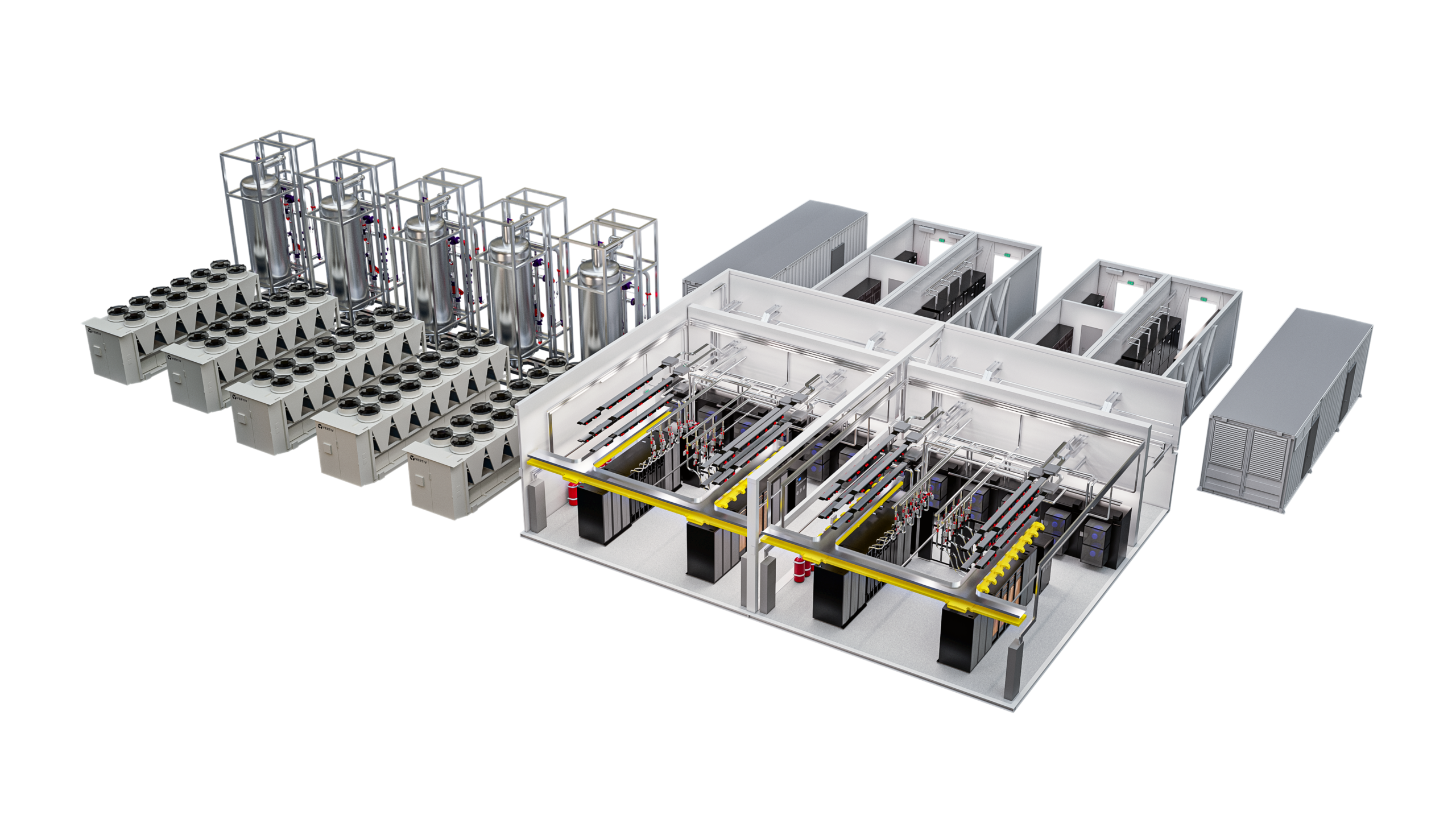
After the reference design has been configured, Vertiv’s deployment approach moves more integration and testing into a factory environment. Prefabricated assemblies can combine electrical and thermal infrastructure before arriving at the data centre site, allowing parts of the installation process to be completed under controlled manufacturing conditions.
The company’s OneCore system is designed to integrate critical power, thermal management and supporting infrastructure within a hybrid-built data centre arrangement. SmartRun provides prefabricated overhead infrastructure for power distribution, liquid cooling, networking and containment.
Factory preparation can reduce the number of separate installation operations required on site. It may also allow equipment interfaces and selected functions to be checked before delivery, although final connections to the building, utilities and computing equipment must still be commissioned under site conditions.
Vertiv models a reduction in the on-site power and cooling deployment period from approximately 90 days to 45 days when factory-built infrastructure is used. This represents a potential halving of the defined deployment period, subject to the assumptions of the comparison and the circumstances of the project.
Combining the modelled configuration and deployment stages produces a comparison of 120 days for the conventional process and 48 days for the proposed approach. The difference is 72 days, equivalent to approximately ten weeks of additional time during which an installation might operate if all other requirements were satisfied.
The company uses this schedule difference to estimate an increase of up to 30% in cumulative AI token output during the first twelve months from project initiation. Its calculation assumes unchanged installed computing capacity and compares 317 productive days with 245 productive days under the two deployment schedules.
The estimated output increase therefore arises from making the computing capacity available earlier. It does not represent a measured improvement in processor efficiency, electrical conversion efficiency or inference throughput after the installation becomes operational.
Actual results will depend on the readiness of the computing hardware, electrical connections, cooling systems, network infrastructure and the facility itself. Completing one part of an installation earlier does not guarantee that every other requirement will be ready at the same time.
At Herøya, Polar Data Centers is adopting Vertiv’s factory-built deployment approach for the initial 41 MW phase of a larger AI data centre project. The multiphase development is intended to scale to 100 MW, although the current arrangement concerns the first phase rather than a completed 100 MW installation.
Vertiv is supplying prefabricated power and thermal modules, SmartRun overhead infrastructure and SmartMod equipment, supported by Unify software. The supplied systems are intended to coordinate the electrical, cooling and physical requirements associated with high-density computing equipment.
Liquid cooling is particularly relevant to these installations because it allows heat from computing components to be transferred into controlled fluid circuits. The facility must manage the resulting flow, pressure and temperature conditions while providing sufficient capacity to remove heat under representative operating loads.
Electrical infrastructure must also satisfy requirements for power quality, protection, isolation and maintenance. High-density computing loads can place substantial demands on upstream distribution systems, and the available electrical capacity must be coordinated with cooling equipment and the operating limits of the installation.
The wider design strategy relies on treating those requirements as parts of a connected system rather than completing electrical, mechanical and computing design independently. Changes to the computing configuration can alter heat loads and physical connections, making coordination important throughout engineering and construction.
Polar’s use of the deployment model establishes a physical project application, but Vertiv has not reported a completed site-wide comparison demonstrating the modelled time savings or additional token output at Herøya. The 41 MW phase remains an infrastructure development rather than a verified example of the entire modelled performance result.
The next engineering evidence will come from installation, commissioning and the operation of completed infrastructure under representative computing loads. Those results will indicate how effectively the virtual design, prefabrication and project coordination translate into measurable delivery times, electrical reliability and thermal performance.