IN Brief:
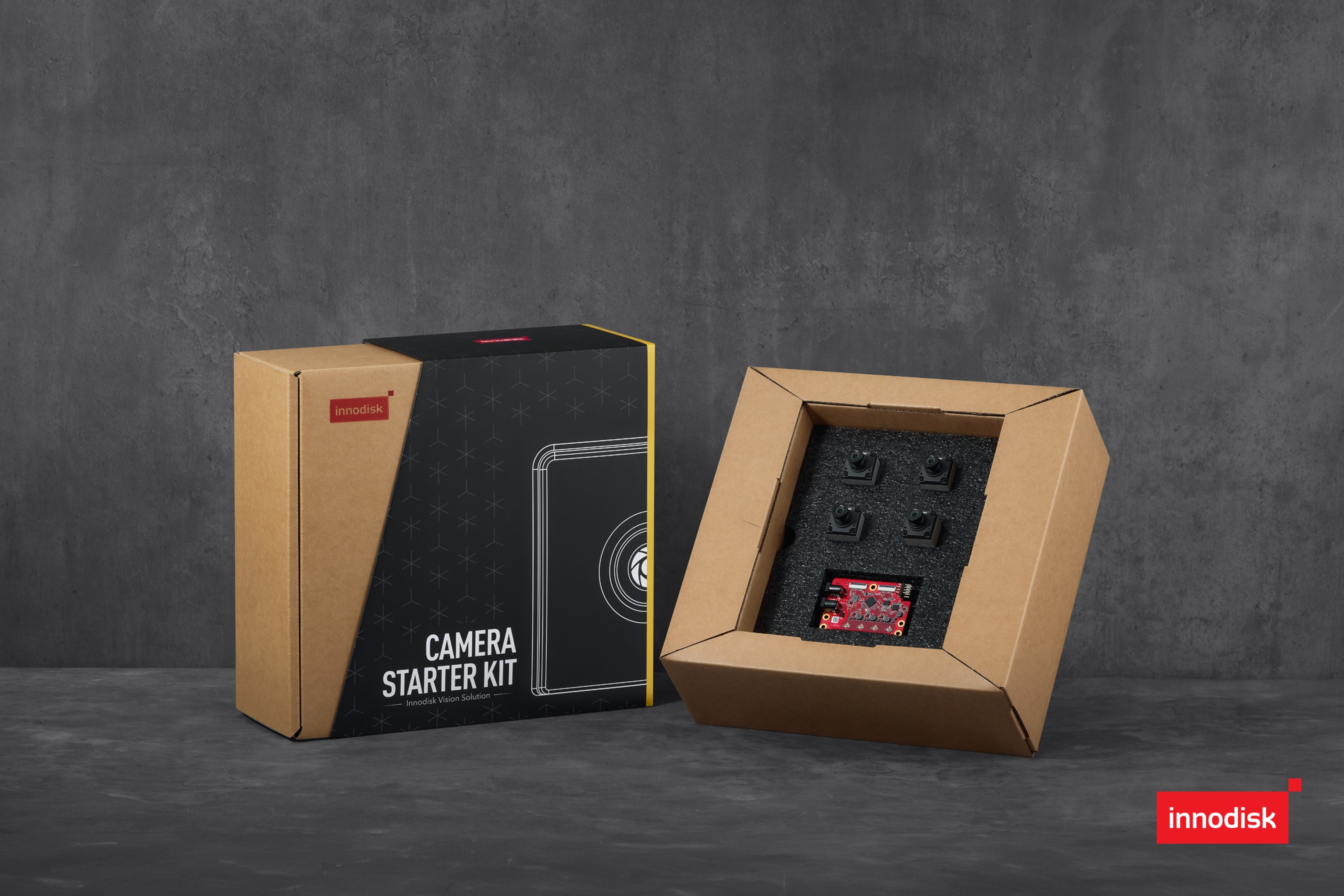
- The EKIT-B14-001 starter kit includes four 3 MP fixed-focus camera modules and an EB022-2M4F capture card.
- Four one-metre FAKRA cables, power accessories, and driver source code are supplied; the NVIDIA Jetson Orin Nano Super Developer Kit is required separately.
- Innodisk positions the integrated hardware for multi-camera prototypes in industrial vision, mobile robotics, and heavy vehicle systems, with integration-time benefits unverified independently.
Innodisk has introduced a GMSL2 camera starter kit that combines four 3 MP imaging modules, a capture card, cables, and driver source code for embedded vision development. The EKIT-B14-001 is designed for use with the NVIDIA Jetson Orin Nano Super Developer Kit, providing the principal camera and interface hardware needed to assess a multi-camera arrangement.
The package includes four EV3F-ZSM1-RXCF fixed-focus camera modules, an EB022-2M4F capture card, four one-metre FAKRA cables, and power accessories. It also includes a quick start guide and power cords for UK, European, and US sockets. The compatible Jetson development platform is required to operate the system but is not listed among the hardware supplied in the kit.
GMSL2 is a high-speed serial interface used to transmit video and related control information between devices. Developed for demanding camera connections including automotive systems, it allows image sensors to be positioned at a distance from the processor. A suitable serializer and deserializer arrangement carries the data across a cable connection rather than using a conventional USB camera interface.
That architecture is useful when cameras must be mounted around a vehicle, a robot, or a larger industrial machine, but it introduces integration tasks that are absent from many basic computer camera installations. The receiving hardware must support the camera interface, and the processing platform needs software capable of configuring the cameras and accepting their image streams.
Innodisk is supplying those elements together rather than asking a developer to select each device separately. Its capture card accepts four GMSL2 FAKRA connections and provides two 22-pin MIPI CSI-2 interfaces for connection to the supported host environment. The exact achievable image throughput will depend on sensor configuration, link settings, and the receiving platform.
Multi-camera development also requires a suitable software path. A connected camera may be electrically functional yet unavailable to the intended application if the host lacks a compatible driver or the video pipeline is incorrectly configured. Clocking, link setup, sensor controls, and image format handling must operate together before useful video can be captured.
Innodisk provides camera source code for the Jetson Orin Nano Super Developer Kit, giving purchasers a starting point for examining or adapting the supplied driver. The company makes that source code available with purchase. Access to the code does not establish compatibility with every operating system release, a different Jetson board, or other processing hardware without additional modification and testing.
The kit is intended to reduce the preliminary work associated with sourcing camera modules, capture electronics, connection cables, and software. Innodisk says multi-camera integration can take six months or longer in some projects, although it has not published an independent comparison demonstrating a particular saving against that reference period for EKIT-B14-001.
CK Hsu, senior manager of the Camera Product Business Department at Innodisk, said: “The biggest challenge in a multi-camera AI vision project is often not the AI application itself, but the camera integration and system tuning that come before it.” The company intends the pre-integrated kit to let developers begin proof-of-concept testing before committing to application-specific hardware.
An industrial inspection system might position cameras around a moving product to observe surfaces that cannot be seen from one viewpoint. Robot perception can similarly require cameras covering different directions or distances, although the usefulness of their combined images depends on calibration, mounting, lighting, and the algorithms processing the data.
Applications involving vehicles introduce further constraints. Heavy machinery and advanced driver assistance systems may need camera feeds for blind spot observation or environmental perception, with cable routing, vibration, temperature, and ingress protection affecting the final equipment design. The starter kit is a development aid, not a certified vehicle safety system.
Working with four cameras creates processing requirements beyond simply connecting the individual sensors. Image streams may need to be buffered, timestamped, and combined, while the processing hardware must handle the data rate and any local inference workload. The supplied kit does not establish that a particular AI model will sustain a given frame rate across four simultaneous streams.
Innodisk offers additional services covering camera module and capture card PCB customisation, lens choices, and image tuning. These services can be used after the initial evaluation to adapt a prototype for the physical interfaces and operating requirements of a finished product. Further variants of the GMSL2 starter kit are planned, but no detailed launch schedule has been provided.
EKIT-B14-001 is now listed as a defined bundle with named camera and capture components. Subsequent development will still need to establish driver compatibility, image performance, thermal behaviour, and application-level reliability under the conditions in which the completed equipment is expected to operate.