IN Brief:
- Six ADQ35 digitisers recorded 4,020GB at an average of 74.989GB/s across 53 seconds.
- The system combines six NVMe SSDs, 10-bit compression, and Teledyne's libads streaming library.
- A separate recording test reached 75.9GB/s, with alternative configurations supporting more acquisition channels.
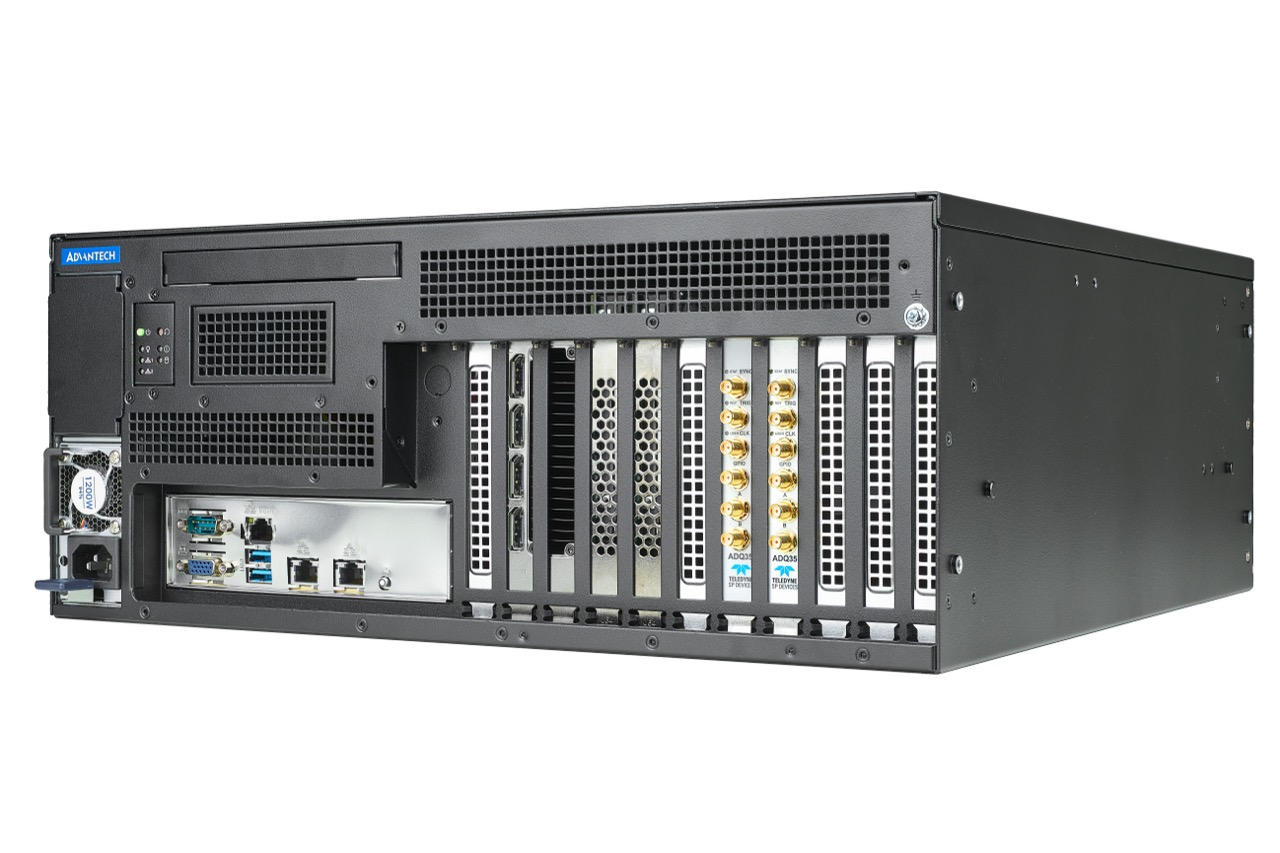
Teledyne SP Devices has demonstrated sustained recording at approximately 75GB/s using six ADQ35 high-speed digitisers and NVMe solid-state storage. The system captured 4,020GB across six channels in 53 seconds, achieving an average throughput of 74.989GB/s. It combines compressed acquisition data, synchronised sampling, and a dedicated disk streaming library within the company’s DPS7-PCIe computing platform.
The demonstration addresses the continuous data rates produced by high-speed measurement equipment. Satellite monitoring, lidar, and other wideband instrumentation applications can acquire large quantities of information over relatively short periods. Where the incoming data exceeds the sustainable write speed of the storage system, acquisition must be interrupted, information must be discarded, or additional buffering and processing must reduce the volume being recorded.
Teledyne’s configuration uses six ADQ35 digitisers, each operating at 10 gigasamples per second on one acquisition channel. The resulting stream is 12.5GB/s per card, giving an aggregate rate of 75GB/s. The cards can alternatively be configured for two channels at 5GSPS, allowing the same six-card platform to acquire 12 channels while retaining the intended aggregate data rate.
Achieving those transfer rates requires the acquisition format to fit within the available data path. The system uses 10-bit compression, reducing the number of bits transferred and stored for each sample. Compression changes the relationship between the incoming sample rate and the storage bandwidth required, although its suitability depends on the characteristics of the measured signals and the acceptable effect on measurement accuracy.
At the specified recording rate, the system generates approximately 3.75TB of data in 50 seconds. Recording continuously for longer therefore requires considerable storage capacity as well as sufficient write throughput. The demonstration was designed around both constraints, using six NVMe SSDs to provide a separate high-speed storage destination for each digitiser.
The drives are Kingston Fury Renegade G5 2TB SSDs configured with approximately 670GB of effective capacity each. Teledyne used an arrangement corresponding to single-level cell operation, sacrificing usable capacity to support sustained writes exceeding 12.5GB/s per drive. The six effective capacities together provide approximately 4.02TB, closely matching the volume recorded during the principal test.
Flash memory performance depends on how information is stored within its cells and how the controller manages writing, buffering, and background operations. Using an SLC configuration reduces the amount of data stored per cell and can improve sustained write behaviour. The approach is appropriate where continuous recording speed is a higher priority than maximising the available capacity of each SSD.
Teledyne describes the consumer-drive configuration as a lower-cost alternative to enterprise storage for applications that do not require equivalent write endurance. Endurance remains a constraint because repeated high-volume acquisition cycles can place substantial demands on the flash memory. A system intended for frequent, continuous recording must account for the total data written over the drives’ expected service life.
The DPS7-PCIe platform brings the acquisition cards and SSDs into a common computing system. Acquired information is transferred from each digitiser into DRAM buffers, from which the storage devices retrieve it for writing. This arrangement separates the timing of incoming acquisition data from individual disk operations, provided the buffers and downstream transfer path can maintain the necessary aggregate throughput.
Teledyne’s libads library manages the streaming process without using the operating system’s conventional file system and caching route for the recorded data. The CPU handles control and monitoring while the high-volume transfers proceed through the storage architecture. Reducing the processor’s involvement in managing individual writes limits one potential source of overhead during sustained acquisition.
The implementation also uses a dedicated data organisation method to identify and retrieve recorded datasets. Recording outside the normal file system changes how the information is stored and subsequently accessed, so applications need the appropriate software to interpret the resulting data and metadata. Teledyne provides development examples through libads for implementing the supported acquisition and storage configurations.
Clock and trigger distribution establish the timing relationship between channels. A fanout board supplies a common 10MHz reference to the digitisers, while their trigger connections are arranged in a daisy chain with one unit acting as master. Coordinating these signals allows acquisition to begin across the cards in a synchronised manner, which is necessary when measurements from several channels must be analysed together.
The principal test recorded 4,020GB over 53 seconds at 74.989GB/s. Teledyne attributes the small difference from 75GB/s to the measurement interval including acquisition startup and shutdown. The company subsequently used development functions to verify the acquired data and metadata, then repeated the recording procedure after reformatting the drives because the test had consumed their effective capacity.
A separate experiment used discrete records containing 2,048 samples in 16-bit format to evaluate maximum sustained storage performance. That configuration achieved 75.9GB/s. The result is distinct from the continuous 4,020GB capture and should not be used as its average recording rate.
The architecture supports other arrangements through changes to digitiser firmware and storage allocation. Multiple digitisers can share drives, while a digitiser can use several drives where additional throughput or capacity is required. Enterprise SSDs, additional expansion chassis, and synchronised multi-chassis arrangements provide options for applications needing longer recordings or larger channel counts.
Processing before storage is another available route. The libads library can support NVIDIA GPUDirect Storage, allowing suitable data processing through a GPU, while the ADQ3 digitiser platform supports FPGA processing through its firmware options. Reducing information before it reaches the drives can change the required storage capacity, provided the processing preserves the measurement data needed by the application.
The demonstrated result establishes sustained recording performance for the specified six-card, six-drive configuration. Longer acquisition periods require additional effective capacity, and greater channel counts place further demands on PCIe bandwidth, synchronisation, and storage organisation. Those requirements must be evaluated together when adapting the platform for another measurement system.