IN Brief:
- Siemens has introduced HyperLynx Agentic Toolkit for electronic systems verification.
- Specialised agents coordinate SerDes, DDR, signal integrity, and power integrity analysis using established simulation tools.
- Early access is planned for selected customers during Q4 2026, with general availability to follow.
Siemens has introduced HyperLynx Agentic Toolkit, combining specialised artificial intelligence agents with physics-based simulation to automate parts of high-speed electronic systems verification. The software allows verification objectives to be expressed in natural language, while separate agents coordinate signal integrity, power integrity, memory interface, and serial-link analysis.
Built on the existing HyperLynx electronic design automation platform, the toolkit uses an orchestration agent to manage tasks assigned to specialists covering SerDes, DDR, signal integrity, and power integrity. These agents can initiate simulations, extract relevant parameters, investigate unexpected results, and evaluate calculated performance against specified design margins.
High-speed printed circuit board verification involves a growing number of electrical interactions between devices, transmission paths, connectors, and power distribution networks. As serial data rates move into 112G and 224G applications, comparatively small changes to conductor geometry and material properties can influence whether an electrical link satisfies its operating requirements.
Transmission paths introduce resistance, capacitance, and inductance, while impedance discontinuities can produce reflections that alter the received waveform. Losses within conductors and dielectric materials also influence signal quality, particularly at high frequencies. These effects must be considered together because changing one aspect of a layout can improve an individual measurement while introducing a different constraint elsewhere.
SerDes interfaces are among the areas addressed by the new toolkit. Such connections convert parallel information into high-speed serial streams for transmission between devices, then recover the transmitted information at the receiving end. Verification examines the combined effect of the transmitter, transmission channel, receiver, and relevant operating conditions.
Measurements and simulations may include signal attenuation, reflections, timing variation, and the available eye opening at the receiver. When a design fails a margin requirement, identifying the source can involve comparing multiple channel configurations, inspecting waveforms, and examining the influence of individual components. Siemens intends to automate parts of that investigative sequence using agents connected to established simulation tools.
DDR memory interfaces introduce related timing challenges. Data, clock, and command signals must maintain specified relationships despite routing differences, electrical loading, and interference. The available timing margin can vary with memory configuration and operating conditions, so verification commonly involves examining numerous combinations rather than relying on a single simulated result.
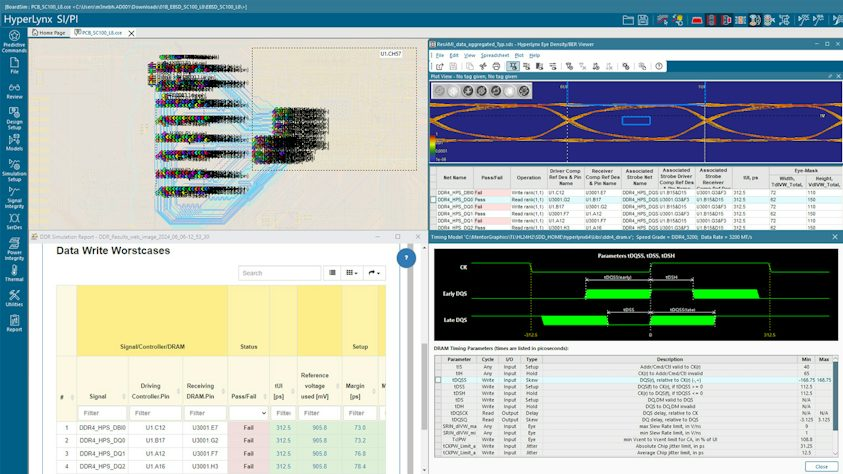
Siemens has illustrated the toolkit with DDR5 compliance analysis and a comparison of signal eye height and width for alternative PAM4 link designs. These examples demonstrate the types of datasets that agents can investigate. The company has not released a standardised customer benchmark showing a specified reduction in verification time across different PCB projects.
Power integrity analysis is another component of the integrated workflow. A board's power distribution network must deliver current while maintaining the required supply voltage at connected devices. Conductor resistance, package characteristics, decoupling capacitors, and transient changes in load current all influence the resulting voltage behaviour.
Power delivery and signal transmission can also interact. Disturbances in the supply network may alter device switching behaviour or increase electrical noise, making it necessary to consider power and signal integrity together. Verification therefore depends on electrical models that represent the relevant physical characteristics of the circuit, rather than solely on an interpretation of schematic connectivity.
The agentic toolkit retains physics-based simulation as the calculation mechanism. AI agents coordinate the sequence of work and examine results, but the numerical assessment is carried out by established engineering solvers. That distinction is important where a plausible explanation of a failure must be supported by calculations that can be checked against the design assumptions.
Siemens also identifies GPU and high-performance computing resources as part of the approach. Additional computing capacity can support larger simulation workloads and exploration of alternative design configurations, although actual acceleration depends on the solver, model complexity, hardware resources, and the tasks performed.
Automated analysis does not remove the need to establish suitable simulation inputs. Component models, transmission-line parameters, stack-up properties, operating conditions, and compliance criteria must match the intended hardware. Incorrect assumptions can produce internally consistent results that do not accurately represent the finished circuit board.
Engineering review also remains necessary when an agent identifies a suspected failure. A simulated margin violation may reflect a genuine design problem, an inaccurate model, or an unsuitable test configuration. Distinguishing between those possibilities requires access to the underlying evidence and an understanding of the physical behaviour being measured.
The development extends Siemens' existing work on specialised AI agents for electronic design automation, including Questa One and the Fuse EDA AI Agent. The company has separately expanded HyperLynx through its 2610 software release, which added improvements across signal analysis, power integrity, and simulation management. The new agentic toolkit concentrates on coordinating verification tasks and investigating the resulting data.
Selected customers are expected to receive early access during the fourth quarter of 2026. General availability will follow, although Siemens has not provided a confirmed wider release date, pricing, or independently verified productivity results for the new toolkit. Its initial deployment will establish how effectively agent-coordinated workflows can reduce repetitive verification work without weakening the underlying engineering analysis.