IN Brief:
- Evident's SilVIR-RAY detector acquires up to four super-resolution channels simultaneously during a single scan.
- The technology extends the FLUOVIEW FV5000 confocal microscope platform, supporting quantitative multicolour imaging.
- It is available for new FV5000 systems and as an upgrade to existing installations, with conventional confocal operation retained.
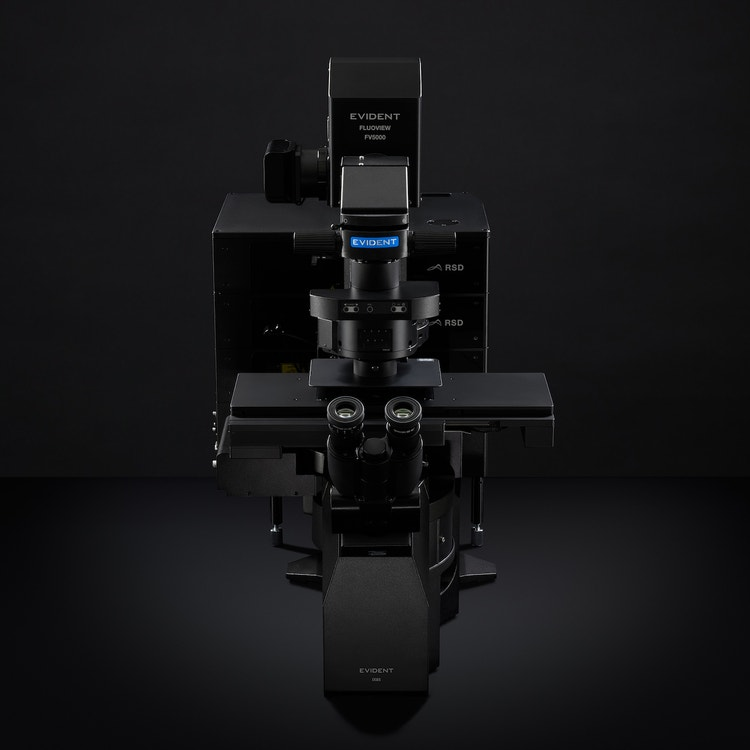
Evident has introduced a detector capable of acquiring four super-resolution imaging channels simultaneously, extending its FLUOVIEW FV5000 confocal laser scanning microscope for research involving rapidly changing cellular structures.
The SilVIR-RAY detector captures information from up to four fluorescent channels during a single scan, reducing the timing differences that arise when separate channels are acquired sequentially. It is available for new FV5000 installations and as an upgrade for existing systems.
Multicolour fluorescence microscopy allows different biological structures or molecular components to be labelled and observed within the same specimen. The resulting images can show where particular substances are located and how their distribution changes during an experiment.
Capturing several fluorescent signals is complicated by differences in their optical characteristics. Each label has particular excitation and emission properties, while the detection system must collect light from the specimen and separate the signals sufficiently for them to be interpreted.
In sequential multicolour acquisition, the microscope records one channel before moving to the next. Although this provides a practical method of separating signals, the completed set of images represents measurements taken at different moments.
The difference can become significant when structures move or biological processes change during acquisition. A molecule observed in one channel may have moved by the time a second channel is recorded, making it harder to determine whether apparent differences between images reflect an actual spatial relationship.
SilVIR-RAY addresses the acquisition sequence by collecting up to four super-resolution channels in the same scan. This allows changes in fluorescent signals to be compared with a smaller temporal offset, supporting observations of molecular interactions and cellular behaviour.
Simultaneous acquisition does not eliminate every source of imaging error. Signal separation, detector sensitivity, optical alignment, sample movement, and illumination conditions still affect the accuracy of the resulting measurements. The degree of improvement also depends on the specimen and the imaging parameters selected.
Confocal laser scanning microscopy illuminates a small region of the specimen and collects emitted light through an optical arrangement designed to suppress signals originating outside the focal plane. Scanning across the specimen creates an image with optical sectioning that can separate structures at different depths.
Super-resolution imaging extends the available detail beyond the normal resolution limits associated with conventional optical microscopy, although different methods achieve this through different optical and computational approaches.
Increasing spatial detail can also increase the demands placed on the detector and acquisition system. Recording more information may require additional scanning time, greater illumination, or more complex processing, creating a balance between spatial resolution, temporal resolution, and sample conditions.
The balance is particularly demanding in live-cell research. Biological specimens can respond to prolonged illumination, while rapidly changing processes require images to be captured before the structures under investigation have changed substantially.
The new detector is designed to support multicolour imaging while maintaining data volumes suitable for subsequent analysis. Evident also emphasises the importance of dynamic range, which determines the range of signal intensities that can be recorded without losing useful information at the brightest or weakest levels.
A detector’s dynamic range influences its ability to represent different fluorescence intensities within the same experiment. If a strong signal saturates the measurement system, information about its magnitude is lost; if a weak signal is indistinguishable from noise, the corresponding structure may be difficult to quantify.
Reliable quantitative imaging consequently depends on more than producing visually detailed pictures. The detection chain must preserve meaningful relationships between optical signals and recorded measurements, while the imaging procedure must account for calibration, illumination, background, and specimen characteristics.
Evident’s established SilVIR technology uses silicon photomultiplier detection and digital signal processing to improve photon detection and measurement characteristics. SilVIR-RAY builds on that technology, although the company has not published a full circuit description of the new detector or disclosed the exact changes to its semiconductor and signal processing architecture.
The FLUOVIEW FV5000 platform combines the detector with high-speed scanning capabilities, including 2K resonant and 8K galvanometer scanning. Its configuration also includes FLUOVIEW Smart software and TruResolution automated spherical aberration correction.
Spherical aberration occurs when light passing through an optical system is not brought to a common focus. It can reduce image quality, particularly where imaging conditions vary with specimen depth or differences in optical properties. Correction mechanisms help maintain the intended focus characteristics during observation.
The FV5000’s modular architecture allows laboratories to add detectors, objectives, cameras, and laser systems as their requirements change. The platform also supports configurations that extend from conventional confocal microscopy into multiphoton imaging.
SilVIR-RAY retains the ability to operate as a standard confocal detector when super-resolution acquisition is unnecessary. This allows the same hardware to support different experimental methods without requiring a separate detector for every imaging arrangement.
Availability as an upgrade is relevant to research laboratories operating existing FV5000 installations. Adding a detector can extend an instrument’s measurement capability without replacing the entire microscope, although installation and compatibility requirements must still be assessed for each configuration.
Evident will demonstrate the technology at Neuroscience 2026 in Washington, DC, from 14 to 18 November. The equipment is intended for research use only and is not approved for diagnostic procedures.
The company has not disclosed a complete set of numerical comparisons for spatial resolution, frame rate, detector noise, or measurement uncertainty against competing systems. Such data will be necessary for detailed performance evaluation across different specimens and acquisition conditions.
SilVIR-RAY is now available through new FV5000 systems and upgrades, giving laboratories an additional method of acquiring simultaneous multicolour measurements during experiments where the timing of changing biological structures is critical.