IN Brief:
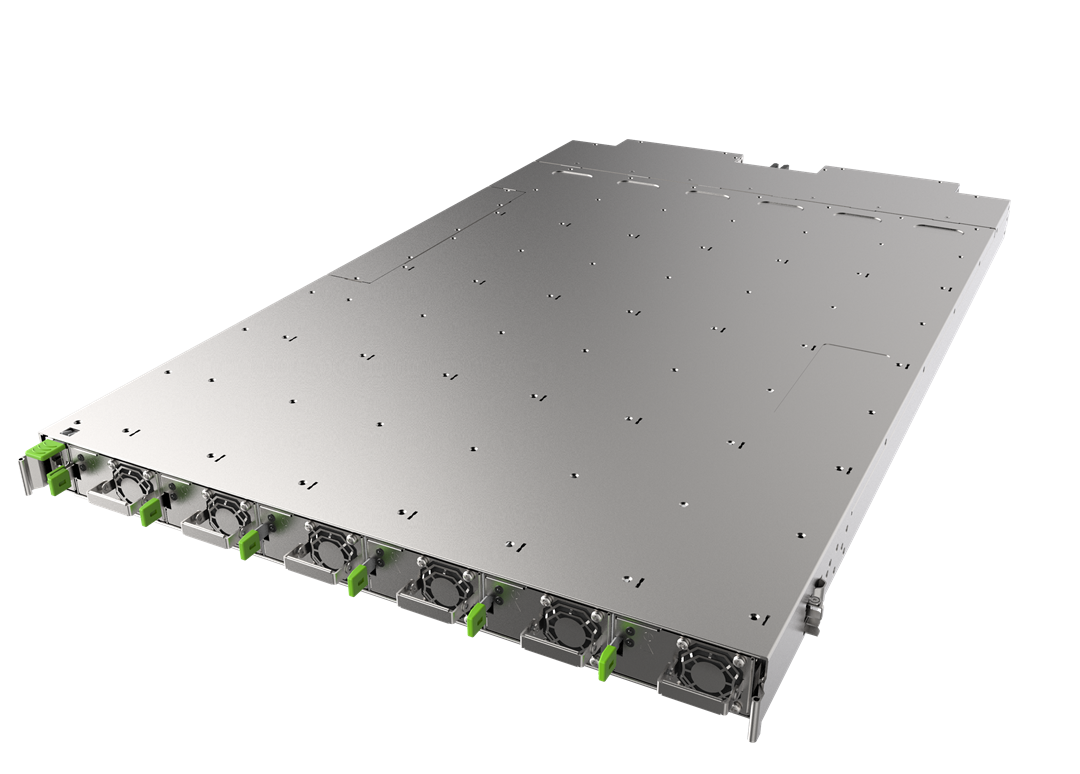
- LITEON has demonstrated a 72 kW power shelf within a 1U enclosure alongside its existing 110 kW rack hardware.
- The portfolio includes active current sharing, input current smoothing, capacitor backup, and conversion hardware positioned closer to accelerators.
- An interactive 800 V DC rack model illustrates configurations rated at 330 kW, 880 kW, and 1.2 MW.
LITEON Technology has detailed a 72 kW power shelf housed within a 1U enclosure, alongside additional conversion and energy backup technologies intended for increasingly dense AI computing infrastructure.
The equipment formed part of LITEON’s electronica 2026 presentation in Munich, where the company demonstrated electrical power systems supporting NVIDIA MGX and Open Compute Project Open Rack V3 architectures. Its display also included an existing 110 kW power shelf, capacitor backup hardware, and an interactive model of 800 V DC rack configurations.
The 72 kW shelf combines substantial electrical output with a chassis occupying one rack unit of height. Accommodating this power level within a restricted enclosure requires careful management of electrical components, current paths, heat removal, and the physical interfaces connecting the supply to the surrounding system.
Power density has become an important constraint in accelerator installations because the available rack space must accommodate processors, networking equipment, electrical distribution, and cooling hardware. Greater computing capacity increases the amount of electrical power that must be converted and delivered, often within a limited physical footprint.
Concentrating 72 kW of output into a 1U shelf also places demands on conversion efficiency. Energy lost during conversion becomes heat within the power electronics, so relatively small changes in efficiency can produce substantial differences in the thermal load that the enclosure must dissipate.
The final temperature of a power semiconductor depends on more than its electrical rating. Device switching behaviour, conduction losses, circuit layout, package construction, and the cooling path all contribute to operating conditions. Magnetic components and electrical connections must also be designed to manage their own losses.
LITEON has not published a detailed efficiency curve, cooling configuration, or measured temperature profile for the 72 kW shelf in its electronica material. Its output rating and chassis dimensions establish the power class and packaging approach, but do not independently quantify sustained performance under every operating condition.
The company’s existing 110 kW shelf addresses the NVIDIA Vera Rubin NVL72 architecture. LITEON demonstrated that power class earlier in 2026, including through collaborations with Quanta Cloud Technology, so the Munich presentation does not represent its initial introduction.
The 110 kW equipment incorporates active current sharing and input current smoothing. Both functions address the electrical behaviour of densely populated computing racks, where the power required by individual accelerators can change as workloads are distributed across the hardware.
Current sharing allows multiple conversion modules to contribute to the overall output rather than leaving individual supplies to carry an uneven proportion of the load. Maintaining a suitable balance can reduce differences in electrical and thermal stress between modules, although the result depends on the behaviour of the control system.
Input current smoothing addresses changes in the electrical current drawn from an upstream supply. Rapid accelerator load transitions can affect the demand imposed on the power distribution system, requiring coordinated conversion and energy management to maintain acceptable voltage and current conditions.
These transient requirements differ from the ability to deliver a specified continuous power output. A supply can meet its steady-state rating while still requiring additional control or stored energy to manage sufficiently rapid changes in load. The response of the complete architecture must therefore be assessed against expected computing activity.
LITEON’s portfolio includes a high-power capacitor backup unit intended to provide temporary electrical support during disturbances. Capacitors can release stored energy quickly, making them suitable for applications requiring short-duration support or management of rapid power variations.
The useful duration depends on the unit’s capacitance, operating voltage range, converter efficiency, and connected load. LITEON has not disclosed the backup unit’s energy capacity or hold-up time, preventing a direct comparison with specified battery systems or alternative capacitor products.
Power conversion closer to the computing hardware forms another part of the design. LITEON displayed intermediate bus converters, voltage regulator modules, and power bricks intended to support distribution through multiple voltage stages.
In a typical arrangement, electrical power is distributed through the rack at a voltage that limits current and associated conductor losses before being converted to the lower voltages required by semiconductor devices. Intermediate bus converters perform part of this reduction, while voltage regulator modules provide tightly controlled supply rails close to the load.
Moving the final conversion stage nearer to an accelerator can reduce the distance over which high current must travel at low voltage. However, each conversion stage introduces its own losses, component requirements, and thermal constraints. System efficiency depends on how those stages operate together rather than on the performance of any single module.
The company also presented an interactive model of NVIDIA’s 800 V DC rack architecture, with configurations rated at 330 kW, 880 kW, and 1.2 MW. The virtual display illustrates a proposed direction for larger computing installations and should not be interpreted as confirmation that all three configurations have been deployed commercially.
Higher distribution voltages allow a specified amount of power to be transmitted at lower current, which can reduce resistive losses and conductor requirements in suitable designs. They also place greater demands on insulation, fault detection, switching equipment, and maintenance procedures.
Direct current protection requires particular attention because a DC fault does not pass through the recurring current zero crossings found in alternating current systems. Protection and isolation devices must therefore be selected for the anticipated voltage, available fault energy, and system operating conditions.
LITEON’s presentation extended to industrial and edge computing supplies, including 800 W and 2,000 W common redundant power supplies, high-power Power over Ethernet injectors, and DIN rail supplies rated from 12 W to 960 W. These address different applications from rack-scale AI hardware, although they draw on related power conversion and system integration capabilities.
The 72 kW shelf adds another configuration to LITEON’s power portfolio, while the capacitor backup and conversion modules address the stability and distribution requirements surrounding higher-density computing systems. Detailed electrical specifications, thermal measurements, and availability information will be needed to establish how the individual products perform within completed rack installations.