IN Brief:
- Altera demonstrated an Agilex 9 Direct RF FPGA quantum controller developed with OQC and NVIDIA at SC26.
- Integrated RF converters, qubit control and readout connect with GPU processing through NVIDIA NVQLink.
- The reference design is expected to be released in January 2027; production performance and qubit capacity were not quantified.
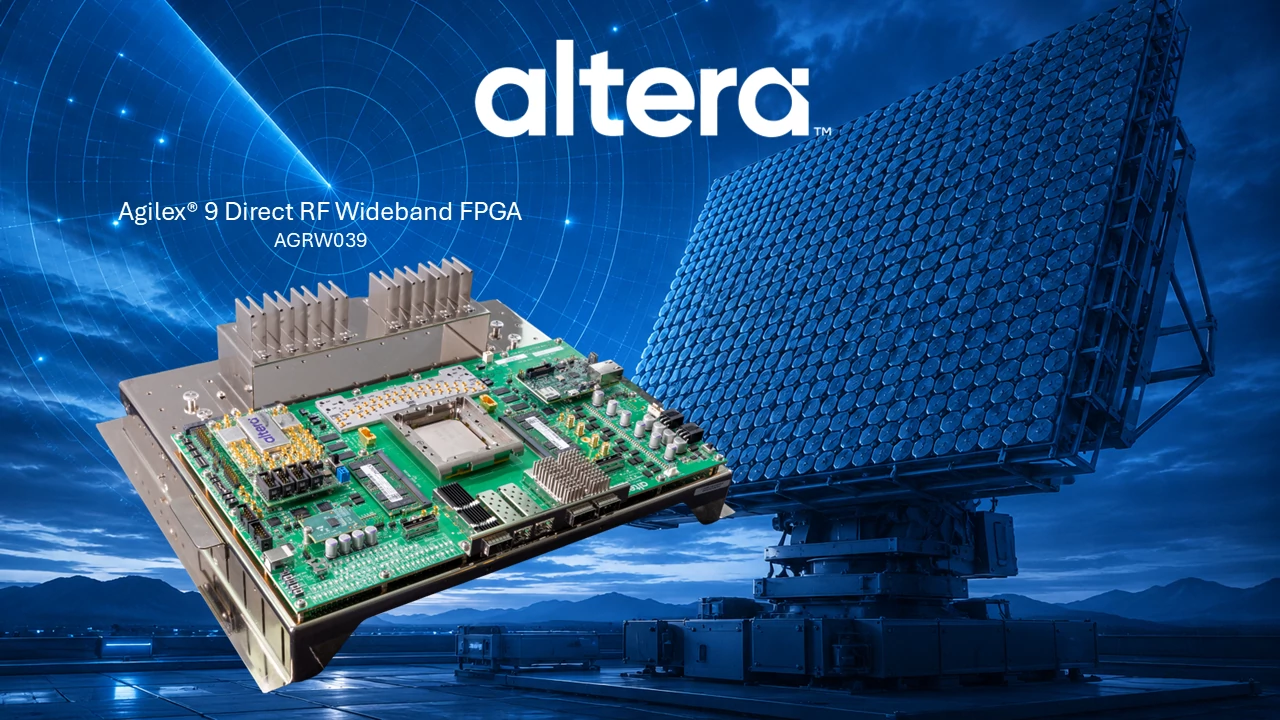
Altera has demonstrated a quantum system controller reference design developed with Oxford Quantum Circuits (OQC) and NVIDIA. The system uses an Agilex 9 Direct RF FPGA for time-critical qubit control and readout, with NVIDIA NVQLink connecting the controller to GPU computing resources. Shown at SC26 in Chicago on 16 November, the reference design is scheduled for release in January 2027; the demonstration is not evidence of a generally available commercial controller.
Quantum processors require classical electronics to send precisely timed control signals, collect measurements and turn those measurements into information used by subsequent operations. The number of control and readout channels can increase as a processor becomes more complex. Those channels have conventionally involved separate converters, RF conditioning stages and substantial connections between equipment. Altera’s design aims to consolidate part of that work into programmable hardware rather than claim to replace every element of a quantum computing installation.
The Agilex 9 Direct RF FPGA incorporates analogue-to-digital and digital-to-analogue converters, allowing signal generation and acquisition without separate external RF up-conversion and down-conversion stages in the reference arrangement. The FPGA is not connected directly to bare qubits: OQC supplies the quantum processing unit and the RF conditioning electronics between it and the control hardware. This separation is important because a simplified converter chain does not remove the need to match the signals to the processor’s physical operating requirements.
A major requirement in superconducting quantum computing is the coordination of control pulses with the state of the device under test. Commands must be issued in a defined sequence, and readout has to be associated with the correct event rather than with an unpredictable software scheduling delay. FPGA logic can implement the deterministic scheduling and signal processing needed for these operations. The demonstration includes qubit and resonator spectroscopy, qubit initialisation, resonator readout and classification functions.
Qubit and resonator spectroscopy help establish operating frequencies before control and measurement sequences are configured. The reference design also supports frequency-multiplexed control and readout, allowing several signals to share RF connections where the target system permits. Altera presents this as a way to reduce associated signal hardware, but has not published a measured reduction in power consumption, cabinet space or latency for a specified multi-qubit installation.
Through NVIDIA NVQLink, GPU processing can be used for computationally intensive tasks, including machine-learning-assisted readout classification and calibration. The FPGA retains responsibility for closely timed signal generation, acquisition and control logic, while the GPU handles work better suited to parallel processing. This is an architectural division of responsibilities rather than evidence that the GPU alone can meet all of the processor’s real-time control deadlines. The reference design includes software examples intended to link the two parts of the system.
The controller further includes an emulation path for bringing up software and testing algorithms before physical qubit hardware is available. Such a facility can help development teams exercise sequences and interfaces without occupying the quantum processor for every software change. It does not remove the need for validation with an operating QPU, whose physical noise, device variation and calibration requirements remain part of the complete system.
OQC supplies a superconducting quantum processor and the associated RF interface used in the demonstration. That provides a working reference for the interaction among control logic, conditioning electronics and quantum hardware, although Altera has not published a universal compatibility claim for other qubit technologies. Neither the announcement nor the demonstration supplies a comparable benchmark for the number of qubits that can be controlled, achieved readout fidelity or system-wide error-correction performance.
The next announced step is publication of the reference design in January 2027. Developers will then be able to evaluate the controller functions and software stack against their own processors, RF interfaces and timing requirements. The demonstration establishes the proposed FPGA-to-GPU control architecture, while hardware qualification and measured system performance remain dependent on the device and configuration used.