IN Brief:
- AIP-RQ87 combines Intel Core Ultra 5/7/9 processors with up to 256GB of DDR5.
- PCIe accelerator options include NVIDIA RTX PRO 6000 Blackwell and Qualcomm Cloud AI 100 Ultra hardware.
- The 500mm-deep system is in mass production with CE, FCC Class A, and UKCA certification.
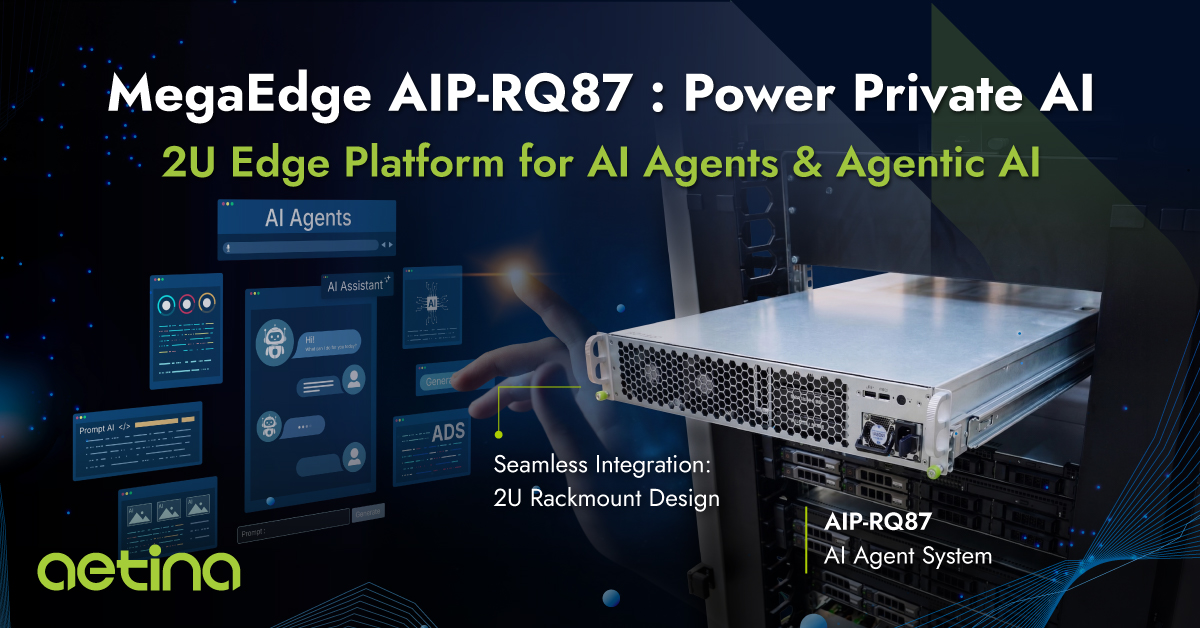
Aetina has launched the MegaEdge AIP-RQ87, a 2U rackmount system for private large language models, retrieval-augmented generation, AI agents, multimodal inference, and other on-premises edge workloads. The platform combines Intel Core Ultra processors with PCIe Gen5 expansion for NVIDIA or Qualcomm AI accelerators.
The system uses Core Ultra 5, 7, or 9 Arrow Lake-S processors with Intel’s Q870 chipset and supports up to 256GB of DDR5 memory across four DIMM slots. Its two PCIe x16 slots can operate as one Gen5 x16 connection or two Gen5 x8 connections through a riser, allowing configurations based on NVIDIA RTX PRO 6000 Blackwell or Qualcomm Cloud AI 100 Ultra acceleration.
Aetina has packaged the hardware into a chassis measuring 438 × 500 × 88mm. That 500mm depth is relatively compact for a 2U system designed around high-power accelerator cards, although the mechanical constraint increases the importance of airflow, cable routing, power distribution, and maintenance access.
The system is specified for up to 2,000W under full load. Aetina says configurations can support two accelerators rated at up to 600W each and has developed a patent-pending power distribution board that replaces some conventional point-to-point cabling with a centralised arrangement intended to simplify high-current delivery inside the chassis.
Reducing cable density has practical value in a shallow server because large power harnesses compete with cooling airflow and service access. It does not remove the thermal problem: accelerator temperature will still depend on card selection, fan performance, rack inlet conditions, sustained workload, and the amount of heat generated by the processor, memory, storage, and power conversion around the GPUs.
Aetina specifies operation from 0°C to 40°C for the base system, narrowing to 0°C to 35°C with RTX PRO 6000 Blackwell Workstation configurations. The published specification also covers operational vibration and shock testing with two RTX PRO 6000 Blackwell cards installed, giving integrators more useful environmental limits than a generic claim of industrial-grade construction.
The platform uses modular, tool-less GPU and SATA assemblies intended to simplify upgrades and replacement. Storage support includes five 2.5-inch SATA positions, with configurations accommodating up to three 3.5-inch hard drives, while rear connectivity provides standard 1Gbps and 2.5Gbps Ethernet. A 10GbE interface is optional rather than standard, alongside optional additional serial and out-of-band management connections.
That distinction is important for inference systems expected to move large model files or video data. Accelerator throughput can easily exceed the rate at which a poorly specified storage or network subsystem can supply data, so an application configuration has to be balanced across compute, system memory, local storage, and external connectivity rather than chosen from the GPU specification alone.
The AIP-RQ87 extends work Aetina has already shown around physical AI and on-premises edge systems. Its earlier COMPUTEX programme combined private models, vision, robotics, and accelerator hardware in demonstration platforms; the new system puts that strategy into a mass-production rackmount product with published ordering information and regulatory certification.
Aetina states that the AIP-RQ87 is now in mass production with CE, FCC Class A, UKCA, LVD, and RoHS certifications. Those approvals support commercial deployment but do not qualify the finished system for every application in which it might be installed. Medical, transport, safety-related, and other regulated uses can impose additional system-level requirements beyond the base computer’s compliance marks.
The choice between NVIDIA and Qualcomm acceleration also prevents the chassis from being tied to one inference architecture. In practice, the decision reaches beyond TOPS or nominal throughput because model support, software libraries, precision formats, host interaction, power consumption, thermal limits, and long-term device availability can determine whether an accelerator remains practical over the life of an installation.
Private AI is often framed around keeping data away from public cloud services, but local deployment shifts responsibility onto the operator. Rack power, cooling, software maintenance, model updates, hardware replacement, monitoring, and security all become part of the installation rather than being abstracted into a cloud service.
Aetina’s contribution is therefore mainly mechanical and electrical integration around that workload. The AIP-RQ87 packages CPU, memory, high-power PCIe acceleration, storage, power distribution, and service access into a defined 2U envelope. Whether that reduces deployment effort will depend on the workload and software stack, but at least the engineering limits are visible before someone attempts to squeeze two 600W accelerators into a rack that was never designed for them.