IN Brief:
- DOCOMO and Samsung have validated AI-RAN optimisation that changes radio settings for individual users instead of whole cells.
- Simulated communication-speed degradation fell from 13.1% to 7.2% in the January validation.
- The work also includes selective measurement-data collection and is being taken into 3GPP discussions towards future 6G systems.
NTT DOCOMO and Samsung Electronics have validated an AI-based radio access network optimisation method that changes network configuration for individual users instead of applying the same settings across every device served by a cell.
The companies tested the approach in Japan in January 2026 using simulations based on information collected from DOCOMO’s commercial mobile network and a local 5G trial environment. They report that the frequency of communication-speed degradation fell from 13.1% to 7.2% compared with operation without the technology.
The user-level element is central to the work. Conventional radio optimisation can apply common configuration parameters to devices connected to the same cell even though those users may be moving differently, receiving different signal conditions, or running applications with very different throughput requirements.
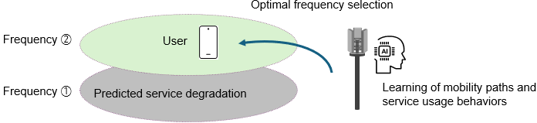
DOCOMO and Samsung instead use AI to estimate the condition of an individual user and predict when transmission performance is likely to drop below the level required by the service. The network can then modify selected radio parameters before the predicted degradation becomes visible to the user.
Frequency-band selection is one example given by DOCOMO. A user whose current connection is predicted to become unsuitable could be moved to a more appropriate band or configuration rather than waiting for throughput to fall and reacting afterwards. The objective is therefore predictive service maintenance rather than simple recovery from an already degraded connection.
The distinction becomes more important as mobile networks carry a wider mixture of traffic. A technically valid radio link does not necessarily deliver acceptable service: a background telemetry connection, voice session, immersive application, and high-resolution video stream can tolerate very different levels of latency and throughput variation.
User-level optimisation gives the radio network a route to account for some of those differences, but it also creates a much larger data and control problem. Continuously collecting every available radio measurement from every device would increase signalling, storage, and processing demand, undermining some of the efficiency benefits the optimisation is intended to deliver.
DOCOMO and Samsung have therefore developed a selective data-collection method alongside the AI model. It uses aggregated Minimization of Drive Test information from user equipment and retrieves only data judged relevant to the specific degradation problem being analysed.
That work may prove as important as the prediction algorithm itself. AI-RAN is increasingly being considered as an architectural function in future networks rather than a stand-alone optimisation tool. If machine-learning models are expected to influence radio configuration continuously, operators need a practical way to gather enough high-quality information without allowing telemetry overhead to grow uncontrollably.
The control loop also has to remain stable. Changing frequency, scheduling, or other radio parameters for one user can affect resources available to others, so a system that optimises individuals cannot ignore wider cell behaviour. Commercial deployment will therefore require policies that determine when AI recommendations should be applied and how frequently the network can alter configuration without creating new interference or resource-management problems.
The January test does not yet represent live nationwide operation. The work used simulations informed by commercial-network data and a local 5G trial field, which means further validation will be needed across larger user populations, more varied mobility patterns, changing traffic loads, and interactions with existing radio resource-management functions.
The companies have nevertheless taken the work into standards discussions. DOCOMO and Samsung jointly contributed to 3GPP work on data-collection methods in February and say they intend to contribute both the throughput-degradation prediction technique and selective data-collection approach as development continues towards future 6G systems.
The reduction from 13.1% to 7.2% gives the project a measurable result rather than leaving AI-RAN at the level of architectural ambition. The next engineering questions concern scale: whether the prediction remains accurate across different services, whether configuration changes can be applied quickly without destabilising neighbouring users, and how much computing infrastructure is required to run the control loop across a commercial network.
If those problems can be resolved, user-level optimisation would move radio management away from treating every device in a cell as broadly equivalent. The network would instead use measured behaviour to predict when an individual connection is heading towards trouble and intervene before performance falls far enough for the application to notice.