IN Brief:
- Orders in the third quarter reached €274.9m, up 122% year on year, while revenue was €183.6m.
- Optoelectronics represented approximately 68% and power electronics 24% of equipment orders.
- The equipment backlog reached €549.4m as AIXTRON ramps manufacturing and expands in Malaysia.
AIXTRON recorded orders in the third quarter of €274.9m, a 122% increase against the corresponding 2025 period, as manufacturers invested in equipment for optical components used in AI data centre networks. The German semiconductor equipment supplier also reported the first signs of renewed capacity investment for gallium nitride and silicon carbide power electronics.
Optoelectronics represented approximately 68% of AIXTRON’s equipment orders in the quarter, while power electronics contributed another 24%. Indium phosphide (InP) production equipment was the main driver, reflecting customers’ investment in lasers for fast optical data links. These shares describe AIXTRON’s equipment orders rather than the eventual volume of optical components or finished transceivers.
The larger order intake lifted AIXTRON’s equipment backlog to €549.4m at the end of September, from €286.5m a year earlier, with scheduled work extending into 2027. Revenue in the third quarter also rose, reaching €183.6m against €119.6m in the corresponding 2025 period. Orders, backlog and recognised revenue measure different stages of a capital equipment purchase, as systems must be built, delivered and accepted before the associated revenue is recorded.
Much of the demand originates in the optical links connecting processors, servers and network switches. InP lasers and related devices provide light sources used in transceivers to convert data between electrical and optical domains. More network bandwidth calls for additional or faster optical channels, which can require changes to semiconductor structures, fabrication steps and manufacturing yield before a higher capacity transceiver can be produced consistently.
The established volume market is 800G transceivers, according to AIXTRON, while customers are qualifying technology for 1.6T links. Those aggregate rates depend on the optical devices, electronic drivers and module design working together. AIXTRON supplies deposition equipment upstream of transceiver assembly, so orders for new tools reflect customers preparing semiconductor manufacturing capacity ahead of final system integration.
Recovery in power semiconductor equipment is less advanced than in optical production. AIXTRON reports initial orders for renewed capacity expansion in gallium nitride (GaN) and silicon carbide (SiC), with a broader pipeline under development. Its customers are addressing both lower voltage power delivery for AI infrastructure and higher voltage conversion, although new tool purchases must be followed by installation, qualification and production ramping.
GaN and SiC serve different switching conditions within that demand. GaN can support fast switching in compact power conversion stages, while SiC is used where voltage ratings and thermal performance impose different design constraints. Device geometry, packaging and cooling influence achievable system efficiency in either case; adding deposition capacity is an upstream step towards qualified devices rather than an immediate increase in finished converter output.
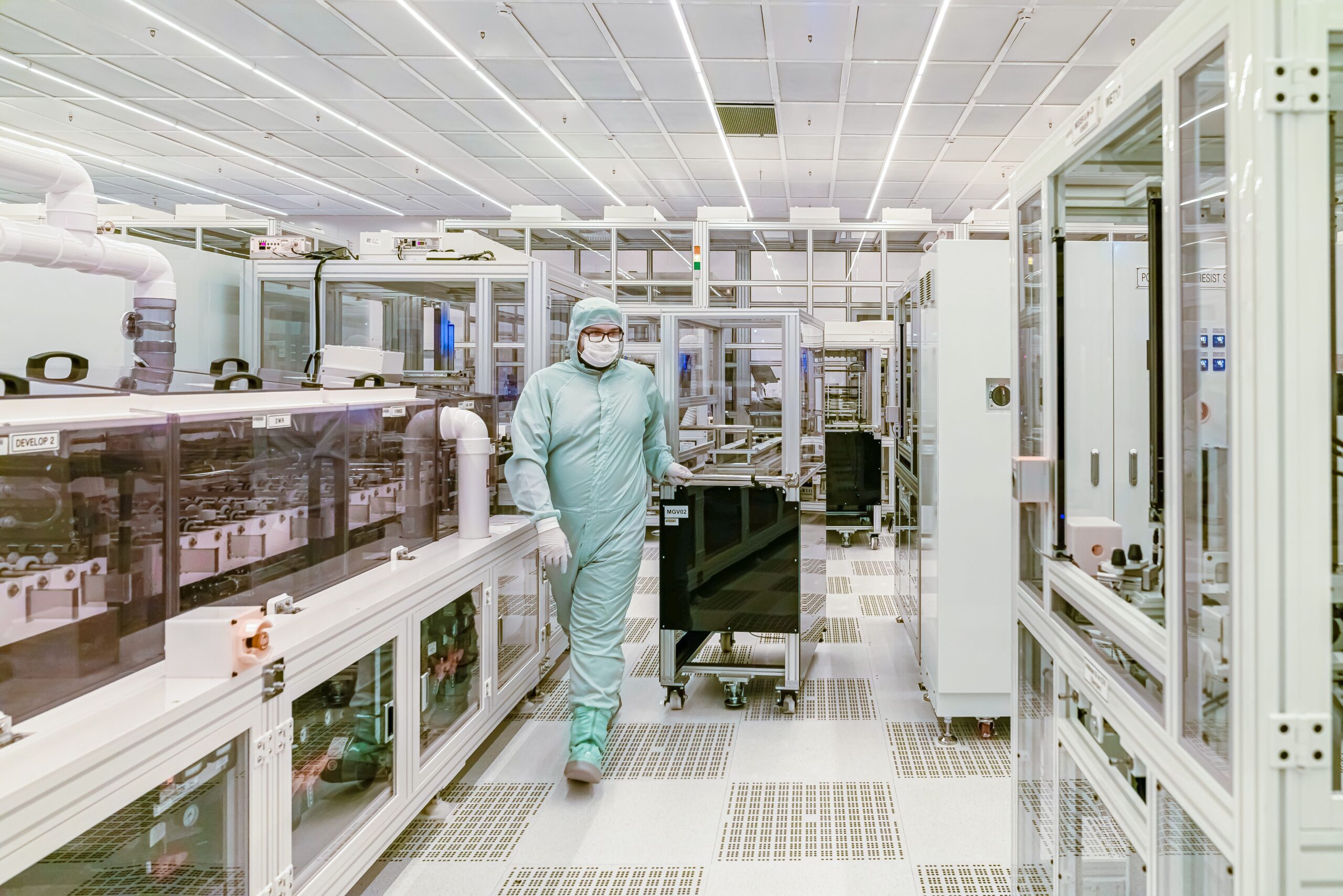
To meet the larger backlog, AIXTRON has increased production with its suppliers during 2026 and expects a further rise in output during the fourth quarter. Construction at its Penang facility in Malaysia is progressing, adding a prospective manufacturing location and supply chain flexibility. The production ramp needs to align equipment deliveries with the optoelectronics programmes already generating orders and the slower recovery in power devices.
Gross profit in the third quarter reached €87.3m, compared with €46.4m a year earlier, while gross margin improved from 39% to 48%. EBIT increased to €56.7m from €15.4m, supported by higher volume and a favourable product and regional mix. For the first nine months, however, revenue was €358.1m, slightly below the €369.5m reported for the same period of 2025, showing how unevenly the recovery has developed during the year.
Revenue guidance for 2026 remains €560m, plus or minus €30m, with a gross margin target around 42% and an EBIT margin range of 17% to 20%. Optoelectronics currently dominates equipment demand, while the emerging order recovery in GaN and SiC gives a second source of potential growth. The combination of €549.4m in backlog and the planned production ramp establishes AIXTRON’s operating priorities into 2027.