IN Brief:
- MSSCORPS has adopted Anritsu’s VectorStar ME7848A for optoelectronic measurements on its MSS HG inspection equipment.
- The modular analyser supports O/E, E/O and O/O characterisation at specified 850nm, 1310nm and 1550nm wavelengths.
- Eye diagram and bit error rate testing remain proposed options, rather than confirmed features of the integrated configuration.
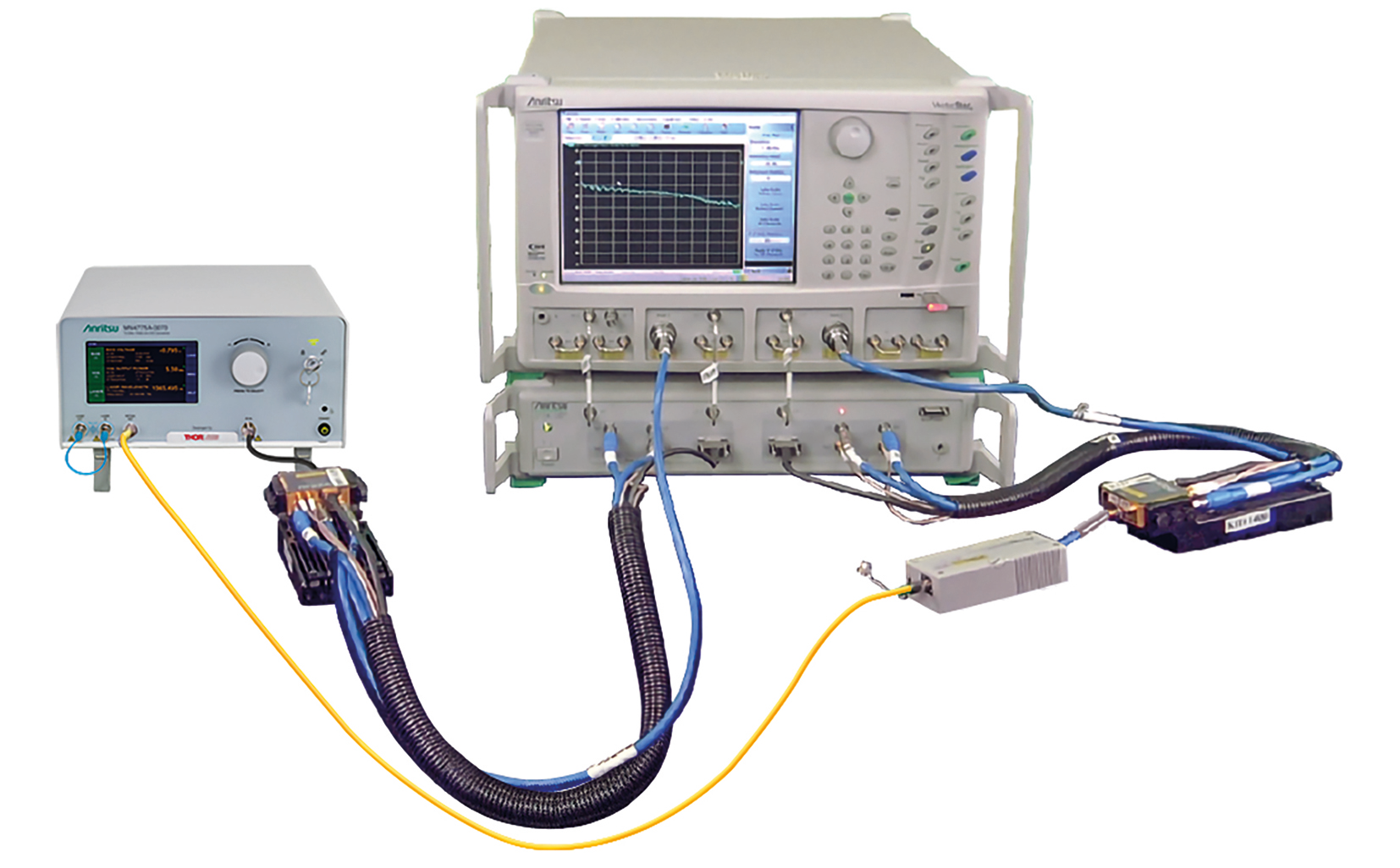
Anritsu’s VectorStar ME7848A optoelectronic network analyser has been adopted by Taiwan’s MSSCORPS for its MSS HG silicon photonics inspection equipment. The integration adds electrical and optical measurement options to the company’s semiconductor analysis platform, enabling characterisation of photonic components used in high-speed data transmission. Anritsu’s Taiwan operation reported the collaboration on 3 November, before the company circulated further regional versions later in the month.
The MSS HG system is intended for semiconductor inspection, where electrical probing alone cannot describe the behaviour of an optical link. Photonic devices may contain modulators, photodetectors and waveguides whose performance changes with optical wavelength and modulation frequency. Characterising the conversions between electrical and optical signals can expose bandwidth limitations or signal distortion before components are integrated into a larger optical communications assembly.
VectorStar combines microwave network analysis with optoelectronic conversion and calibration hardware. Anritsu specifies optical-to-electrical, electrical-to-optical and optical-to-optical measurements at wavelengths of 850nm, 1310nm and 1550nm, according to the fitted configuration. Each measurement path needs appropriate conversion devices and calibration; the three wavelengths are supported configurations, not evidence that a single optical connection covers all of them simultaneously.
On the MSS HG platform, the additional measurement options cover responsivity, frequency response, conversion efficiency, transfer function, group delay and optical loss. These parameters answer different design questions. Frequency response indicates how a receiver or modulator behaves as the modulation rate changes. Group delay records variation in signal propagation time with frequency, while optical loss describes attenuation through a device or connection. Together they provide information beyond a simple pass-or-fail electrical continuity test.
Such parameters are particularly relevant to integrated photonic circuits that must carry high-speed data without excessive distortion. A receiver may provide adequate optical sensitivity at one operating point but show reduced response at higher modulation frequencies. A modulator can likewise introduce amplitude or phase variations that affect the recovered electrical signal. Testing these behaviours across a defined operating range allows designers to compare devices and identify deviations, although it does not replace system-level assessment of a complete communications link.
The instrument family supports measurement configurations at 70GHz, 110GHz and 145GHz, with Anritsu also describing arrangements extending to 170GHz. Available frequency coverage depends on the particular instruments, converters and calibration path. Anritsu identifies its MN4765B optical-to-electrical calibration module as providing a measurement chain traceable to the US National Institute of Standards and Technology. Traceability concerns the calibration reference; it is not a blanket certification of every result obtained with the MSS HG equipment.
Adding these measurements within an inspection system could reduce the need to move samples between separate test setups, subject to wafer handling, probe alignment and the options installed. Neither company has supplied comparative inspection-cycle figures, manufacturing yield data or deployment volumes. Repeatability therefore remains a question of the complete measurement configuration, including optical coupling, fixtures and environmental conditions, rather than an intrinsic property of the analyser alone.
MSSCORPS intends to make further functions available through the modular architecture, including eye diagram analysis and bit error rate testing. An eye diagram reveals amplitude and timing behaviour across repeated digital signal transitions; a bit error rate test counts incorrect decisions over a defined number of transmitted bits. Both would complement analogue frequency-domain measurements, but their inclusion in future MSS HG configurations has not been presented as a completed installation.
Advanced optical packaging creates further measurement demands because an integrated circuit, photonic die and external fibre connections may contribute different losses or distortions. Co-packaged optics, which places optical communications functions close to electronic processing devices, makes the ability to characterise devices and connections under repeatable conditions increasingly useful. Results nevertheless depend on calibration, test fixtures, coupling alignment and environmental stability, and cannot be inferred from the headline frequency capability alone.
Wafer manufacturers, integrated circuit designers and co-packaged optics suppliers are among the intended users of the combined platform. The confirmed development is MSSCORPS’s integration of Anritsu optoelectronic measurement capability with its inspection equipment. Any wider claims about production throughput or the proposed additional tests will depend on subsequent equipment specifications and operating results.