
IN Brief:
- General Atomics, Thales Belgium, Octave Intelligence, and dotOcean will collaborate on MQ-9B ISR integration and manufacturing activity.
- The work covers C4ISR software, geospatial visualisation, sensor processing, automated exploitation, and human-machine interfaces.
- A demonstration is planned during 2026 as Belgium develops domestic industrial capability around its MQ-9B fleet.
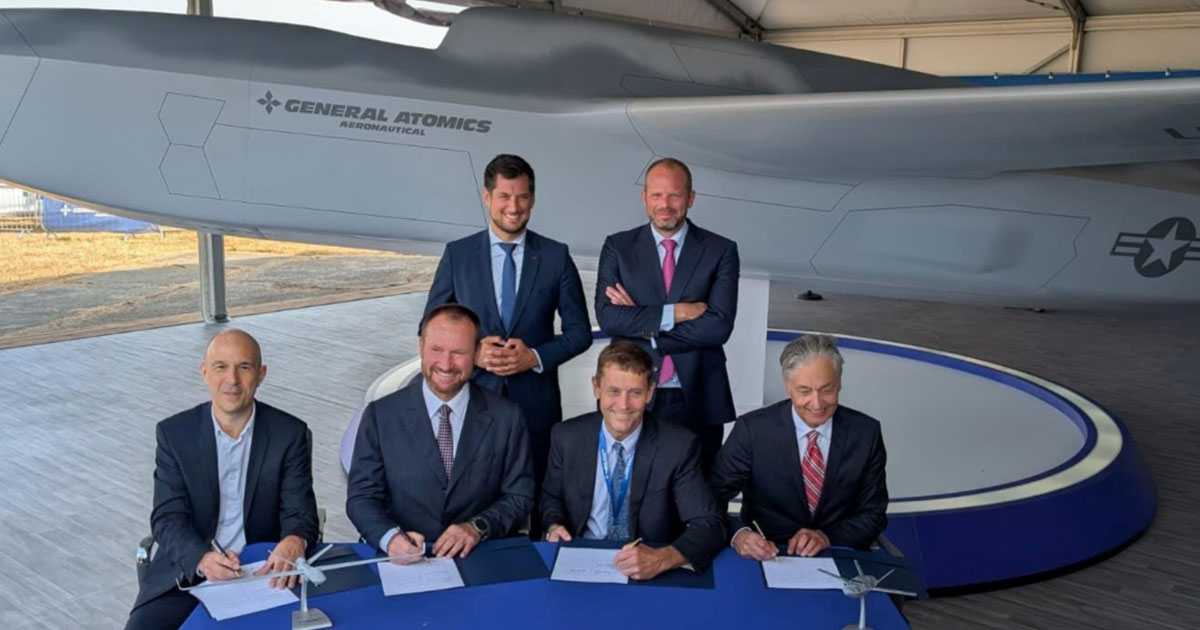
General Atomics Aeronautical Systems, Thales Belgium, Octave Intelligence, and dotOcean have agreed to integrate Belgian-developed command, intelligence, geospatial, and sensor-processing software with the MQ-9B SkyGuardian and SeaGuardian remotely piloted aircraft.
The memorandum covers integration and manufacturing activity supporting multi-domain intelligence, surveillance, and reconnaissance operations. Work will centre on the processing, exploitation, and dissemination chain that converts aircraft sensor output into information that can be visualised, correlated, shared, and acted upon across command networks.
Thales Belgium will contribute C4ISR software connecting operational stakeholders and supporting real-time information exchange. Octave Intelligence will provide technology from its Alto portfolio, formerly Luciad, for high-performance geospatial visualisation, while dotOcean will supply processing software that converts sensor data into structured information for automation and artificial-intelligence systems.
General Atomics expects Belgian companies to provide elements of the human-machine interface, external-interface adaptors, and automated data exploitation. A demonstration is planned before the end of 2026, with scope for further capabilities to be introduced through later trials.
Belgium selected MQ-9B for its remotely piloted aircraft requirement and has joined the United Kingdom among the first European operators of the platform. The same aircraft family underpins the Royal Air Force’s Protector RG Mk1 programme, creating a wider European base for mission software, support, training, and payload integration.
Long-endurance aircraft can generate persistent electro-optical imagery, radar tracks, positional metadata, communications information, and other mission data over periods extending beyond 40 hours. As sensor coverage and resolution increase, the limiting factor moves towards the rate at which information can be processed and distributed without obscuring the events that require immediate attention.
Geospatial software provides the framework for combining those sources across terrain, airspace, maritime boundaries, mission routes, intelligence layers, and tracks from other platforms. Displays must handle large datasets and several coordinate systems while preserving timing, provenance, classification, and confidence information for each item shown to an operator.
Automated exploitation can identify changes, classify objects, prioritise tracks, or highlight unusual behaviour, but the algorithms have to operate within controlled thresholds and clearly defined authority. A machine-generated assessment must remain distinguishable from verified intelligence and from decisions taken by an authorised operator.
Integration becomes more difficult when nationally developed software connects with a US-designed air vehicle and coalition command networks. Data formats, encryption, cybersecurity boundaries, latency, export controls, releasability rules, and interface ownership can constrain functions that appear straightforward at application level.
Modular interfaces allow analytical and visualisation software to evolve more quickly than the aircraft structure, although every revision still requires configuration control and regression testing. Updates to one processing component cannot be allowed to disturb flight-critical software, communications security, sensor timing, or the evidential chain attached to collected data.
Protector’s weapon qualification has shown the breadth of work required around apparently discrete integrations. Brimstone and Paveway testing has involved aircraft software, ground-control functions, interfaces, modelling, carriage trials, and release certification rather than attachment hardware alone.
The Belgian programme addresses the intelligence side of the same systems problem. Sensor output must pass through secure communications, processing, visualisation, interpretation, and dissemination while retaining sufficient context for different users to understand where the information originated and how recently it was collected.
European software content also gives operators greater control over functions that may need to change during the aircraft’s service life. National threat libraries, mapping data, target-recognition models, maritime surveillance tools, and command interfaces can be updated independently, provided the underlying architecture exposes stable and adequately documented boundaries.
Industrial participation will therefore depend on more than completing a single demonstration. Sustained access to development environments, interface documentation, verification evidence, cybersecurity processes, and aircraft upgrade schedules will determine whether Belgian companies remain involved when sensors, communications links, and mission requirements change.
If the planned demonstration proves the combined architecture, Belgium will have established a domestic software layer around an internationally operated air vehicle. The resulting capability could be adopted by other MQ-9B users, but its durability will rest on controlled interfaces and support arrangements that survive successive aircraft and mission-system updates.

