
IN Brief:
- A private 5G network carried four live video feeds between Challenger 2, Boxer, and Bulldog vehicles.
- Sources included an unmanned aircraft and fixed cameras positioned around the exercise area.
- The experiment examined how dispersed headquarters could share sensor data without concentrating personnel and equipment.
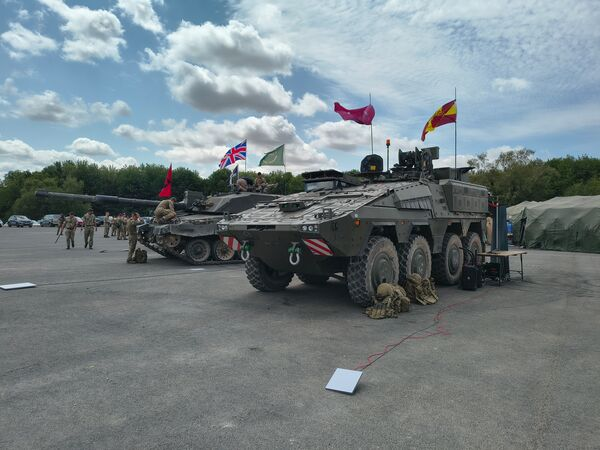
The British Army has used a private 5G network to distribute several live video feeds between armoured platforms during an experiment with a dispersed command post on Salisbury Plain.
Conducted by 7th Signal Group during Exercise Mercury Acumen, the demonstration connected a Challenger 2 tank acting as the forward element, a Boxer in command configuration, and a Bulldog communications vehicle. Each platform could receive imagery from the shared network without requiring the vehicles and their crews to occupy one concentrated headquarters site.
A Kestrel Indago 4 unmanned aircraft and three fixed transceivers supplied the video, producing four simultaneous feeds for display inside the Challenger 2, Boxer, and Bulldog. The central trial moved full motion video from the aircraft camera into an armoured vehicle turret through the private cellular network while maintaining access at the other nodes.
Unlike a public mobile service, a private 5G installation gives its operator control over the local radio access network, core functions, device permissions, and service configuration. Coverage and capacity can be arranged around a defined operating area, while traffic policies can prioritise video, command data, voice, or other applications according to available bandwidth.
Full motion video places sustained demands on throughput, latency, packet delivery, and processing, especially when several feeds must reach multiple moving platforms. Radio coverage, antenna position, encoding settings, display hardware, and network scheduling all influence whether imagery remains usable when vehicles alter position or terrain obstructs the propagation path.
The experiment did not replace the Army’s wider tactical communications architecture. Instead, it examined how a local high capacity cellular network could carry data intensive services within a dispersed formation and exchange information with systems operating beyond the immediate 5G coverage area.
Dispersion reshapes the electronic architecture
Conventional headquarters concentrate personnel, processors, displays, radios, antennas, and power equipment within a relatively small footprint, simplifying local connections while creating a prominent physical and electromagnetic signature. Separating those functions across several vehicles reduces dependence on one location, but shifts greater responsibility onto networking, timing, identity management, and data synchronisation.
Cellular technology provides a mature method for connecting many devices, although military operation imposes requirements far beyond those of a factory or campus network. Spectrum may be contested, interference can be deliberate, nodes must move through irregular terrain, and backhaul links may disappear without warning; useful services must therefore degrade predictably rather than fail as a single block.
Edge processing can reduce those pressures by compressing imagery, detecting objects, generating tracks, or discarding low priority data before transmission. The same movement towards local analysis is visible in cyber systems that place detection and response closer to deployed networks, limiting dependence on remote infrastructure when connectivity becomes intermittent.
A private 5G network also creates an electronic system that must itself be defended. Base stations, user equipment, timing references, management software, authentication services, and gateways into other tactical networks introduce interfaces that need monitoring, hardening, and controlled update mechanisms throughout deployment.
Electromagnetic visibility produces a further design compromise because additional radio activity can improve situational awareness while making a network easier to detect or locate. Directional antennas, adaptive power control, transmission scheduling, frequency management, and intermittent operation may all be needed to balance connectivity against the risk created by the network’s emissions.
Vehicle integration imposes practical limits of its own. Radios, processors, storage, and displays must tolerate shock, vibration, dust, temperature extremes, and unstable electrical supplies, while antennas need useful coverage without obstructing other equipment or creating unacceptable coupling with existing communications systems.
Interoperability will determine how readily the architecture can move beyond experimental use. Video and sensor data must arrive in formats recognised by command applications, retain dependable timing and location information, and remain subject to permissions that reflect operational roles rather than simple network membership.
Data provenance becomes increasingly important as several sensors contribute to a shared picture. Operators need to know which device produced an image, when it was captured, how it has been processed, and whether any interruption or compression has altered its evidential value; raw bandwidth alone cannot preserve that context.
The Salisbury Plain exercise established that four live feeds could be shared across three armoured platform types through a private 5G network. Longer range operation, resilience under interference, secure integration with existing radios, and service management across moving nodes now form the harder engineering stages between a successful demonstration and routine field deployment.

