
IN Brief:
- Order intake reached CHF399.8m, producing a book-to-bill ratio of 1.2 for the fifth consecutive quarter.
- Aerospace and defence revenue increased 55% and represented 28% of group sales.
- Cicor is consolidating production while preparing for stronger second-half revenue and continued component constraints.
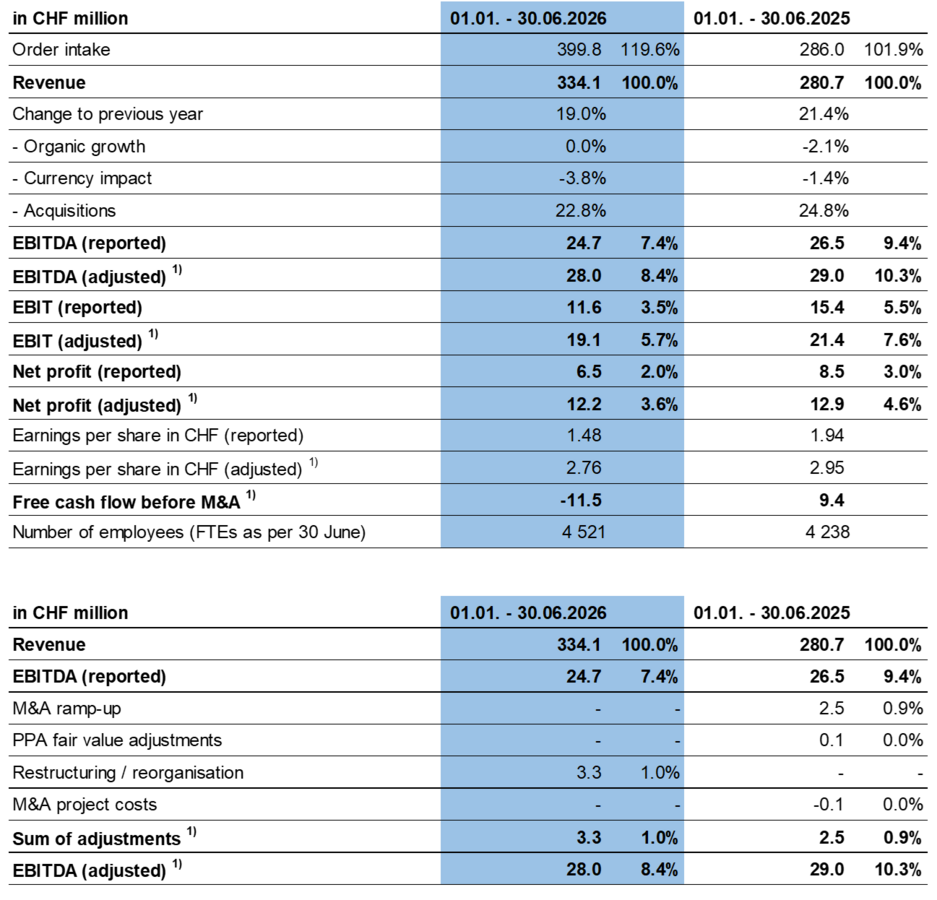
Cicor increased first-half order intake by 39.8% to CHF399.8m as European defence-electronics demand strengthened and recently acquired operations expanded the group’s manufacturing footprint.
Revenue rose 19% to CHF334.1m, while the book-to-bill ratio reached 1.2 for the fifth consecutive quarter. Organic growth was flat across the half after component availability and supply constraints affected the first quarter, then returned to 5.3% during the second quarter.
Aerospace and defence revenue increased 55%, supported by double-digit organic growth, and represented 28% of group sales. Cicor added two customers in the sector, including Kongsberg, and now supplies around three-quarters of Europe’s leading defence prime contractors.
Initial orders from those customers and a French rail-infrastructure partnership are expected during 2026, with their combined annual revenue contribution forecast to exceed CHF20m once programmes reach normal production. A separate French defence-electronics award has already produced purchase orders approaching €10m and carries longer-term revenue potential above €50m.
Rapid expansion has increased scale while temporarily reducing profitability. Adjusted EBITDA was CHF28m, equivalent to 8.4% of revenue, compared with CHF29m and 10.3% a year earlier, as production transfers, factory integration, capacity additions, and higher inventories absorbed resources.
Most of a restructuring programme intended to provide more than CHF10m in recurring annual EBITDA improvement has now been completed. Manufacturing transfers between Tunisia, Morocco, Geneva, Newport, Singapore, and Batam are concentrating work within selected sites while simplifying management and reducing duplicated capacity.
Approximately 220 positions are being removed, including employees at the divested Tunisian operation. North African manufacturing is being concentrated near Casablanca, work from Geneva is moving to Newport and Bronschhofen, and selected Singapore activities are transferring to Batam in Indonesia.
The changes expose the tension facing Europe’s electronics manufacturing services sector. Defence, medical, and industrial customers increasingly require regional engineering, controlled supply chains, secure production, and long-term support, yet EMS providers must maintain competitive costs across processes that vary widely in labour content, automation potential, and qualification burden.
Defence programmes provide longer visibility than many commercial markets, but they impose strict configuration control. Assemblies may remain in service for decades while component manufacturers revise or discontinue commercial devices, leaving the EMS provider to manage obsolescence, approved alternatives, controlled repairs, documentation, and secure storage alongside routine production.
Higher order intake is also increasing working-capital requirements. Free cash flow before acquisitions was negative CHF11.5m as receivables and inventories rose. The additional stock is intended to support stronger second-half production and protect programmes from component delays, although it ties up cash before finished equipment is accepted and paid for.
Supply has improved across much of the electronics market, but high-reliability production remains vulnerable to shortages in specialist devices. Defence assemblies often use modest volumes of radiation-tolerant parts, RF components, secure processors, precision timing devices, and qualified connectors that do not always receive priority when manufacturing capacity is directed towards larger commercial markets.
Cicor’s geographic concentration adds further exposure. Europe, the Middle East, and Africa generated 86% of group revenue, including 23% from the UK, 16% from Switzerland, 15% from France, and 14% from Germany. Continued expansion therefore depends heavily on regional industrial, healthcare, and defence investment moving beyond isolated procurement cycles.
The group expects revenue between CHF700m and CHF750m, with adjusted EBITDA of CHF70m to CHF80m. Second-half revenue is forecast to exceed the first half by 10% to 25%, supported by the order book, integration benefits, and the return of organic growth.
Execution now moves from acquisition and restructuring into sustained production delivery. Cicor must convert a larger European factory network into consistent margins, cash generation, and dependable high-reliability output while managing component constraints and programme transfers that leave little tolerance for disruption.

