
IN Brief:
- Delos Data has introduced its Nonstop AI platform for large-scale AI inference systems.
- The portfolio includes server and management technology for scale-up accelerator domains.
- AI infrastructure design is increasingly constrained by interconnect, memory access, and utilisation efficiency.
Delos Data has launched its Nonstop AI platform, targeting the interconnect and utilisation bottlenecks that appear as AI inference systems scale across large numbers of GPUs, CPUs, and accelerators.
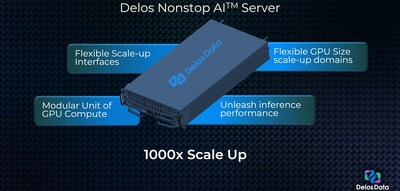
The platform includes Delos Server, which brings scale-up I/O to the server faceplate, and Delos Mosaic, a management layer designed to provide visibility across scale-up domains. The architecture supports flexible system scaling based on model size, inference demand, and accelerator mix.
Delos is focusing on AI inference rather than only model training. That distinction is becoming more important as AI workloads move from experimental deployment into production services, where operators need consistent throughput, predictable latency, and stronger energy efficiency across changing model portfolios.
The platform is designed to reduce GPU idle time by improving how compute is distributed and interconnected. Accelerator performance is no longer determined only by the device at the centre of the board. Memory access, east-west traffic, cable reach, switching behaviour, system management, and failure handling all influence delivered performance.
AI infrastructure growth is already affecting the wider component base. Rising accelerator deployment has contributed to tighter MLCC supply, with power delivery, passives, cooling, substrates, and interconnect technologies all being pulled into the build-out.
That pressure is broadening the definition of processor system design. A large AI deployment is not simply a group of accelerators connected to a network. It is a tightly coupled electrical, mechanical, and software-managed environment where signal integrity, thermal limits, power density, and orchestration all affect cost per token and tokens per watt.
Scale-up architectures are particularly demanding because they attempt to make multiple accelerators behave as a closely coordinated compute resource. That can reduce data movement penalties and improve utilisation for heavy inference workloads, but it also places greater stress on the physical interconnect.
Cable management, connector density, retimer use, and serviceability all become engineering issues in these environments. As more compute is packed into each deployment, the ability to manage and reconfigure scale-up domains may become as important as the performance of the accelerator silicon itself.
Delos plans early access for selected customers ahead of broader availability in the fourth quarter of 2026. Its platform enters the market as hyperscale AI operators, cloud providers, and systems companies look for more work from each accelerator before adding more silicon, power, and cooling capacity.
AI models are also diversifying. Some workloads will need large shared memory pools and high-bandwidth scale-up fabrics, while others will require lower-latency distributed inference closer to users and industrial systems. Flexible topologies could therefore become more valuable than fixed accelerator blocks built around a single expected workload.
Delos’ launch highlights a shift in AI hardware competition. The next gains will depend on system architecture, interconnect management, and utilisation efficiency as much as raw processor performance.

