IN Brief:
- Delta has opened a new R&D centre in Soest, Germany, to support AI data centre and e-mobility power development.
- The facility includes 7,500m² of laboratory space and 2,500m² of office space for up to 250 people.
- The centre strengthens European engineering capacity around grid-to-chip power, 800VDC server supplies, and integrated EV power systems.
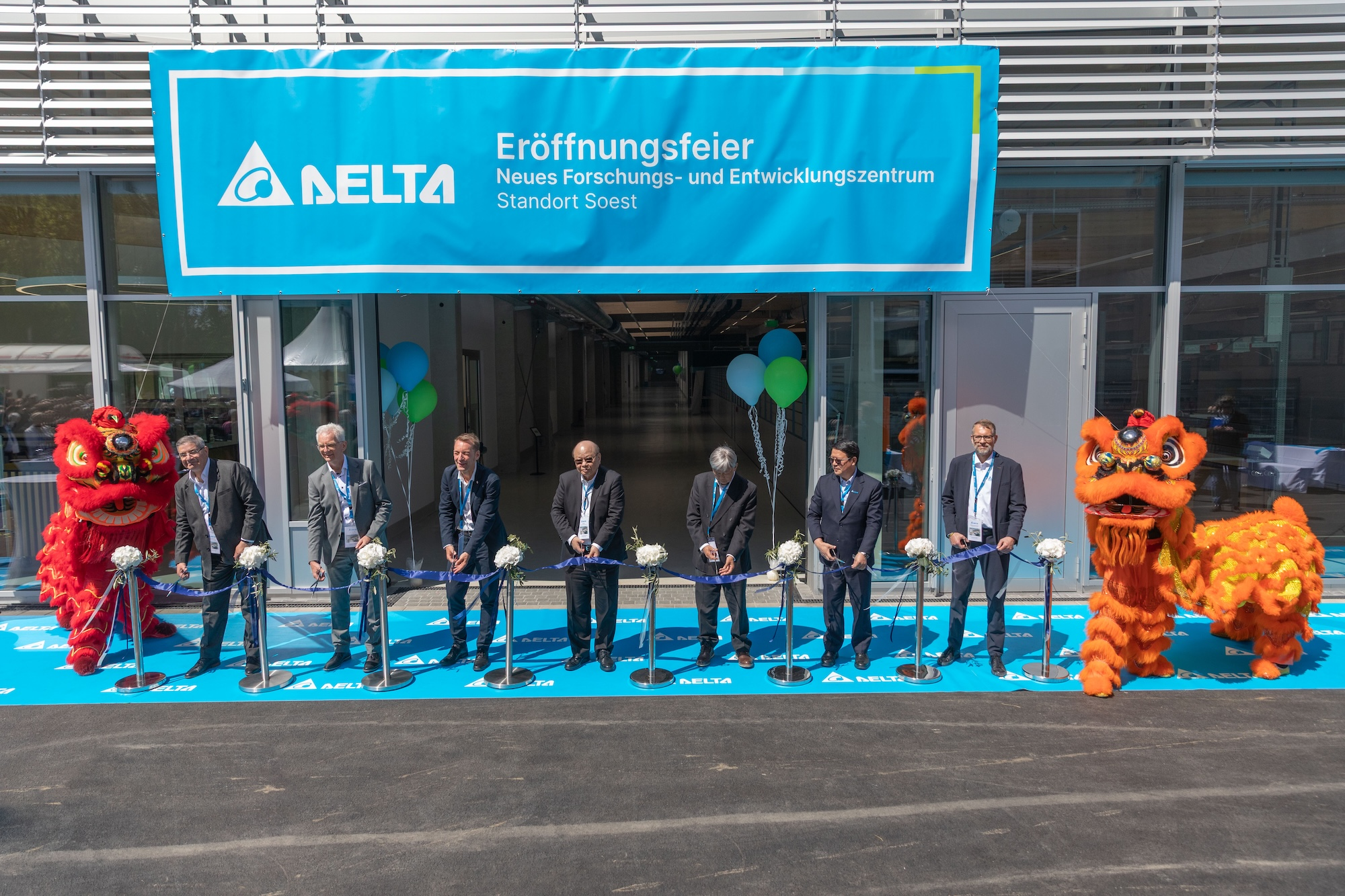
Delta has opened a new research and development centre in Soest, Germany, expanding its European engineering base for high-efficiency power systems used in AI data centres, high-performance computing infrastructure, and electric mobility.
The facility adds 7,500m² of advanced R&D laboratory space and 2,500m² of office space, with capacity for up to 250 people. It will support development work on technologies including 800VDC server power supplies and 4-in-1 EV power systems, both of which sit at the centre of rising demands for higher conversion efficiency, greater power density, and more compact system integration.
Delta already employs approximately 450 people from 35 nations at its Soest site, which operates as a central competence hub for high-efficiency power and charging solutions. The new building will house existing engineering teams and support further recruitment as laboratory requirements expand around data centre, automotive, and industrial energy systems.
Dr Peter Ide, managing director of Delta Energy Systems, said: “Soest has been a vital innovation engine for Delta in EMEA for decades, and this expansion reflects our commitment to strengthening localized R&D capabilities in Europe. It enables closer collaboration with customers and faster development of advanced and sustainable solutions for data center and automotive applications. In the field of AI, Delta’s engineers in Soest play a key role in developing advanced power solutions across the ‘grid-to-chip’ value chain.”
The grid-to-chip reference points to the changing structure of AI data centre power design. Electrical efficiency is no longer treated only at facility level, where improvements are measured through cooling, backup infrastructure, and grid connection strategies. Power architecture is now being pushed deeper into the rack, board, and processor supply chain, as accelerator densities increase and each conversion stage adds cost, heat, and design complexity.
High-performance AI clusters place severe demands on power conversion. Server supplies have to manage higher loads, faster transients, tighter thermal limits, and greater system redundancy, while data centre operators work to contain energy consumption and cooling overhead. The move towards 800VDC supply architectures is part of that wider push to reduce conversion losses and simplify distribution in power-dense compute environments.
Automotive electrification is creating similar engineering pressure. Integrated EV power systems are being developed to reduce weight, volume, wiring complexity, and subsystem count across vehicle platforms. Combining charging, conversion, and control functions can simplify packaging, but it also raises the engineering burden around thermal design, electromagnetic compatibility, reliability, and service life.
The Soest centre gives Delta additional laboratory capacity close to European customers working on these systems. Regional R&D capability helps shorten development loops where application engineering, validation, compliance, and customer-specific requirements need to be resolved before products move into production qualification.
Andreas Kostrzewa, managing director of Delta Energy Systems, said: “Customer requirements are escalating rapidly, both technologically and in terms of energy efficiency and scalability. With this new development center, we are establishing optimal conditions to implement innovations faster and further expand our global competitiveness.”
The building has been designed to meet EG 40 energy efficiency standards and achieve LEED Gold certification. It integrates a photovoltaic system with more than 1MW of installed capacity, expected to generate more than 1 million kWh of solar energy annually, alongside heat pumps, a 2.5MW / 5MWh battery energy storage system, and intelligent energy management.
Process heat generated during product testing will be used to heat the building, connecting laboratory operation with site energy management. The site also includes a DC fast charging station and more than 60 AC EV charging points for employees.
Delta has also used a combination of retained concrete structure and modern timber-hybrid construction. The company maintains partnerships with universities in Soest, Paderborn, Hannover, Berlin, Eindhoven, and Aalborg, giving the expanded centre a wider role in European power electronics skills development as demand rises across data centre and e-mobility platforms.