IN Brief:
- Dynex has developed a 450A, 650V GaN half-bridge power module.
- The module uses planar PCB embedding, double-sided cooling, and sub-1nH commutation loop inductance.
- The design targets high-density power conversion in EV, energy, charging, industrial, and data-centre applications.
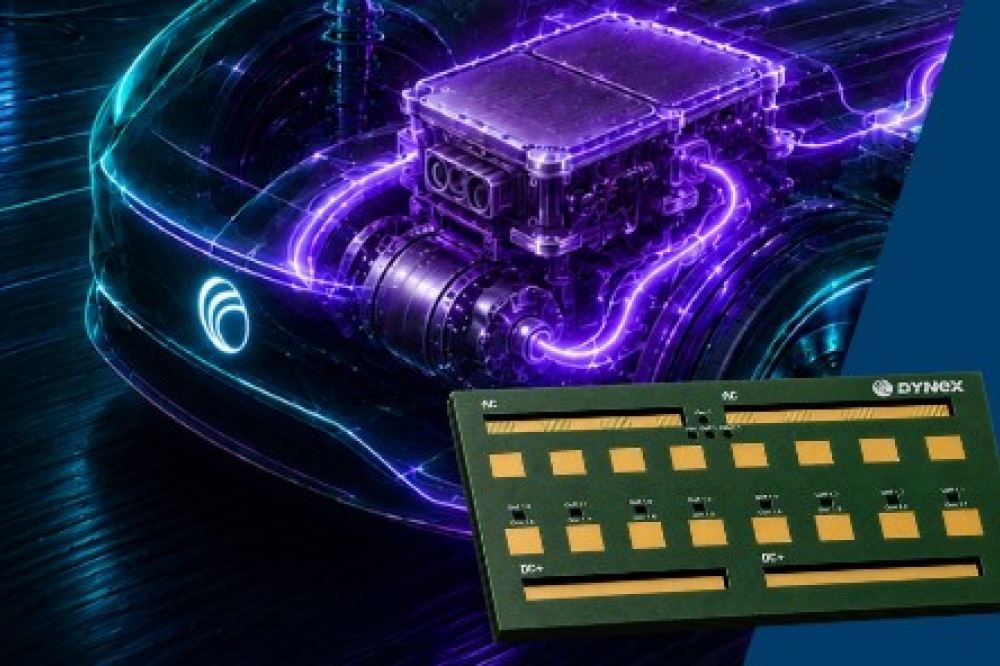
Dynex Semiconductor has developed a 450A, 650V GaN half-bridge power module for high-density conversion in EVs, renewable energy systems, storage, fast charging, data-centre power supplies, and industrial electronics.
The Lincoln-based company’s module combines gallium nitride semiconductor technology with packaging designed to reduce parasitics and improve thermal performance. Key specifications include 450A continuous current capability, 650V blocking voltage, a half-bridge inverter configuration, planar PCB embedding, double-sided cooling, and commutation loop inductance below 1nH.
The planar PCB embedding approach is used to minimise parasitic inductance within the power loop, supporting fast and stable switching. It also allows closer matching and balancing of parallel GaN devices, helping maintain more consistent switching behaviour across the module.
Thermal performance is addressed through a double-sided cooled planar package structure, reducing resistance between the semiconductor junction and the cooling system. In high-power GaN designs, the thermal path is not a secondary packaging issue, since switching speed and power density can quickly expose weaknesses in layout, interconnect, and heat removal.
GaN power devices have moved beyond compact chargers into higher-value conversion markets where frequency, efficiency, and size are under constant pressure. The material offers high switching speed, low switching losses, and the potential for smaller passives, but those advantages can be eroded if the module introduces excessive inductance, uneven current sharing, or difficult thermal behaviour.
Design and verification workflows are also maturing around GaN, with new approaches to reducing GaN MMIC design risk showing how the material is moving through a broader industrialisation phase. Whether used in RF or power conversion, GaN depends on strong modelling, packaging discipline, and early validation to avoid late-stage performance surprises.
In a fast-switching power module, parasitic inductance directly affects overshoot, ringing, EMI, uneven current distribution, and device stress. Keeping the commutation loop below 1nH helps preserve the switching performance that designers choose GaN to obtain, while reducing the amount of compensation or derating required later in the converter design.
Double-sided cooling addresses the matching thermal problem. Higher power density only reduces system size if heat can be removed predictably, and the final system has to survive outside a controlled laboratory setup. EV converters, charging modules, storage systems, solar equipment, and AI data-centre supplies all face tight thermal limits, with cooling design affecting enclosure size, reliability, maintenance, and cost.
The module also sits alongside continuing wide-bandgap activity in adjacent power markets, including expanded SiC modules for data-centre, EV charging, storage, solar, and industrial drive applications. GaN and SiC are often grouped together, but their best-fit use cases differ by voltage, current, switching frequency, thermal environment, and system economics.
Dynex’s 650V GaN module addresses a range where compact, high-frequency conversion is especially attractive. Designers working on high-density supplies, chargers, storage converters, and industrial power stages need usable building blocks rather than discrete-device layouts that have to be solved from first principles on every programme.
Adoption will depend on qualification, availability, gate-drive behaviour, thermal impedance, EMI performance, protection strategy, and converter-level evidence. If the packaging delivers on its low-inductance and thermal claims in production designs, the module could help move high-current GaN from promising device technology into more practical industrial power platforms.