IN Brief:
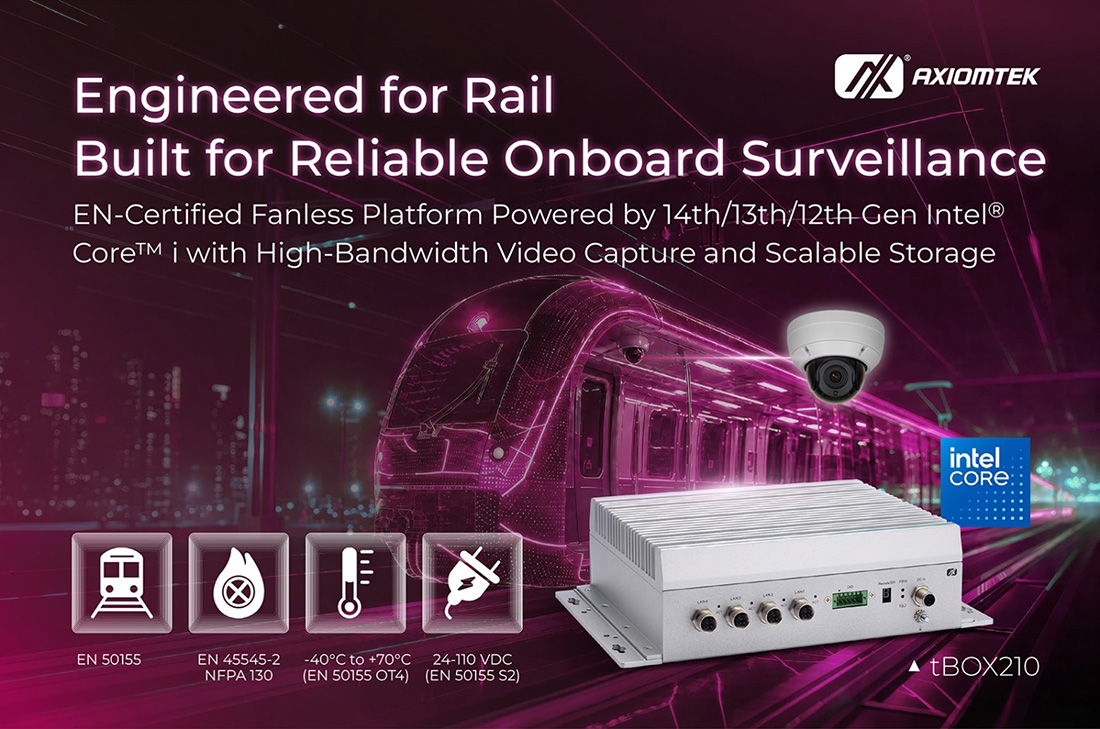
- The tBOX210 supports 12th, 13th, and 14th generation Intel Core processors with up to 32GB of DDR5 memory.
- Four rugged 2.5GbE interfaces and removable RAID storage support onboard video and data workloads.
- Railway, fire safety, shock, vibration, and wide temperature certifications target demanding rolling stock installations.
FORTEC United Kingdom has added Axiomtek’s tBOX210 fanless railway computer to its British transport portfolio, targeting onboard surveillance, condition monitoring, passenger information, and local data processing.
The system supports 12th, 13th, and 14th generation Intel Core processors, with configurations extending from Core i3 to Core i9 devices and a processor thermal design power of 35W. Up to 32GB of DDR5 memory can be installed, providing capacity for video handling, analytics, and several concurrent vehicle applications.
Storage options comprise an NVMe device for the operating system and either two or four removable 2.5in SATA drives measuring up to 15mm thick. RAID support allows capacity and redundancy to be arranged around continuous recording, operational data, and the retention periods required by a particular fleet or application.
Four X coded M12 Ethernet interfaces provide 2.5Gbps connectivity for cameras, sensors, displays, and other onboard equipment. Their threaded circular connectors are better suited to vibration and repeated maintenance than office style network plugs, while the higher link rate creates additional headroom for several high resolution video streams.
M.2 and PCI Express Mini Card slots support 5G, LTE, Wi-Fi, Bluetooth, and satellite navigation options, enabling the computer to combine local processing with depot, control centre, or passenger connectivity. A Trusted Platform Module 2.0 device supplies protected cryptographic storage for secure boot, device identity, and other security functions.
Input voltage can range from 24V to 110V DC, covering common rolling stock electrical systems without an additional external converter. Overcurrent, overvoltage, undervoltage, and reverse polarity protection are included, while programmable ignition control coordinates startup and shutdown with the operating state of the vehicle.
Environmental specifications include operation from minus 40°C to 70°C and compliance with EN 50155 for electronic equipment on rolling stock. The design also addresses EN 45545-2 and NFPA 130 fire requirements, EN 61373 shock and vibration, and selected MIL-STD-810G environmental tests.
Onboard processing moves beyond recording
Railway computing loads are growing as operators add higher resolution surveillance, passenger counting, driver monitoring, predictive maintenance, and real time information systems. Processing more of that data inside the vehicle reduces dependence on external connectivity and allows faults or security events to be identified without waiting for a remote server.
Local analysis can also lower communications costs by transmitting alerts, metadata, and selected clips instead of every camera stream. That approach requires enough processing headroom to run inference and recording simultaneously, while preserving predictable performance when several applications share memory, storage, and network interfaces.
The four 2.5GbE ports provide considerable aggregate bandwidth, although the practical requirement depends on camera resolution, frame rate, codec, retention period, and the number of concurrent streams. High resolution footage can consume storage rapidly, particularly when recordings must be retained throughout long journeys or preserved for investigation.
Removable drives simplify replacement and evidence retrieval, while RAID can maintain service after an individual disk failure. Neither feature replaces disciplined data management, because storage must also withstand vibration, temperature changes, sustained writes, and sudden power loss without corrupting recordings or shortening media life.
Processor selection involves a parallel compromise between analytical capacity and thermal load. Higher performance Core devices can support more video channels and more complex models, but their heat still has to leave the sealed chassis through its mounting surfaces and surrounding airflow even though the absence of a fan removes one mechanical failure point.
The tBOX210 joins a broader move towards modular and rugged edge platforms, including SMARC systems that separate processor modules from application specific carrier boards. Axiomtek has taken a more integrated route here, combining certified power conditioning, networking, storage, and environmental protection within one enclosure.
Certification of the computer does not automatically qualify the finished installation. Cables, antennas, cameras, displays, mounting hardware, power distribution, and software all need assessment within the intended vehicle, while electromagnetic compatibility can change once several systems share the same cabinet and cable routes.
Cybersecurity extends that qualification over the product’s service life. Wireless modules and remote management improve availability and maintenance, yet they also introduce interfaces that require secure boot, signed updates, encrypted storage, network segmentation, credential management, and dependable patch support over periods far longer than those common in office computing.
FORTEC’s addition of the tBOX210 gives British integrators local access to a platform developed around rolling stock constraints rather than adapted from general industrial hardware. Reliable deployment will depend on how each project balances processor performance, storage endurance, thermal behaviour, network capacity, certification, and long term software maintenance.