IN Brief:
- CRYME can test electronic materials, components, and systems at temperatures down to 4 K, or -269 °C.
- Two cryostats, a cryogenic materials test system, and a cryogenic scanning electron microscope support the laboratory.
- Industry collaborations have already begun as Chemnitz expands cryogenic reliability work for quantum and heterogeneous integration.
Fraunhofer ENAS and Chemnitz University of Technology have opened the Cryo-Lab for Materials and Electronics Packaging Chemnitz, extending semiconductor and packaging reliability work to temperatures as low as 4 K, or -269 °C. Known as CRYME, the laboratory sits within the university’s MAIN research centre and forms part of the European Test and Reliability Center in Chemnitz. Its remit covers materials, components, packaging structures, and complete systems intended to operate under the cryogenic conditions required by several quantum computing architectures.
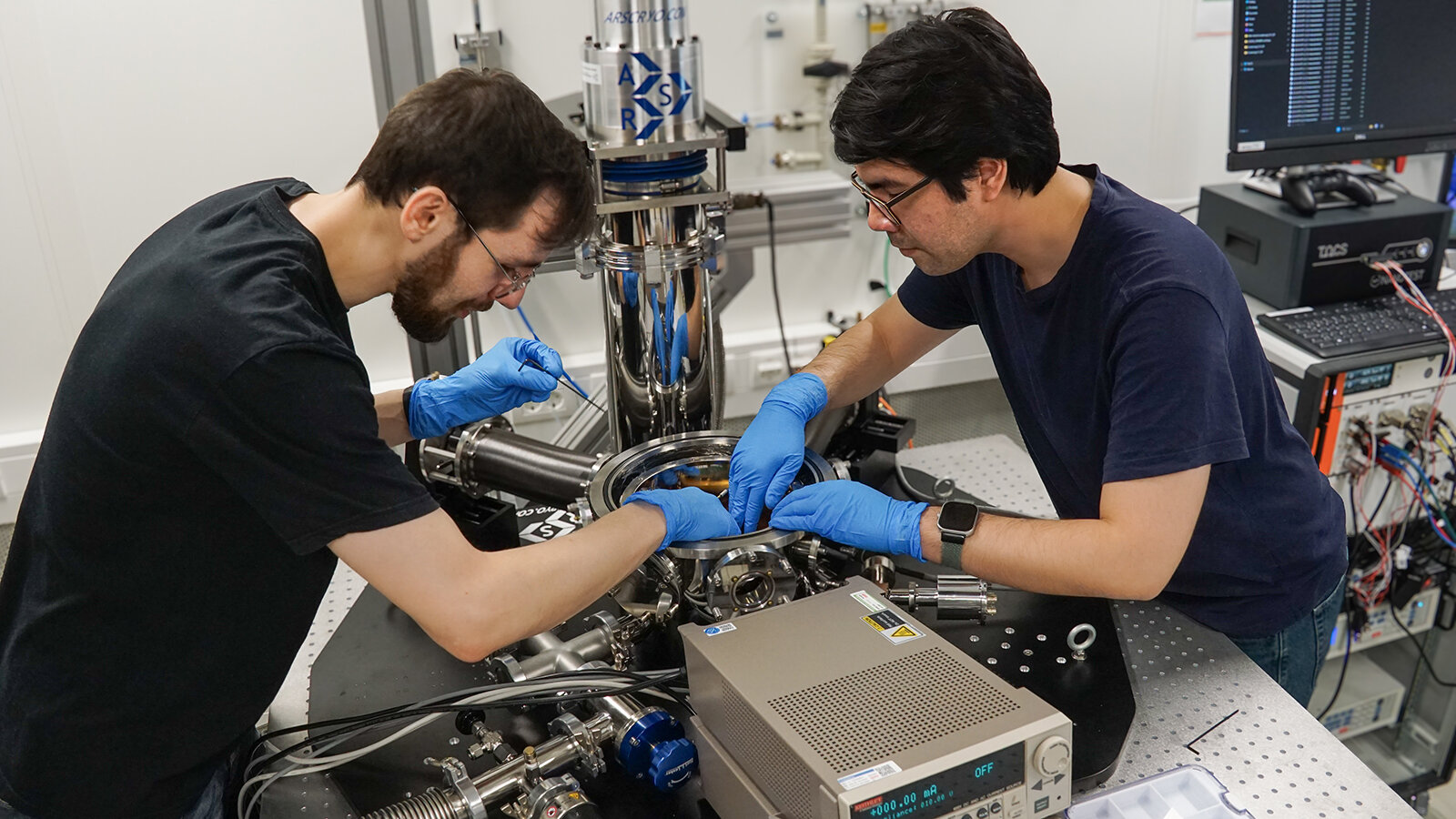
The facility combines two cryostats with a cryogenic materials testing system and a cryogenic scanning electron microscope. One test rig can determine the thermal properties of thin films from -269 °C to +25 °C, while the wider equipment set supports electrical, photonic, mechanical, and thermomechanical characterisation. The equipment was acquired through an investment project funded by Germany’s Federal Ministry of Research, Technology and Space and is being operated jointly by Fraunhofer ENAS and Chemnitz University of Technology.
Cryogenic operation creates a difficult reliability problem because electronics and packaging materials must continue to behave predictably as temperature falls towards absolute zero. Ion-trap quantum computers, for example, can require trapped ions to operate below 10 K in high vacuum so environmental disturbance is minimised. Miniaturising such systems increases the need for heterogeneous integration, bringing electronic, photonic, mechanical, and packaging elements into tighter physical relationships while their material properties change sharply with temperature.
CRYME is intended to put those interactions under controlled test rather than extrapolate them from room temperature behaviour. Prof Dr Daniel Kriesten, head of the European Test and Reliability Center, said: “These conditions place the highest demands on the integrated microelectronic components and materials.” The centre can now examine system functions, mechanical properties, composite behaviour, and thermomechanical effects at cryogenic temperatures, giving researchers a route to assess functionality, robustness, and lifetime under conditions closer to those expected in service.
The laboratory extends an infrastructure programme that began before the current quantum expansion. Fraunhofer ENAS opened the European Test and Reliability Center in June 2025 as a platform for semiconductor test and reliability work from chip design through front-end processing and packaging. Its wider programme spans technologies including silicon carbide and gallium nitride devices, chiplets, MEMS, and photonic-electronic co-design, alongside thermal and electrical stress methods used to support qualification and production readiness.
Adding a 4 K capability broadens that test envelope into an area where conventional reliability assumptions become less useful. It also links the centre more closely with European work on advanced packaging and heterogeneous integration. For quantum hardware, the packaging challenge is not simply to connect dies and devices; interfaces, films, joints, substrates, and optical structures must remain mechanically and electrically credible after repeated exposure to extreme thermal conditions.
The surrounding Chemnitz infrastructure is part of that work. Some of CRYME’s cryostats use liquid helium supplied by a new liquefaction plant at the neighbouring Institute of Physics, while the laboratory connects with Fraunhofer’s Research Fab Microelectronics Germany and university groups working on micro- and nanotechnology. Fraunhofer says several companies have expressed interest in collaboration, specific joint projects have already begun, and further projects are being planned.
Those industrial projects will provide the first test of whether the new equipment can produce repeatable engineering data beyond academic demonstrations. Quantum hardware still spans competing architectures and rapidly changing integration approaches, so a useful cryogenic test environment has to inform material selection, package design, failure analysis, and reliability models rather than merely show that hardware survives the cold. The Chemnitz facility opened on 2 September alongside a two-day seminar on test and reliability, with its next phase centred on turning an unusually wide temperature range into comparable data for devices and packages that cannot be validated credibly at room temperature.