IN Brief:
- The Ge/Si avalanche photodiode combines 100GHz bandwidth, 5V operation, and 1.8A/W responsivity across O-band and C-band.
- Imec demonstrated a net 400Gbps link with a 3dB receiver-sensitivity improvement using the new detector.
- Further work will address temperature and optical-power reliability alongside integration with high-speed receiver electronics.
imec has demonstrated a 100GHz germanium-silicon avalanche photodiode operating at 5V and used the device in a net 400Gbps optical link, pushing the receiver side of silicon photonics towards higher lane rates without substantially increasing detector bias voltage.
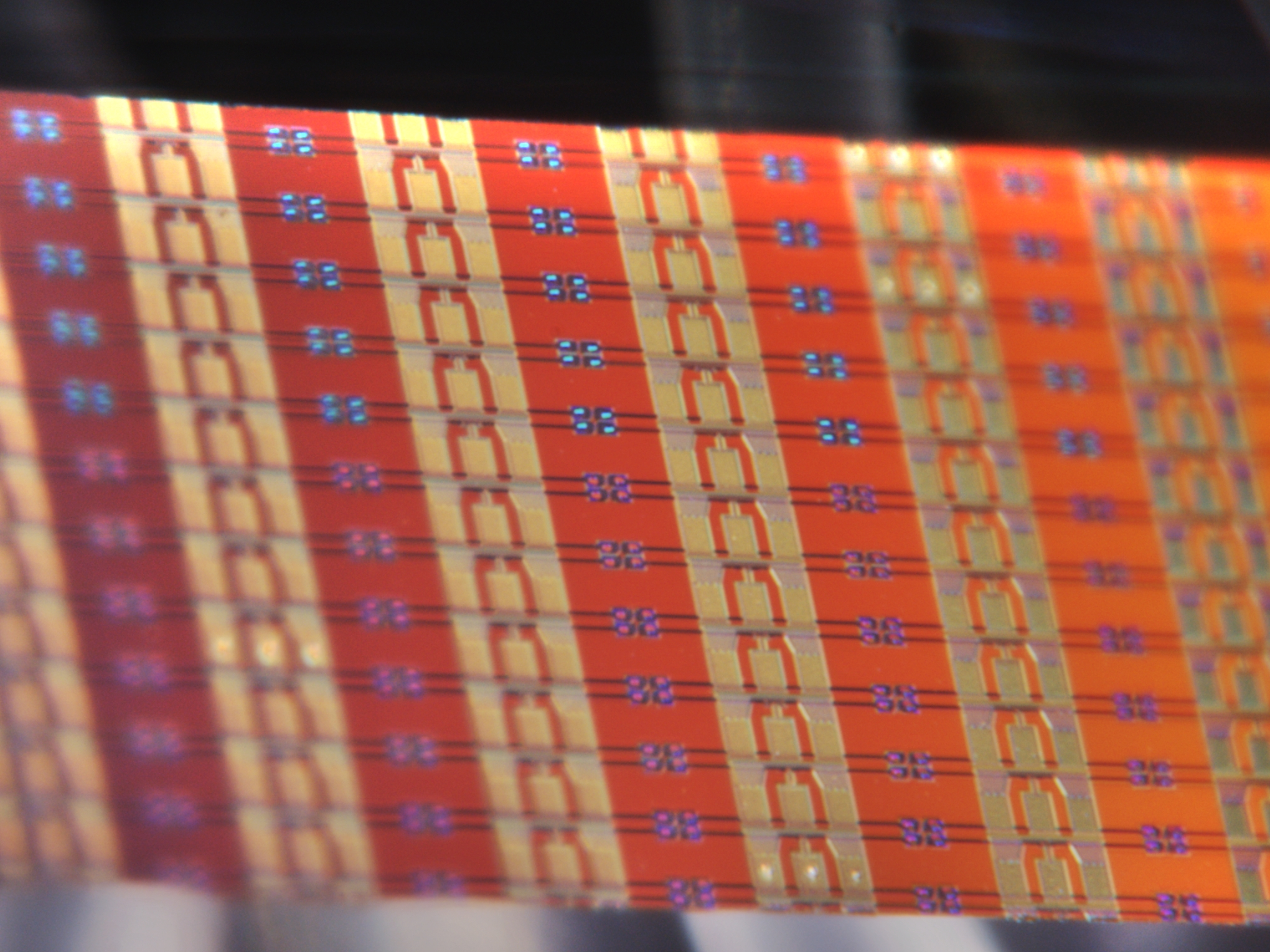
The device was fabricated on imec’s 300mm silicon photonics platform and reaches a responsivity of 1.8A/W across both the O-band and C-band. Imec reports a 3dB receiver-sensitivity improvement compared with a conventional photodiode and approximately twofold internal gain, creating additional optical margin within the link.
Avalanche photodiodes use a high electric field to multiply charge carriers generated by incoming light. The internal gain can improve receiver sensitivity, but increasing avalanche multiplication while preserving very high bandwidth at practical operating voltages has been difficult. Imec’s device addresses that trade-off as datacentre optical links move towards higher per-lane data rates.
The detector uses a separate absorption, charge, and multiplication architecture with substantial changes to the multiplication region. Imec scaled the multiplication layer below 100nm, introduced a deeply recessed germanium-in-silicon structure, and removed the charge layer. The resulting device combines the 100GHz bandwidth, 5V operating point, and 1.8A/W responsivity in the same structure.
Comparable operation in O-band and C-band gives system developers greater freedom over wavelength planning. O-band is widely used for shorter-reach datacentre links because chromatic dispersion is low, while C-band offers a mature ecosystem around amplification and wavelength-division multiplexing. A detector capable of operating effectively in both bands can serve a broader range of optical architectures without changing the underlying receiver concept.
Imec paired the APD with the beyond-110GHz C-band germanium-silicon electro-absorption modulator it presented at ECOC in 2025. The resulting experiment delivered net 400Gbps reception through an APD-based receiver, joining a high-speed transmitter building block with the higher-sensitivity detector in the same silicon photonics development programme.
The work targets scale-up optical interconnects connecting processors, accelerators, memory systems, and network switches. Electrical links remain effective at short reach, but insertion loss, equalisation power, and signal integrity become harder to manage as data rates and physical distances increase. Optical interfaces move part of that transport into the photonic domain while leaving demanding electronic driver and receiver functions at either side.
The detector does not remove the remaining link constraints. Receiver electronics must process the output at comparable bandwidth, while laser power, fibre coupling, packaging, thermal behaviour, and manufacturing variation continue to determine overall system performance. Imec plans further testing across temperature and optical input power before integrating the APD with high-speed receiver electronics.
The additional 3dB of sensitivity can be retained as loss margin or traded against transmitter power, depending on the architecture. In tightly integrated optical systems, extra margin can absorb losses introduced by connectors, coupling structures, waveguides, and package interfaces without demanding more optical power from the laser source.
Manufacturing scale is already built into the research path. The detector is fabricated on imec’s iSiPP300 platform using 300mm silicon photonics processing rather than a stand-alone laboratory flow. That does not establish production readiness, but it places the APD in a process intended for repeatable photonic integration with other transceiver building blocks.
The next milestones will centre on reliability and integration rather than another headline bandwidth figure. Temperature stability, optical-power tolerance, receiver-electronics integration, and repeatability across the 300mm process will determine whether the APD can move from a high-speed demonstration into a practical optical receiver platform.