
IN Brief:
- SPOC Wire Guard combines a protected 12V high side switch with I²t wire protection and current sensing.
- Software configurable limits, 24 bit daisy chain SPI, and diagnostics support reusable vehicle power distribution platforms.
- Electronic fusing is becoming central to zonal architectures, fail operational ADAS, and software defined vehicle updates.
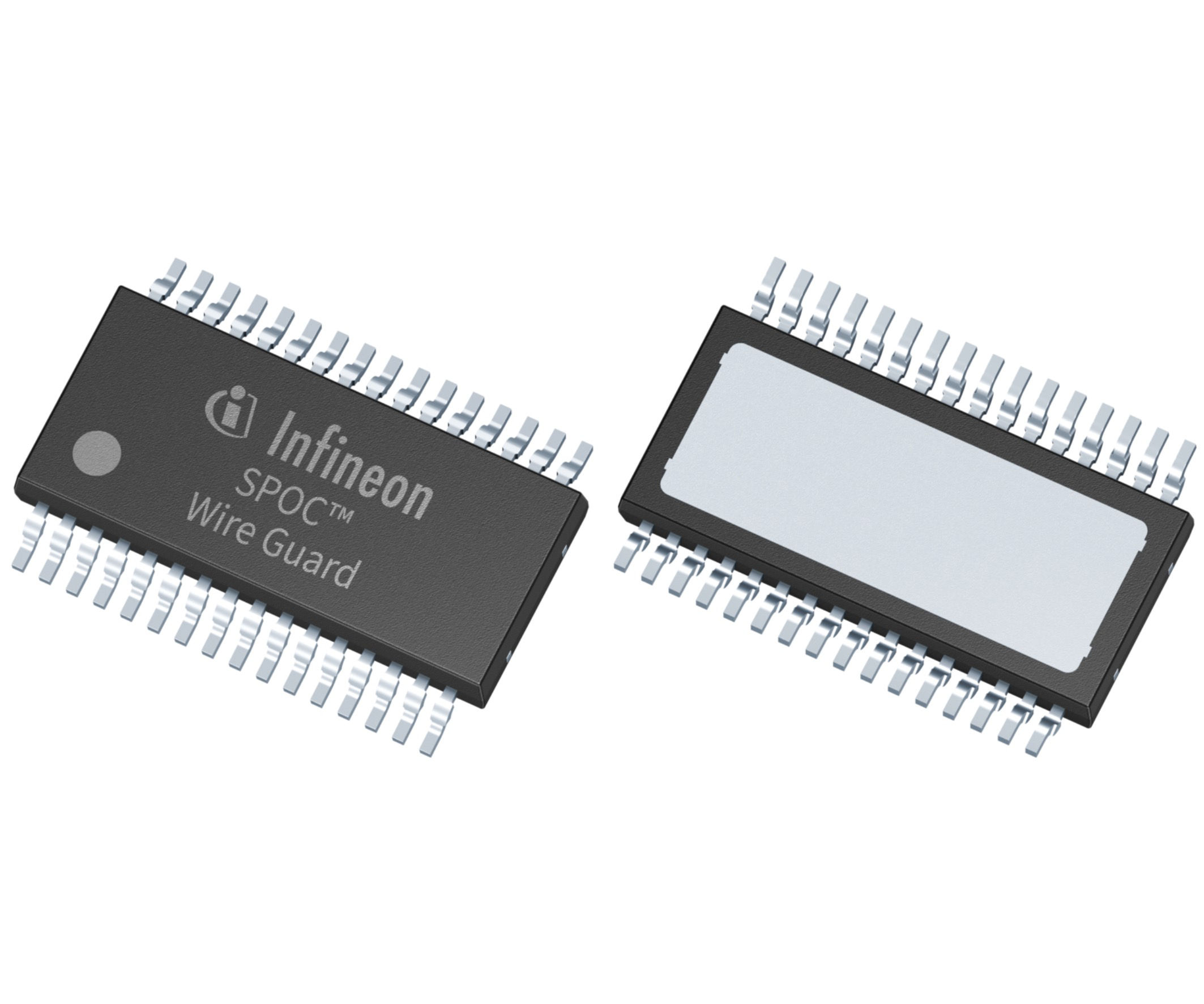
Infineon Technologies has placed the first member of its SPOC Wire Guard family into production, combining a 12V automotive high side switch with electronic wire protection, configurable diagnostics, and a daisy chain capable SPI interface.
The BTS80009 SWPx 1ES is designed to replace conventional melting fuses and more complex combinations of gate driver, MOSFET, and shunt circuitry within software defined vehicle power distribution. Integrated I²t wire protection monitors load current and isolates failures within microseconds.
Precise current sensing allows the protection threshold to follow the connected conductor more closely. Traditional fuses often require additional wire margin because their operating tolerance and interruption time vary with temperature and previous current loading, increasing harness mass across a vehicle with hundreds of protected circuits.
The device supports currents up to 34.5A and is offered in A, I, P, and F variants with different feature levels. A 24 bit SPI interface supports daisy chaining, reducing the number of microcontroller connections required when several protected outputs are combined within one power distribution module.
Real time status, pre warning indicators, and diagnostic data can be passed to the vehicle controller, while software defined current limits and protection parameters allow one hardware platform to serve several vehicle variants. The same module can therefore feed different loads according to body style, trim level, or regional configuration.
Permanently powered loads are supported through an idle mode consuming only a few microamps while retaining protection. Low standby current is becoming harder to preserve as vehicles add always active communications, access, security, monitoring, and update functions across a growing number of electronic modules.
SPOC Wire Guard is supplied as a Safety Element out of Context for systems up to ASIL-D under ISO 26262. Integrated non volatile memory stores an application specific safe state, while the single channel architecture is intended to prevent one output fault propagating into neighbouring branches.
The device can also react autonomously to supply voltage drops caused by a load fault. That behaviour supports electrical architectures in which selected sensors, processors, actuators, and communications paths must remain powered after another circuit has failed.
Fail operational design does not require every load to remain active. Instead, the power system must identify the failure, isolate the affected branch, preserve priority functions, and maintain sufficient operation for the vehicle to reach a controlled or safe state.
Astemo’s £100 million Bolton inverter expansion shows how automotive electronics capacity is scaling around electrified drivetrains. Low voltage distribution is evolving alongside the traction system because every inverter controller, sensor, actuator, and compute platform still depends on a protected auxiliary supply.
Replacing a melting fuse shifts more responsibility into electronics and software. Current measurement, thermal behaviour, wiring models, diagnostic timing, configuration data, and the response to short circuits or intermittent connections must all be validated across development, production, servicing, and future updates.
Electronic fusing also creates data that a passive fuse cannot supply. Rising current may reveal a deteriorating motor, damaged cable, or developing connector fault before the branch trips, allowing the vehicle to record the condition or adjust the load before service is required.
That diagnostic capability increases network traffic and configuration complexity, so the controller must distinguish between normal load variation, a temporary overload, and a genuine deterioration. Incorrect thresholds could either interrupt a healthy circuit or allow a damaged conductor to remain energised.
Three further on resistance variants are planned by the end of 2026, extending the family across different current and thermal requirements. A broader range will allow designers to balance conduction loss, package temperature, current capability, and cost while preserving a common interface and software model.
SPOC Wire Guard turns the fuse box into a distributed electronic control system, with protection settings, diagnostics, and safe states embedded into the vehicle architecture. The resulting flexibility can reduce harness mass and improve fault isolation, provided configuration and thermal behaviour remain controlled throughout the vehicle’s operating life.

