
IN Brief:
- ISSI20B devices combine isolated signal transfer and gate drive energy in a compact PG-DSO-8 package.
- Integrated protection and diagnostics target PLC I/O, power supplies, test systems, and building controls.
- Industrial switching is moving towards electronically managed fault isolation as equipment becomes denser and more connected.
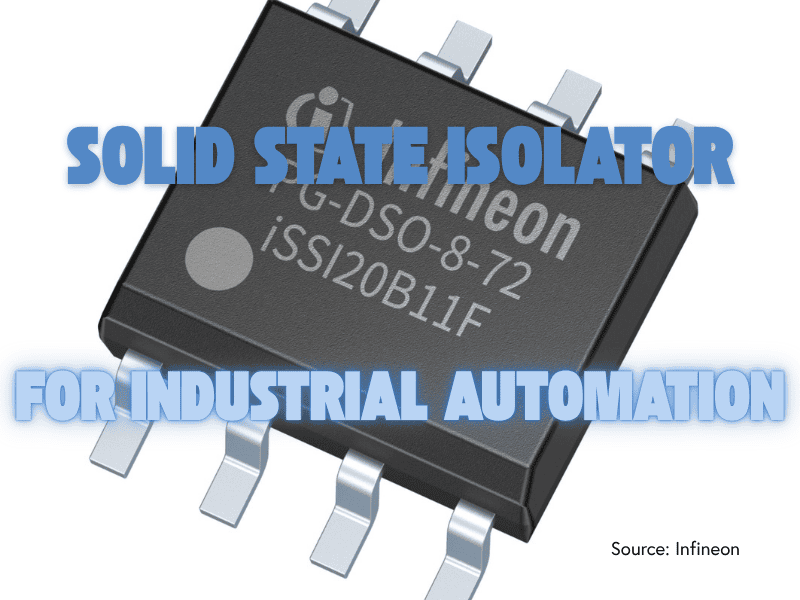
Infineon Technologies has expanded its solid state isolation portfolio with the ISSI20BxxF family, combining galvanic isolation, gate drive energy, protection, and diagnostics in a compact package for industrial switching applications.
Built around coreless transformer technology, the devices transfer both the control signal and sufficient energy to drive an external semiconductor switch across the isolation barrier. The arrangement removes the separate isolated secondary supply required by many conventional gate drive circuits, while offering a potential replacement path for photovoltaic isolators used in solid state relay designs.
Infineon is offering the initial ISSI20B02F, ISSI20B03F, and ISSI20B11F devices in a 150 mil PG-DSO-8 package. The family provides 3kVrms isolation and 4mm creepage, with certification to UL 1577, although the working voltage of a finished assembly will continue to depend on PCB geometry, pollution degree, coating, and the wider insulation system.
Protection functions include overcurrent and overtemperature detection, fast fault turn off, and latch off behaviour. Selected variants add a dynamic Miller clamp and faster turn on, addressing unwanted gate movement and switching instability when external MOSFETs operate near fast transients, long interconnections, or electrically noisy industrial loads.
Applications extend across programmable logic controller inputs and outputs, factory automation modules, automatic test equipment, laboratory DC power supplies, telecommunications hardware, and building controls. Each requires reliable separation between logic and field circuitry, yet board area, switching speed, service life, and diagnostic coverage increasingly restrict the use of conventional mechanical relays.
Photovoltaic isolators eliminate moving contacts and provide electrical isolation without a secondary supply, although their available output current can lengthen MOSFET turn on and turn off times. Those delays become harder to accommodate as load current rises, thermal margins tighten, or the protection system must interrupt a fault before conductors and downstream components exceed their safe limits.
By delivering more energy across the barrier, the ISSI20B family gives the external switch firmer gate control while consolidating protection functions that would otherwise require additional circuitry. MOSFET gate charge, on resistance, transient capability, safe operating area, thermal impedance, and off state leakage nevertheless remain part of the complete relay design.
A recent generation of wider creepage Vishay optocouplers showed how isolation components are being adapted for more severe electrical environments in electric vehicle and solar inverter systems. Industrial control equipment is moving in the same direction, with smaller assemblies expected to withstand higher transient stress while reporting faults to supervisory electronics.
Electronically managed switching also changes the maintenance model. Current, temperature, and fault status can be exposed to the controller, allowing an output to be isolated selectively and its condition recorded before equipment is serviced. Mechanical relays offer a visible physical gap when open, whereas semiconductor solutions rely on controlled leakage, predictable failure behaviour, and coordinated upstream protection.
Layout will determine how much of the specified performance survives implementation. Clearance around the package, the position of high current conductors, gate trace inductance, return paths, and heat flow from the external switch can all alter switching behaviour. A nominally compatible footprint therefore does not remove the need to compare output current, timing, fault response, and thermal conditions against the original isolator.
Dense PLC and test modules increasingly require each channel to occupy less space while providing more diagnostic information. Consolidating isolation, gate drive, and protection into one device can reduce component count and simplify replication across multi channel designs, particularly where several outputs share the same architecture but switch different load types.
The first ISSI20B devices are available now. Their adoption will depend on whether engineers can retain familiar solid state relay topologies while gaining faster switching and more complete fault handling, without transferring excessive complexity into MOSFET selection, thermal design, or system certification.

